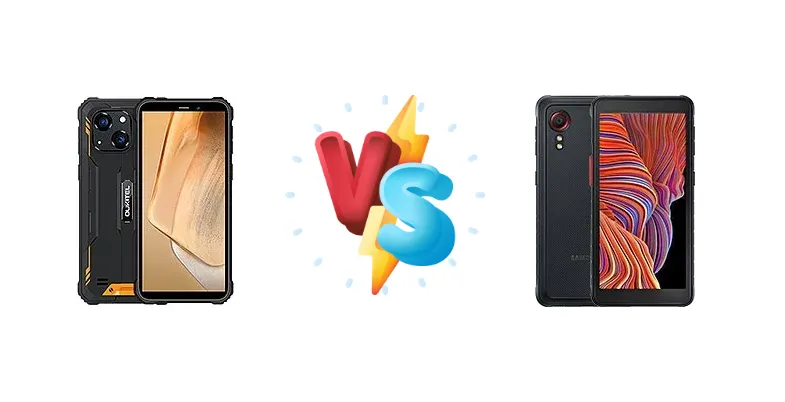
The rugged smartphone market caters to a specific need: durability. But within that niche, price and performance vary wildly. We pit the budget-focused Oukitel WP20 against the more established Samsung Galaxy XCover 5 to determine which offers the best blend of toughness and usability for demanding users.
🏆 Quick Verdict
For the average user prioritizing affordability and basic functionality, the Oukitel WP20 provides a compelling entry point into the rugged phone world. However, the Samsung Galaxy XCover 5’s significantly more powerful Exynos 850 chipset delivers a smoother, more responsive experience, justifying its higher price for users who demand better performance.
| Network |
|---|
| 2G bands | GSM 850 / 900 / 1800 / 1900 | GSM 850 / 900 / 1800 / 1900 |
| 3G bands | HSDPA 900 / 2100 | HSDPA 850 / 900 / 1700(AWS) / 1900 / 2100 |
| 4G bands | 1, 3, 7, 8, 19, 20 | 1, 2, 3, 4, 5, 7, 8, 12, 17, 20, 26, 28, 38, 40, 41, 66 |
| Speed | HSPA, LTE | HSPA, LTE |
| Technology | GSM / HSPA / LTE | GSM / HSPA / LTE |
| Launch |
|---|
| Announced | 2022, June | 2021, March 04 |
| Status | Available. Released 2022, June | Available. Released 2021, March 12 |
| Body |
|---|
| Dimensions | 166.2 x 81.2 x 15.5 mm (6.54 x 3.20 x 0.61 in) | 147.1 x 71.6 x 9.2 mm (5.79 x 2.82 x 0.36 in) |
| SIM | Nano-SIM + Nano-SIM | · Nano-SIM· Nano-SIM + Nano-SIM |
| Weight | 297 g (10.48 oz) | 172 g (6.07 oz) |
| | - | IP68 dust/water resistant (up to 1.5m for 30 min)
MIL-STD-810H compliant |
| Display |
|---|
| Resolution | 720 x 1440 pixels, 18:9 ratio (~271 ppi density) | 720 x 1480 pixels, 18.5:9 ratio (~311 ppi density) |
| Size | 5.93 inches, 90.7 cm2 (~67.2% screen-to-body ratio) | 5.3 inches, 71.3 cm2 (~67.7% screen-to-body ratio) |
| Type | IPS LCD | PLS LCD |
| Platform |
|---|
| CPU | Quad-core 2.0 GHz Cortex-A53 | Octa-core (4x2.0 GHz Cortex-A55 & 4x2.0 GHz Cortex-A55) |
| Chipset | Mediatek MT6761 Helio A22 (12 nm) | Exynos 850 (8 nm) |
| GPU | PowerVR GE8320 | Mali-G52 |
| OS | Android 12 | Android 11, upgradable to Android 14, One UI 6.1 |
| Memory |
|---|
| Card slot | microSDXC (uses shared SIM slot) | microSDXC (dedicated slot) |
| Internal | 32GB 4GB RAM | 64GB 4GB RAM |
| | - | eMMC 5.1 |
| Main Camera |
|---|
| Dual | 20 MP, (wide), AF
Secondary unspecified camera | - |
| Features | LED flash | Dual LED flash, HDR, panorama |
| Single | - | 16 MP, f/1.8, PDAF |
| Video | 1080p@30fps | 1080p@30fps |
| Selfie camera |
|---|
| Single | 5 MP | 5 MP, f/2.2 |
| Video | Yes | - |
| Sound |
|---|
| 3.5mm jack | - | Yes |
| 35mm jack | Unspecified | Yes |
| Loudspeaker | Yes | Yes |
| Comms |
|---|
| Bluetooth | Yes | 5.0, A2DP, LE |
| NFC | No | Yes |
| Positioning | GPS, GLONASS, GALILEO, BDS | GPS, GLONASS, GALILEO, BDS |
| Radio | Unspecified | Unspecified |
| USB | Yes | USB Type-C 2.0, charging connector pins |
| WLAN | Yes | Wi-Fi 802.11 a/b/g/n/ac, dual-band, Wi-Fi Direct |
| Features |
|---|
| Sensors | Unspecified | Accelerometer, gyro, proximity, compass |
| Battery |
|---|
| Charging | - | 15W wired |
| Type | Li-Po 6300 mAh | Li-Ion 3000 mAh, removable |
| Misc |
|---|
| Colors | Black, Orange, Green | Black |
| Models | - | SM-G525F, SM-G525F/DS, SM-G525N |
| Price | About 140 EUR | £ 61.49 / € 74.89 |
| SAR EU | - | 0.70 W/kg (head) 1.27 W/kg (body) |
Oukitel WP20
- Significantly lower price point
- Rugged design for durability
- Potentially longer battery life with light use
- Weak processor performance
- Limited multitasking capabilities
- Basic camera system
Samsung Galaxy XCover 5
- Powerful Exynos 850 processor
- Smoother user experience
- Faster 15W charging
- Higher price tag
- May not offer significantly better battery life than WP20
- Ruggedness may not be substantially greater
Display Comparison
Neither device boasts a cutting-edge display. Details regarding panel type (IPS, TFT) and resolution are missing for the WP20, suggesting a basic implementation. The XCover 5’s display specs are also limited, but Samsung’s history indicates a higher quality panel with better color accuracy. The key difference lies in processing power; the Exynos 850 can drive a more complex display pipeline, potentially resulting in smoother animations and better image processing. Both are likely to prioritize durability over visual fidelity.
Camera Comparison
Camera details are sparse for both devices. The WP20 likely features a basic camera setup, while the XCover 5’s camera specs are also limited. Without sensor size or aperture information, it’s difficult to make a definitive judgment. However, Samsung’s image processing algorithms are generally more sophisticated, potentially delivering better image quality in various lighting conditions. The presence of OIS (Optical Image Stabilization) on the XCover 5, if equipped, would further enhance image clarity and reduce blur, especially in low light. The usefulness of a 2MP macro camera on either device is questionable, offering limited practical benefit.
Performance
The performance gap is substantial. The Oukitel WP20’s MediaTek Helio A22, a quad-core processor built on a 12nm process, is designed for entry-level smartphones. It will handle basic tasks, but will struggle with demanding applications. Conversely, the Samsung Galaxy XCover 5’s Exynos 850, fabricated on an 8nm node, features an octa-core configuration (4x2.0 GHz Cortex-A55 & 4x2.0 GHz Cortex-A55). This translates to significantly faster processing speeds and improved multitasking capabilities. The 8nm process also contributes to better thermal efficiency, reducing the likelihood of throttling under sustained load. Users who rely on GPS navigation, mapping apps, or occasional gaming will find the XCover 5 far more responsive.
Battery Life
Battery capacity is not specified for the WP20, but rugged phones typically prioritize large batteries. The XCover 5 offers 15W wired charging, a moderate speed. The Helio A22’s lower power consumption in the WP20 may offset a potentially smaller battery capacity, offering comparable battery life for light usage. However, the Exynos 850’s efficiency gains at 8nm, combined with Samsung’s software optimizations, could provide similar or better real-world battery performance despite the higher processing power. The XCover 5’s faster charging will reduce downtime.
Buying Guide
Buy the Oukitel WP20 if you need a highly durable phone for basic tasks like communication, simple navigation, and occasional photography, and your budget is a primary concern. Buy the Samsung Galaxy XCover 5 if you prefer a more refined user experience, require better performance for multitasking and demanding apps, and value Samsung’s software ecosystem and faster charging capabilities.
Frequently Asked Questions
❓ Does the Exynos 850 chip in the Galaxy XCover 5 overheat during prolonged use, like GPS navigation or video recording?
The Exynos 850, built on an 8nm process, is relatively efficient. While it will generate heat under sustained load, the thermal design of the XCover 5 should prevent significant throttling. Users should expect some warmth, but not performance-limiting overheating during typical rugged phone use cases.
❓ Is the Oukitel WP20 suitable for running apps like WhatsApp, Facebook, and basic email clients without significant lag?
The Helio A22 processor in the WP20 is capable of running these apps, but performance will be noticeably slower than on the XCover 5. Expect longer loading times and occasional stuttering, especially when multitasking. It's suitable for basic communication, but not for demanding app usage.
❓ How does the ruggedness of the Oukitel WP20 compare to the Samsung Galaxy XCover 5 in terms of drop resistance and water/dust ingress protection?
Both phones are built to withstand harsh conditions, but specific drop test heights and IP ratings are needed for a precise comparison. Samsung generally adheres to stricter military-grade standards (MIL-STD-810H), suggesting potentially higher durability. However, the WP20 is still a robust device designed for demanding environments.
❓ Can the Samsung Galaxy XCover 5 be used with gloves on, and does it support NFC for mobile payments?
The Galaxy XCover 5 features glove mode, allowing for touchscreen use while wearing gloves. It also supports NFC, enabling contactless payments and other NFC-based functionalities. The Oukitel WP20's glove mode and NFC support are unconfirmed.