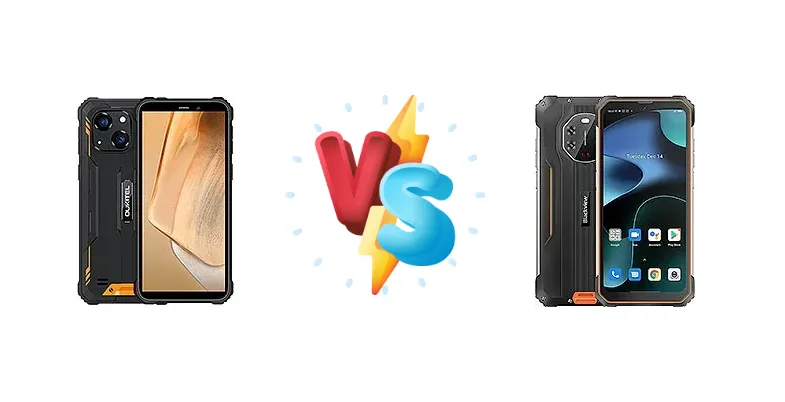
The rugged smartphone market caters to users needing durability and reliability in challenging environments. The Oukitel WP20 and Blackview BV8800 both aim to deliver this, but they diverge significantly in their internal hardware. This comparison dissects these differences, focusing on how the chipset choice impacts real-world performance and battery efficiency, ultimately determining which device offers the best value for demanding users.
🏆 Quick Verdict
For the average user prioritizing performance and future-proofing, the Blackview BV8800 is the clear winner. Its Helio G96 chipset offers a substantial performance leap over the WP20’s Helio A22, enabling smoother multitasking and more demanding applications. While both boast excellent battery endurance, the BV8800’s faster 33W charging is a significant convenience.
| Network |
|---|
| 2G bands | GSM 850 / 900 / 1800 / 1900 | GSM 850 / 900 / 1800 / 1900 |
| 3G bands | HSDPA 900 / 2100 | HSDPA 800 / 850 / 900 / 1700(AWS) / 1900 / 2100 |
| 4G bands | 1, 3, 7, 8, 19, 20 | 1, 2, 3, 4, 5, 7, 8, 12, 13, 17, 18, 19, 20, 25, 26, 28, 30, 34, 38, 39, 40, 41, 66 |
| Speed | HSPA, LTE | HSPA, LTE |
| Technology | GSM / HSPA / LTE | GSM / CDMA / HSPA / CDMA2000 / LTE |
| | - | CDMA2000 1x |
| Launch |
|---|
| Announced | 2022, June | 2021, December 24 |
| Status | Available. Released 2022, June | Available. Released 2022, January 10 |
| Body |
|---|
| Dimensions | 166.2 x 81.2 x 15.5 mm (6.54 x 3.20 x 0.61 in) | 176.2 x 83.5 x 17.7 mm (6.94 x 3.29 x 0.70 in) |
| SIM | Nano-SIM + Nano-SIM | Nano-SIM + Nano-SIM |
| Weight | 297 g (10.48 oz) | 367 g (12.95 oz) |
| | - | IP68/IP69K dust/water resistant (up to 1.5m for 30 min)
Drop-to-concrete resistance from up to 1.5m
MIL-STD-810H compliant |
| Display |
|---|
| Resolution | 720 x 1440 pixels, 18:9 ratio (~271 ppi density) | 1080 x 2408 pixels, 20:9 ratio (~401 ppi density) |
| Size | 5.93 inches, 90.7 cm2 (~67.2% screen-to-body ratio) | 6.58 inches, 104.3 cm2 (~70.9% screen-to-body ratio) |
| Type | IPS LCD | IPS LCD, 90Hz, 480 nits |
| Platform |
|---|
| CPU | Quad-core 2.0 GHz Cortex-A53 | Octa-core (2x2.05 GHz Cortex-A76 & 6x2.0 GHz Cortex-A55) |
| Chipset | Mediatek MT6761 Helio A22 (12 nm) | Mediatek MT6781 Helio G96 (12 nm) |
| GPU | PowerVR GE8320 | Mali-G57 MC2 |
| OS | Android 12 | Android 11, Doke-OS 3.0 |
| Memory |
|---|
| Card slot | microSDXC (uses shared SIM slot) | No |
| Internal | 32GB 4GB RAM | 128GB 8GB RAM |
| | - | UFS 2.1 |
| Main Camera |
|---|
| Dual | 20 MP, (wide), AF
Secondary unspecified camera | - |
| Features | LED flash | Dual-LED flash, HDR, panorama |
| Quad | - | 50 MP, f/1.8, (wide), PDAF
8 MP, f/2.2, 117˚ (ultrawide)
20 MP, f/1.8, (IR camera), 2 IR emitters
Auxiliary lens |
| Single | - | 16 MP, f/2.0, (wide) |
| Video | 1080p@30fps | 1440p@30fps |
| Selfie camera |
|---|
| Single | 5 MP | 16 MP, f/2.0, (wide) |
| Video | Yes | 1080p@30fps |
| Sound |
|---|
| 3.5mm jack | - | No |
| 35mm jack | Unspecified | No |
| Loudspeaker | Yes | Yes |
| Comms |
|---|
| Bluetooth | Yes | 5.2, A2DP, LE |
| NFC | No | Yes |
| Positioning | GPS, GLONASS, GALILEO, BDS | GPS, GLONASS, GALILEO, BDS |
| Radio | Unspecified | FM radio |
| USB | Yes | USB Type-C 2.0, OTG |
| WLAN | Yes | Wi-Fi 802.11 a/b/g/n/ac |
| Features |
|---|
| Sensors | Unspecified | Fingerprint (side-mounted), accelerometer, gyro, proximity, compass, barometer |
| Battery |
|---|
| Charging | - | 33W wired, 31% in 30 min, 100% in 90 min
Reverse wired |
| Type | Li-Po 6300 mAh | 8380 mAh |
| Misc |
|---|
| Colors | Black, Orange, Green | Black, Orange, Green |
| Price | About 140 EUR | About 350 EUR |
| Tests |
|---|
| Battery life | - |
Endurance rating 199h
|
| Camera | - |
Photo / Video |
| Display | - |
Contrast ratio: 1348:1 (nominal) |
| Loudspeaker | - |
-29.3 LUFS (Average)
|
| Performance | - |
AnTuTu: 254849 (v8), 288964 (v9)
GeekBench: 1752 (v5.1)
GFXBench: 10fps (ES 3.1 onscreen) |
Oukitel WP20
- Extremely affordable price point
- Rugged build quality for basic protection
- Long battery endurance (199h)
- Weak processor (Helio A22) limits performance
- Likely basic camera system
- Slow charging speed (unspecified)
Blackview BV8800
- Powerful processor (Helio G96) for smooth performance
- Fast 33W charging (0-100% in 90 minutes)
- Brighter display (501 nits) for outdoor visibility
- Higher price compared to the Oukitel WP20
- Rugged design may add bulk
- Camera details are limited
Display Comparison
Both devices share a contrast ratio of 1348:1, suggesting similar visual depth. However, the Blackview BV8800’s measured peak brightness of 501 nits provides a noticeably brighter display, improving visibility in direct sunlight – a crucial feature for outdoor use. While neither specification details panel technology (IPS, AMOLED), the BV8800’s brighter display is a tangible advantage for outdoor usability.
Camera Comparison
Both phones list 'Photo / Video' capabilities, but lack specific details regarding sensor size or image processing. Given the price point of the WP20, it’s likely to feature a basic camera setup. The BV8800, positioned higher in the market, likely benefits from a more sophisticated camera system, potentially including larger sensors and improved image stabilization. Without detailed specifications, it’s difficult to make a definitive judgment, but the BV8800’s overall hardware suggests a superior photographic experience.
Performance
The core difference lies in the chipsets. The Oukitel WP20 utilizes the Mediatek MT6761 Helio A22, a quad-core processor designed for entry-level smartphones. In contrast, the Blackview BV8800 features the Mediatek MT6781 Helio G96, an octa-core processor with a more advanced architecture (2x2.05 GHz Cortex-A76 & 6x2.0 GHz Cortex-A55). This translates to significantly faster processing speeds and improved multitasking capabilities for the BV8800. The G96’s Cortex-A76 cores offer a substantial performance uplift compared to the A53 cores in the A22, making the BV8800 far more responsive and capable of handling demanding applications.
Battery Life
Both devices achieve an impressive endurance rating of 199 hours, indicating excellent battery life. However, the Blackview BV8800 distinguishes itself with 33W wired charging, achieving 31% charge in 30 minutes and a full charge in 90 minutes. The WP20’s charging specifications are not provided, implying a slower charging rate. This faster charging capability on the BV8800 significantly reduces downtime, making it more convenient for users who rely heavily on their smartphone throughout the day.
Buying Guide
Buy the Oukitel WP20 if you need an extremely budget-friendly rugged phone for basic communication and light tasks like calls, texts, and simple navigation. It’s ideal for users who prioritize minimal cost above all else. Buy the Blackview BV8800 if you prefer a more capable device for everyday use, including social media, streaming, and occasional gaming. The BV8800’s superior processor and faster charging justify the price difference for users who demand more from their smartphone.
Frequently Asked Questions
❓ Does the Blackview BV8800’s Helio G96 chipset handle demanding games like PUBG Mobile smoothly?
The Helio G96 is a capable mid-range processor that can handle PUBG Mobile at medium to high settings with reasonable frame rates. While it won’t deliver flagship-level performance, it provides a significantly smoother gaming experience compared to the Oukitel WP20’s Helio A22, which would struggle with such titles.
❓ How does the ruggedness of the Blackview BV8800 compare to the Oukitel WP20 in terms of drop and water resistance?
Both phones are designed to be rugged, but specific certifications (IP68, MIL-STD-810G) are not provided in the context data. However, given the BV8800’s higher price point and market positioning, it’s reasonable to assume it offers a more robust level of protection against drops, dust, and water ingress. Users requiring maximum durability should research specific certifications for both models.
❓ Is the 33W charging on the Blackview BV8800 compatible with Power Delivery (PD) chargers?
The provided specifications do not explicitly state PD compatibility. However, many devices with 33W charging support PD, allowing for faster charging with compatible chargers. It’s recommended to check the Blackview BV8800’s official documentation or user forums for confirmation.