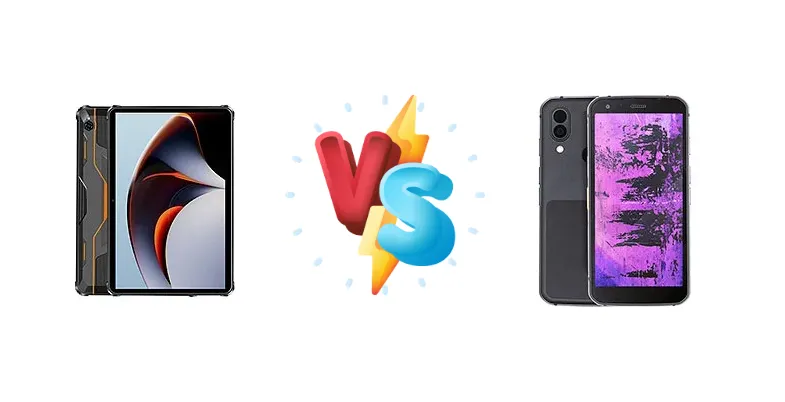
The rugged smartphone market caters to a specific need: durability. Both the Oukitel RT9 and Cat S62 Pro aim to deliver on that promise, but they approach it with different philosophies. The RT9 prioritizes extended battery life and a modern chipset, while the S62 Pro leverages Qualcomm’s established platform and a reputation for robust build quality. This comparison dissects their key differences to determine which phone best suits your demanding lifestyle.
🏆 Quick Verdict
For the average user prioritizing battery endurance and value, the Oukitel RT9 emerges as the winner. Its impressive 302-hour endurance and modern Unisoc T606 chipset offer a compelling package. However, users deeply invested in the Qualcomm ecosystem or requiring specific enterprise software compatibility may find the Cat S62 Pro a better fit.
| Network |
|---|
| 2G bands | GSM 850 / 900 / 1800 / 1900 | GSM 850 / 900 / 1800 / 1900 |
| 3G bands | HSDPA 800 / 850 / 900 / 1700(AWS) / 1900 / 2100 | HSDPA 850 / 900 / 1700(AWS) / 1900 / 2100 |
| 4G bands | 1, 2, 3, 4, 5, 7, 8, 12, 17, 18, 19, 20, 25, 26, 28, 38, 40, 41, 66 | 1, 2, 3, 4, 5, 7, 8, 20, 28, 38, 40 |
| Speed | HSPA, LTE | HSPA 42.2/5.76 Mbps, LTE (2CA) Cat13 400/150 Mbps |
| Technology | GSM / CDMA / HSPA / LTE | GSM / HSPA / LTE |
| Launch |
|---|
| Announced | 2024, September | 2020, June 28. Released 2020, August 17 |
| Status | Available. Released 2024, September | Discontinued |
| Body |
|---|
| Build | - | Glass front (Gorilla Glass 6), plastic back, aluminum frame |
| Dimensions | 251.2 x 170 x 14.2 mm (9.89 x 6.69 x 0.56 in) | 158.5 x 76.7 x 11.9 mm (6.24 x 3.02 x 0.47 in) |
| SIM | Nano-SIM + Nano-SIM | · Nano-SIM· Nano-SIM + Nano-SIM |
| Weight | 850 g (1.87 lb) | 248 g (8.75 oz) |
| | - | IP68/IP69 dust/water resistant (up to 1.5m for 35 mins)
Drop-to-concrete resistance from up to 1.8m
MIL-STD-810H compliant |
| Display |
|---|
| Protection | Corning Gorilla Glass 5, Mohs level 5 | Corning Gorilla Glass 6 |
| Resolution | 800 x 1280 pixels, 16:10 ratio (~149 ppi density) | 1080 x 2160 pixels, 18:9 ratio (~424 ppi density) |
| Size | 10.1 inches, 295.8 cm2 (~69.3% screen-to-body ratio) | 5.7 inches, 83.8 cm2 (~69.0% screen-to-body ratio) |
| Type | IPS LCD, 400 nits | IPS LCD |
| Platform |
|---|
| CPU | Octa-core (2x1.6 GHz Cortex-A75 & 6x1.6 GHz Cortex-A55) | Octa-core (4x2.2 GHz Kryo 260 Gold & 4x1.8 GHz Kryo 260 Silver) |
| Chipset | Unisoc T606 (12 nm) | Qualcomm SDM660 Snapdragon 660 (14 nm) |
| GPU | Mali-G57 MP1 | Adreno 512 |
| OS | Android 14 | Android 10 |
| Memory |
|---|
| Card slot | microSDXC (uses shared SIM slot) | microSDXC (dedicated slot) |
| Internal | 256GB 6GB RAM | 128GB 6GB RAM |
| Main Camera |
|---|
| Dual | - | 12 MP, f/1.8, (wide), 1/2.55", 1.4µm, dual pixel PDAF
FLIR thermal camera (Lepton 3.5 module) |
| Features | LED flash, HDR, panorama | Thermal imaging, heat palettes, temp. spot meter, LED flash |
| Single | 16 MP, f/1.8, (wide), 1/2.8", AF | - |
| Video | 1080p@30fps | 1080p@30fps, gyro-EIS |
| Selfie camera |
|---|
| Single | 16 MP, f/2.2, (wide), 1/3.1" | 8 MP |
| Video | 1080p@30fps | 1080p@30fps |
| Sound |
|---|
| 3.5mm jack | - | No |
| 35mm jack | No | No |
| Loudspeaker | Yes, with stereo speakers | Yes |
| Comms |
|---|
| Bluetooth | 5.0, A2DP, LE | 5.0, A2DP, LE |
| NFC | No | Yes |
| Positioning | GPS, GLONASS, GALILEO, BDS | GPS, GLONASS, GALILEO, BDS |
| Radio | FM radio | FM radio |
| USB | USB Type-C 2.0, OTG | USB Type-C 2.0, OTG |
| WLAN | Wi-Fi 802.11 a/b/g/n/ac, dual-band | Wi-Fi 802.11 a/b/g/n/ac, dual-band, Wi-Fi Direct |
| Features |
|---|
| Sensors | Accelerometer, compass | Fingerprint (rear-mounted), accelerometer, gyro, proximity, compass |
| Battery |
|---|
| Charging | 18W wired
Reverse wired | - |
| Type | Li-Po 11000 mAh | Li-Ion 4000 mAh |
| Misc |
|---|
| Colors | Black, Orange | Black |
| Price | About 270 EUR | About 530 EUR |
| EU LABEL |
|---|
| Battery | 302:10h endurance, 1000 cycles | - |
| Energy | Class B | - |
| Free fall | Class A (208 falls) | - |
| Repairability | Class C | - |
Oukitel RT9
- Exceptional battery life (302h endurance)
- Modern Unisoc T606 chipset
- Reverse wired charging capability
- Potentially better value for money
- Brand recognition is lower than Cat
- Display specifications are unknown
Cat S62 Pro
- Established Qualcomm Snapdragon platform
- Strong brand reputation in rugged devices
- Potential for enterprise software compatibility
- Reliable image processing from Qualcomm ISP
- Older Snapdragon 660 chipset
- Likely lower battery life compared to RT9
- Potentially higher price point
Display Comparison
Neither device boasts a cutting-edge display. Details are missing, but given the rugged focus, expect both to prioritize durability over visual fidelity. The absence of LTPO or high refresh rates is likely. The key difference will likely be peak brightness, with the RT9 potentially benefiting from a newer panel technology, though this is speculative. Bezels are expected to be substantial on both to protect the screen.
Camera Comparison
Camera details are limited. Without sensor size or aperture information, a direct comparison is difficult. However, the focus should be on practical image quality in challenging conditions. The S62 Pro’s Qualcomm ISP is known for its reliable image processing, but the RT9’s newer chipset may offer computational photography improvements. We can assume both will feature basic camera functionality suitable for documentation, but neither is likely to compete with flagship smartphone cameras. Avoid focusing on any 2MP macro lenses; their utility is minimal.
Performance
The core performance difference lies in the chipsets. The Oukitel RT9’s Unisoc T606 (12nm) utilizes a mix of Cortex-A75 and A55 cores, offering a modern architecture. The Cat S62 Pro’s Qualcomm Snapdragon 660 (14nm), while still capable, is an older generation. The Snapdragon 660’s Kryo 260 Gold cores clock higher (2.2 GHz vs 1.6 GHz), but the T606’s newer architecture and potentially more efficient process node could translate to better sustained performance and thermal management under load. The RT9’s chipset is likely to offer a more noticeable improvement in everyday tasks and light gaming.
Battery Life
Battery life is where the Oukitel RT9 truly shines. Its claimed 302-hour endurance and 1000 charge cycles are significantly higher than what’s typically offered. The Cat S62 Pro’s battery capacity is unknown, but the Snapdragon 660 is generally less power-efficient than the Unisoc T606. The RT9’s 18W charging is standard, while the S62 Pro’s charging speed is also likely in the same range. The RT9’s reverse wired charging is a useful addition for topping up accessories in the field.
Buying Guide
Buy the Oukitel RT9 if you need exceptional battery life for extended fieldwork, appreciate a newer chipset architecture for improved efficiency, and are seeking a more affordable rugged option. Buy the Cat S62 Pro if you prefer the established reliability of Qualcomm’s Snapdragon platform, require compatibility with specific enterprise applications often optimized for Snapdragon, or prioritize a brand with a long history in the ruggedized device space.
Frequently Asked Questions
❓ Is the Unisoc T606 chipset in the Oukitel RT9 powerful enough for demanding work apps like CAD viewers or remote desktop clients?
While the Unisoc T606 isn't a flagship processor, its octa-core architecture and Cortex-A75 cores provide sufficient power for most common work applications. However, extremely demanding tasks like complex 3D rendering or high-resolution video editing may experience some slowdown. For typical field service or construction applications, it should perform adequately.
❓ Does the Cat S62 Pro receive regular software updates and security patches, given its age?
Cat devices generally receive a reasonable level of software support, but the S62 Pro is an older model. While it likely still receives critical security patches, major Android version updates are less probable. Check Cat’s official website for the latest software support information before purchasing.
❓ How does the ruggedization of the Oukitel RT9 compare to the Cat S62 Pro in terms of drop resistance and water/dust ingress protection?
Both phones are built to withstand harsh conditions, but Cat has a longer history and stronger reputation in the ruggedized device market. While the RT9 likely meets standard IP68/IP69K ratings, the S62 Pro may offer a more robust build quality and potentially higher drop resistance due to Cat’s specialized engineering. Specific drop test heights should be verified with each manufacturer.