
Oukitel RT8 vs Ulefone Armor 15: A Deep Dive into Rugged Smartphone Performance
| Phones Images | |||||
|---|---|---|---|---|---|
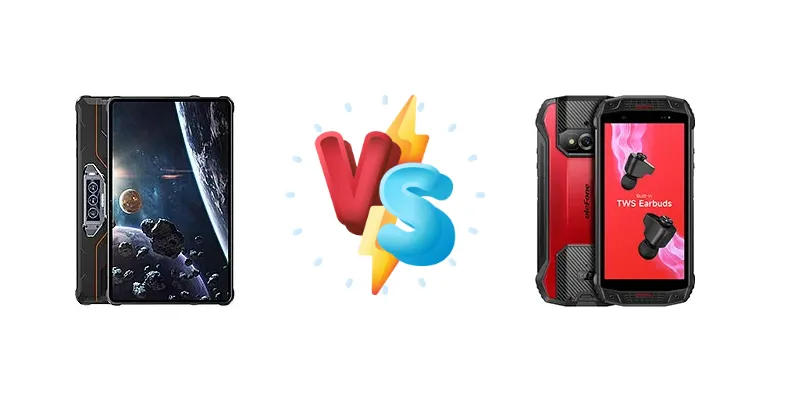
|
🏆 Quick Verdict
For the average user prioritizing performance and longevity, the Oukitel RT8 is the clear winner. Its Mediatek Helio G99 chipset, built on a 6nm process, provides a substantial performance advantage over the Ulefone Armor 15’s Helio G35, making it better suited for gaming and demanding applications. While the Armor 15 offers ruggedness, the RT8’s superior processing power justifies the choice.
| PHONES | ||
|---|---|---|
| Phone Names | Oukitel RT8 | Ulefone Armor 15 |
| Network | ||
|---|---|---|
| 2G bands | GSM 850 / 900 / 1800 / 1900 | GSM 850 / 900 / 1800 / 1900 |
| 3G bands | HSDPA 800 / 850 / 900 / 1700(AWS) / 1900 / 2100 | HSDPA 850 / 900 / 1700(AWS) / 1900 / 2100 |
| 4G bands | 1, 2, 3, 4, 5, 7, 8, 12, 13, 17, 18, 19, 20, 25, 26, 28, 34, 38, 39, 40, 41, 66 | 1, 2, 3, 4, 5, 7, 8, 12, 13, 17, 18, 19, 20, 25, 26, 28, 38, 39, 40, 41, 66 |
| Speed | HSPA, LTE | HSPA, LTE Cat13 300/150 Mbps |
| Technology | GSM / CDMA / HSPA / LTE | GSM / HSPA / LTE |
| Launch | ||
|---|---|---|
| Announced | 2024, March | 2022, July 27 |
| Status | Available. Released 2024, March | Available. Released 2022, August 10 |
| Body | ||
|---|---|---|
| Dimensions | 265.1 x 176.7 x 15.1 mm (10.44 x 6.96 x 0.59 in) | 170.2 x 79.6 x 18.2 mm (6.70 x 3.13 x 0.72 in) |
| SIM | Nano-SIM + Nano-SIM | Nano-SIM + Nano-SIM |
| Weight | 996.7 g (2.20 lb) | 346 g (12.20 oz) |
| - | IP68 dust/water resistant (up to 1.5m for 30 min) Drop-to-concrete resistance from up to 1.5m MIL-STD-810G compliant Built-in wireless earbuds housed inside the top side of the phone; charging | |
| Display | ||
|---|---|---|
| Protection | Corning Gorilla Glass 5, Mohs level 5 | - |
| Resolution | 1200 x 1920 pixels, 16:10 ratio (~206 ppi density) | 720 x 1440 pixels, 18:9 ratio (~295 ppi density) |
| Size | 11.0 inches, 350.9 cm2 (~74.9% screen-to-body ratio) | 5.45 inches, 76.7 cm2 (~56.6% screen-to-body ratio) |
| Type | IPS LCD, 500 nits | IPS LCD |
| Platform | ||
|---|---|---|
| CPU | Octa-core (2x2.2 GHz Cortex-A76 & 6x2.0 GHz Cortex-A55) | Octa-core (4x2.3 GHz Cortex-A53 & 4x1.8 GHz Cortex-A53) |
| Chipset | Mediatek Helio G99 (6 nm) | Mediatek MT6765G Helio G35 (12 nm) |
| GPU | Mali-G57 MC2 | PowerVR GE8320 |
| OS | Android 13 | Android 12 |
| Memory | ||
|---|---|---|
| Card slot | microSDXC (uses shared SIM slot) | microSDXC (dedicated slot) |
| Internal | 256GB 6GB RAM | 128GB 6GB RAM |
| Main Camera | ||
|---|---|---|
| Dual | - | 12 MP, f/1.8, (wide), 1.4μm 13 MP, f/2.4, 106˚ (ultrawide) |
| Features | LED flash, HDR, panorama | LED flash, HDR, panorama |
| Single | - | 16 MP, f/2.4, (wide), 1.0μm |
| Triple | 48 MP, f/1.8, (wide), 1/2", PDAF 20 MP, f/1.8, (night vision), 1/2.78", AF, infrared night vision lights 5 MP (macro) | - |
| Video | 1440p@30fps, 1080p@30fps | 1080p@30fps |
| Selfie camera | ||
|---|---|---|
| Single | 32 MP, f/2.2, (wide), 1/2.8" | 16 MP, f/2.4, (wide), 1.0μm |
| Video | 1080p@30fps | 1080p@30fps |
| Sound | ||
|---|---|---|
| 3.5mm jack | - | No |
| 35mm jack | No | No |
| Loudspeaker | Yes, with stereo speakers (4 speakers) | Yes |
| Comms | ||
|---|---|---|
| Bluetooth | 5.1, A2DP, LE | 5.0, A2DP |
| NFC | Yes | Yes |
| Positioning | GPS, GLONASS, GALILEO, BDS | GPS, GLONASS, BDS, GALILEO |
| Radio | FM radio | Stereo FM radio, RDS, recording |
| USB | USB Type-C 2.0, OTG | USB Type-C 2.0, OTG |
| WLAN | Wi-Fi 802.11 a/b/g/n/ac, dual-band | Wi-Fi 802.11 a/b/g/n/ac, dual-band |
| Features | ||
|---|---|---|
| Sensors | Accelerometer, gyro, proximity, compass | Fingerprint (side-mounted), accelerometer, proximity, gyro, compass |
| Battery | ||
|---|---|---|
| Charging | 33W wired Reverse wired | 18W wired |
| Type | Li-Po 20000 mAh | Li-Po 6600 mAh |
| Misc | ||
|---|---|---|
| Colors | Black, Black/Orange | Meteorite Black, Tech Blue, Sport Red |
| Price | About 280 EUR | About 300 EUR |
| EU LABEL | ||
|---|---|---|
| Battery | 499:59h endurance, 1000 cycles | - |
| Energy | Class B | - |
| Free fall | Class A (208 falls) | - |
| Repairability | Class C | - |
Oukitel RT8
- Significantly faster processor (Helio G99)
- More efficient 6nm chipset
- Faster 33W charging
- Longer battery lifespan (1000 cycles)
- Ruggedness level not specified (may be less than Armor 15)
- Camera specs unknown
Ulefone Armor 15
- Robust rugged design (Ulefone Armor series reputation)
- Lower price point (likely)
- Adequate for basic smartphone tasks
- Durable build quality
- Significantly slower processor (Helio G35)
- Less efficient 12nm chipset
- Slower 18W charging
- Limited performance for gaming and multitasking
Display Comparison
Neither device's display specifications are provided, so a direct comparison is limited. However, given the RT8's focus on performance, it's reasonable to expect a higher refresh rate panel. The Armor 15, targeting a budget-conscious segment, likely utilizes a standard 60Hz display. Bezels are likely similar, given both phones' rugged designs prioritize protection over minimizing screen borders. Color accuracy is also unknown, but both will likely prioritize visibility in direct sunlight over color fidelity.
Camera Comparison
Camera specifications are not provided, making a detailed comparison impossible. However, given the RT8’s overall focus on performance, it’s likely to feature a more advanced camera system with a larger sensor and improved image processing. The Armor 15 will likely prioritize affordability, resulting in a simpler camera setup. Without specific details, it’s safe to assume the RT8 will deliver superior image quality, especially in low-light conditions.
Performance
The performance gap between these two devices is substantial. The Oukitel RT8’s Mediatek Helio G99, fabricated on a 6nm process, boasts a more modern architecture – specifically, two Cortex-A76 cores clocked at 2.2 GHz and six Cortex-A55 cores at 2.0 GHz. This contrasts sharply with the Ulefone Armor 15’s Helio G35, which uses four Cortex-A53 cores at 2.3 GHz and another four at 1.8 GHz, built on a less efficient 12nm process. The G99’s architecture and smaller node translate to significantly improved CPU and GPU performance, making the RT8 far more capable in gaming and multitasking. The G35 is adequate for basic tasks, but will struggle with graphically intensive applications.
Battery Life
The Oukitel RT8 claims an impressive 499:59h endurance and 1000 charge cycles, suggesting a focus on long-term battery health. While the Armor 15’s battery capacity is unknown, its 18W charging is significantly slower than the RT8’s 33W wired charging. The RT8’s faster charging will allow users to quickly replenish the battery, minimizing downtime. The 1000 charge cycle claim on the RT8 is a significant advantage, indicating the battery will retain a higher capacity over its lifespan.
Buying Guide
Buy the Oukitel RT8 if you need a rugged phone capable of handling demanding tasks like gaming, video editing, or running multiple apps simultaneously. Its faster processor and more efficient chipset will provide a smoother, more responsive experience. Buy the Ulefone Armor 15 if you prioritize basic functionality and extreme durability on a tighter budget, and your usage primarily consists of calls, texts, and light app usage. The Armor 15 is a workhorse for essential communication.