
Oukitel RT8 vs Doogee S98 Pro: A Deep Dive into Rugged Smartphone Performance
| Phones Images | |||||
|---|---|---|---|---|---|
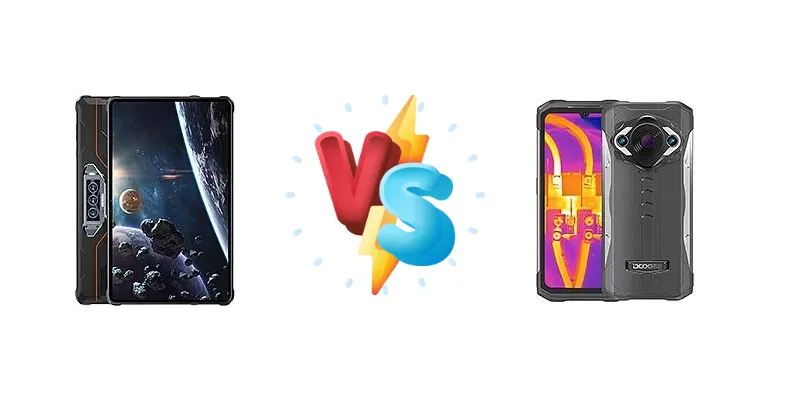
|
🏆 Quick Verdict
For the average user prioritizing long-term battery endurance and efficient performance, the Oukitel RT8 emerges as the winner. Its newer Mediatek Helio G99 chipset, built on a 6nm process, provides a noticeable efficiency advantage over the Doogee S98 Pro’s 12nm Helio G96, translating to significantly longer usage times.
| PHONES | ||
|---|---|---|
| Phone Names | Oukitel RT8 | Doogee S98 Pro |
| Network | ||
|---|---|---|
| 2G bands | GSM 850 / 900 / 1800 / 1900 | GSM 850 / 900 / 1800 / 1900 |
| 3G bands | HSDPA 800 / 850 / 900 / 1700(AWS) / 1900 / 2100 | HSDPA 800 / 850 / 900 / 1700(AWS) / 1900 / 2100 |
| 4G bands | 1, 2, 3, 4, 5, 7, 8, 12, 13, 17, 18, 19, 20, 25, 26, 28, 34, 38, 39, 40, 41, 66 | 1, 2, 3, 4, 5, 7, 8, 12, 13, 17, 18, 19, 20, 25, 26, 28, 34, 38, 39, 40, 41, 66 |
| Speed | HSPA, LTE | HSPA, LTE |
| Technology | GSM / CDMA / HSPA / LTE | GSM / CDMA / HSPA / LTE |
| Launch | ||
|---|---|---|
| Announced | 2024, March | 2022, May 27 |
| Status | Available. Released 2024, March | Available. Released 2022, June 06 |
| Body | ||
|---|---|---|
| Dimensions | 265.1 x 176.7 x 15.1 mm (10.44 x 6.96 x 0.59 in) | 172 x 82 x 15.5 mm (6.77 x 3.23 x 0.61 in) |
| SIM | Nano-SIM + Nano-SIM | Nano-SIM + Nano-SIM |
| Weight | 996.7 g (2.20 lb) | 320 g (11.29 oz) |
| Display | ||
|---|---|---|
| Protection | Corning Gorilla Glass 5, Mohs level 5 | Corning Gorilla Glass |
| Resolution | 1200 x 1920 pixels, 16:10 ratio (~206 ppi density) | 1080 x 2340 pixels, 19.5:9 ratio (~409 ppi density) |
| Size | 11.0 inches, 350.9 cm2 (~74.9% screen-to-body ratio) | 6.3 inches, 97.4 cm2 (~69.1% screen-to-body ratio) |
| Type | IPS LCD, 500 nits | IPS LCD, 500 nits (peak) |
| Platform | ||
|---|---|---|
| CPU | Octa-core (2x2.2 GHz Cortex-A76 & 6x2.0 GHz Cortex-A55) | Octa-core (2x2.05 GHz Cortex-A76 & 6x2.0 GHz Cortex-A55) |
| Chipset | Mediatek Helio G99 (6 nm) | Mediatek MT6781 Helio G96 (12 nm) |
| GPU | Mali-G57 MC2 | Mali-G57 MC2 |
| OS | Android 13 | Android 12 |
| Memory | ||
|---|---|---|
| Card slot | microSDXC (uses shared SIM slot) | microSDXC (dedicated slot) |
| Internal | 256GB 6GB RAM | 256GB 8GB RAM |
| Main Camera | ||
|---|---|---|
| Features | LED flash, HDR, panorama | Dual-LED flash, HDR, panorama |
| Triple | 48 MP, f/1.8, (wide), 1/2", PDAF 20 MP, f/1.8, (night vision), 1/2.78", AF, infrared night vision lights 5 MP (macro) | 48 MP, f/1.8, (wide), PDAF 20 MP, f/1.8, (night vision), 2 infrared night vision lights Thermal imaging camera |
| Video | 1440p@30fps, 1080p@30fps | 1440p, 1080p |
| Selfie camera | ||
|---|---|---|
| Single | 32 MP, f/2.2, (wide), 1/2.8" | 16 MP, f/2.0, (wide) |
| Video | 1080p@30fps | 1080p |
| Sound | ||
|---|---|---|
| 35mm jack | No | Unspecified |
| Loudspeaker | Yes, with stereo speakers (4 speakers) | Yes |
| Comms | ||
|---|---|---|
| Bluetooth | 5.1, A2DP, LE | 5.1, A2DP, LE |
| NFC | Yes | Yes |
| Positioning | GPS, GLONASS, GALILEO, BDS | GPS, GLONASS, BDS, GALILEO |
| Radio | FM radio | FM radio |
| USB | USB Type-C 2.0, OTG | USB Type-C 2.0, OTG |
| WLAN | Wi-Fi 802.11 a/b/g/n/ac, dual-band | Wi-Fi 802.11 a/b/g/n/ac, dual-band |
| Features | ||
|---|---|---|
| Sensors | Accelerometer, gyro, proximity, compass | Fingerprint (side-mounted), accelerometer, gyro, proximity, compass |
| Battery | ||
|---|---|---|
| Charging | 33W wired Reverse wired | 33W wired 15W wireless |
| Type | Li-Po 20000 mAh | 6000 mAh |
| Misc | ||
|---|---|---|
| Colors | Black, Black/Orange | Black |
| Price | About 280 EUR | About 470 EUR |
| EU LABEL | ||
|---|---|---|
| Battery | 499:59h endurance, 1000 cycles | - |
| Energy | Class B | - |
| Free fall | Class A (208 falls) | - |
| Repairability | Class C | - |
Oukitel RT8
- Superior chipset efficiency (Helio G99)
- Exceptional battery endurance (499:59h)
- Long battery lifespan (1000 cycles)
- Lacks wireless charging
- Display specifications unknown
Doogee S98 Pro
- Convenient 15W wireless charging
- Potentially more mature software support
- Rugged design
- Less efficient chipset (Helio G96)
- Shorter battery life compared to RT8
- Larger process node (12nm)
Display Comparison
Neither device's display specifications are provided, so a direct comparison is limited. However, given the price points, we can assume both utilize IPS LCD panels. The absence of LTPO technology suggests neither will offer adaptive refresh rates for power saving. Users should expect typical rugged phone display characteristics – prioritizing durability and visibility over color accuracy and peak brightness.
Camera Comparison
Without detailed camera specifications, a comprehensive comparison is impossible. However, the rugged phone segment often prioritizes durability over camera quality. We can assume both phones feature a multi-camera setup, but image processing and sensor size will be key differentiators. The absence of information regarding OIS or large sensors suggests neither phone will excel in low-light photography. Users should manage expectations accordingly.
Performance
The core difference lies in the chipsets. The Oukitel RT8’s Mediatek Helio G99 (6nm) is a clear architectural upgrade over the Doogee S98 Pro’s Helio G96 (12nm). The smaller node size of the G99 translates to improved power efficiency and thermal performance. While both CPUs feature the same core configuration (2x2.2 GHz Cortex-A76 & 6x2.0 GHz Cortex-A55), the G99’s efficiency gains will result in less throttling during prolonged gaming or demanding tasks. The G99’s improved GPU will also provide a smoother experience in graphically intensive applications. The RT8 will likely offer a more consistent and responsive user experience.
Battery Life
The Oukitel RT8 boasts an impressive 499:59h endurance rating and a 1000-cycle battery lifespan, indicating a focus on long-term reliability. While both phones offer 33W wired charging, the RT8’s superior chipset efficiency means it will likely reach a full charge faster and maintain that charge for a significantly longer period. The Doogee S98 Pro adds 15W wireless charging, a convenience feature that the RT8 lacks. However, the slower wireless charging speed and the G96’s higher power draw may negate some of the convenience for users who frequently rely on wireless charging.
Buying Guide
Buy the Oukitel RT8 if you need exceptional battery life and prioritize sustained performance over peak bursts. This phone is ideal for travelers, field workers, or anyone who frequently finds themselves away from a power outlet. Buy the Doogee S98 Pro if you value wireless charging convenience and potentially benefit from a slightly more mature software ecosystem, though you'll trade some battery endurance for it.