
Oukitel RT8 vs Blackview BL8800 Pro: A Deep Dive into Rugged Smartphone Choices
| Phones Images | |||||
|---|---|---|---|---|---|
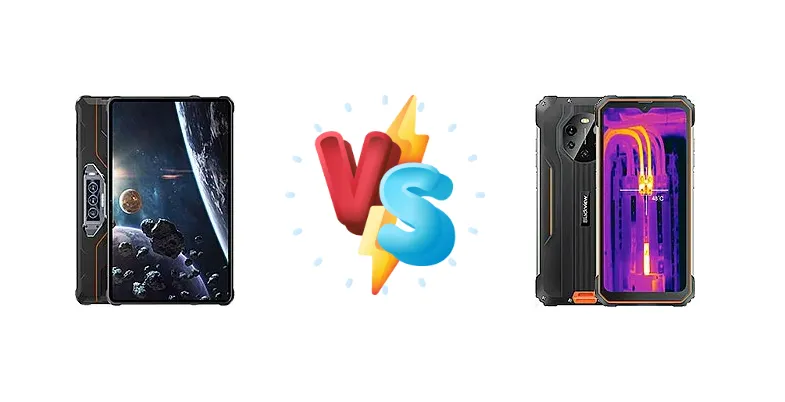
|
🏆 Quick Verdict
For users prioritizing maximum uptime and longevity, the Oukitel RT8 is the clear winner. Its exceptional 499-hour endurance and 1000 charge cycles outweigh the Blackview BL8800 Pro’s slightly more powerful chipset. However, those needing a bit more processing power for demanding apps will find the BL8800 Pro a better fit.
| PHONES | ||
|---|---|---|
| Phone Names | Oukitel RT8 | Blackview BL8800 Pro |
| Network | ||
|---|---|---|
| 2G bands | GSM 850 / 900 / 1800 / 1900 | GSM 850 / 900 / 1800 / 1900 |
| 3G bands | HSDPA 800 / 850 / 900 / 1700(AWS) / 1900 / 2100 | HSDPA 800 / 850 / 900 / 1700(AWS) / 1900 / 2100 |
| 4G bands | 1, 2, 3, 4, 5, 7, 8, 12, 13, 17, 18, 19, 20, 25, 26, 28, 34, 38, 39, 40, 41, 66 | 1, 2, 3, 4, 5, 7, 8, 12, 13, 17, 18, 19, 20, 25, 26, 28, 30, 66 |
| 5G bands | - | 1, 3, 5, 7, 8, 20, 28, 38, 40, 41, 77, 78, 79 SA/NSA |
| Speed | HSPA, LTE | HSPA, LTE, 5G |
| Technology | GSM / CDMA / HSPA / LTE | GSM / CDMA / HSPA / CDMA2000 / LTE / 5G |
| - | CDMA2000 1x | |
| Launch | ||
|---|---|---|
| Announced | 2024, March | 2022, May 09 |
| Status | Available. Released 2024, March | Available. Released 2022, May 09 |
| Body | ||
|---|---|---|
| Dimensions | 265.1 x 176.7 x 15.1 mm (10.44 x 6.96 x 0.59 in) | 176.2 x 83.5 x 17.7 mm (6.94 x 3.29 x 0.70 in) |
| SIM | Nano-SIM + Nano-SIM | Nano-SIM + Nano-SIM |
| Weight | 996.7 g (2.20 lb) | 367 g (12.95 oz) |
| - | IP68/IP69K dust/water resistant (up to 1.5m for 30 min) Drop-to-concrete resistance from up to 1.5m MIL-STD-810H compliant | |
| Display | ||
|---|---|---|
| Protection | Corning Gorilla Glass 5, Mohs level 5 | - |
| Resolution | 1200 x 1920 pixels, 16:10 ratio (~206 ppi density) | 1080 x 2408 pixels, 20:9 ratio (~401 ppi density) |
| Size | 11.0 inches, 350.9 cm2 (~74.9% screen-to-body ratio) | 6.58 inches, 104.3 cm2 (~70.9% screen-to-body ratio) |
| Type | IPS LCD, 500 nits | IPS LCD, 480 nits |
| Platform | ||
|---|---|---|
| CPU | Octa-core (2x2.2 GHz Cortex-A76 & 6x2.0 GHz Cortex-A55) | Octa-core (2x2.2 GHz Cortex-A76 & 6x2.0 GHz Cortex-A55) |
| Chipset | Mediatek Helio G99 (6 nm) | Mediatek Dimensity 700 (7 nm) |
| GPU | Mali-G57 MC2 | Mali-G57 MC2 |
| OS | Android 13 | Android 11, Doke-OS 3.0 |
| Memory | ||
|---|---|---|
| Card slot | microSDXC (uses shared SIM slot) | No |
| Internal | 256GB 6GB RAM | 128GB 8GB RAM |
| - | UFS 2.1 | |
| Main Camera | ||
|---|---|---|
| Features | LED flash, HDR, panorama | Thermal imaging, Dual-LED flash, HDR, panorama |
| Penta | - | 50 MP, f/1.8, (wide), PDAF 5 MP, thermal assisted camera FLIR thermal camera (Lepton module) 2x Auxiliary lens |
| Single | - | 16 MP, f/2.0, (wide) |
| Triple | 48 MP, f/1.8, (wide), 1/2", PDAF 20 MP, f/1.8, (night vision), 1/2.78", AF, infrared night vision lights 5 MP (macro) | - |
| Video | 1440p@30fps, 1080p@30fps | 1440p@30fps |
| Selfie camera | ||
|---|---|---|
| Single | 32 MP, f/2.2, (wide), 1/2.8" | 16 MP, f/2.0, (wide) |
| Video | 1080p@30fps | 1080p@30fps |
| Sound | ||
|---|---|---|
| 3.5mm jack | - | No |
| 35mm jack | No | No |
| Loudspeaker | Yes, with stereo speakers (4 speakers) | Yes |
| Comms | ||
|---|---|---|
| Bluetooth | 5.1, A2DP, LE | 5.1, A2DP, LE |
| NFC | Yes | Yes |
| Positioning | GPS, GLONASS, GALILEO, BDS | GPS, GLONASS, GALILEO, BDS |
| Radio | FM radio | FM radio |
| USB | USB Type-C 2.0, OTG | USB Type-C 2.0, OTG |
| WLAN | Wi-Fi 802.11 a/b/g/n/ac, dual-band | Wi-Fi 802.11 a/b/g/n/ac |
| Features | ||
|---|---|---|
| Sensors | Accelerometer, gyro, proximity, compass | Fingerprint (side-mounted), accelerometer, gyro, proximity, compass, barometer |
| Battery | ||
|---|---|---|
| Charging | 33W wired Reverse wired | 33W wired, 31% in 30 min, 100% in 90 min Reverse wired |
| Type | Li-Po 20000 mAh | 8380 mAh |
| Misc | ||
|---|---|---|
| Colors | Black, Black/Orange | Black, Orange, Green |
| Price | About 280 EUR | About 300 EUR |
| EU LABEL | ||
|---|---|---|
| Battery | 499:59h endurance, 1000 cycles | - |
| Energy | Class B | - |
| Free fall | Class A (208 falls) | - |
| Repairability | Class C | - |
Oukitel RT8
- Exceptional battery life (499:59h endurance)
- High charge cycle count (1000 cycles)
- Potentially better thermal efficiency with Helio G99 (6nm)
- Likely lacks 5G connectivity
- Camera specifications unknown, potentially average
Blackview BL8800 Pro
- Integrated 5G modem for faster data speeds
- Faster charging times (100% in 90 minutes)
- Slightly more powerful chipset for multitasking
- Lower battery endurance compared to Oukitel RT8
- Potentially more thermal throttling under sustained load
Display Comparison
Neither device provides display specifications in the provided data. However, given their price points, we can expect both to utilize IPS LCD panels. The focus here will be on durability, with both likely featuring Gorilla Glass or similar protection. The absence of high refresh rate or LTPO technology suggests neither is geared towards visually intensive tasks.
Camera Comparison
The provided data lacks camera specifications. Based on market positioning, both phones likely feature multi-camera setups with a primary sensor, ultrawide, and potentially macro/depth sensors. Without sensor size or aperture information, it’s difficult to assess image quality. The inclusion of a 2MP macro camera on either device is likely for marketing purposes and offers limited practical benefit. Image processing algorithms will be a key differentiator, but without sample images, a definitive comparison is impossible.
Performance
Both the Oukitel RT8 and Blackview BL8800 Pro utilize an octa-core CPU configuration with the same core arrangement (2x2.2 GHz Cortex-A76 & 6x2.0 GHz Cortex-A55). The key difference lies in the chipset: the RT8’s Mediatek Helio G99 (6nm) versus the BL8800 Pro’s Dimensity 700 (7nm). While the core architecture is identical, the 6nm process of the Helio G99 *should* offer improved power efficiency compared to the 7nm Dimensity 700. This translates to potentially better thermal management under sustained load, even if peak performance is similar. The Dimensity 700, however, benefits from integrated 5G modem support, a feature likely absent in the RT8.
Battery Life
The Oukitel RT8’s standout feature is its exceptional battery endurance, rated at 499:59h and 1000 charge cycles. This suggests a significantly larger battery capacity than the BL8800 Pro, despite the latter offering 33W charging with a claimed 31% charge in 30 minutes and 100% in 90 minutes. The RT8 also supports 33W charging and reverse wired charging, but lacks specific timing data. The RT8’s longevity is geared towards users who prioritize minimizing charging frequency, while the BL8800 Pro offers a faster top-up when needed.
Buying Guide
Buy the Oukitel RT8 if you need a phone that can reliably last for days on a single charge, are frequently away from power outlets, or require a device built for extreme longevity. Buy the Blackview BL8800 Pro if you prefer a more balanced experience with a slightly faster processor for smoother multitasking and light gaming, and value quicker charging times.