
Oukitel RT7 5G vs. Blackview BV9200: A Deep Dive into Rugged Smartphone Performance
| Phones Images | |||||
|---|---|---|---|---|---|
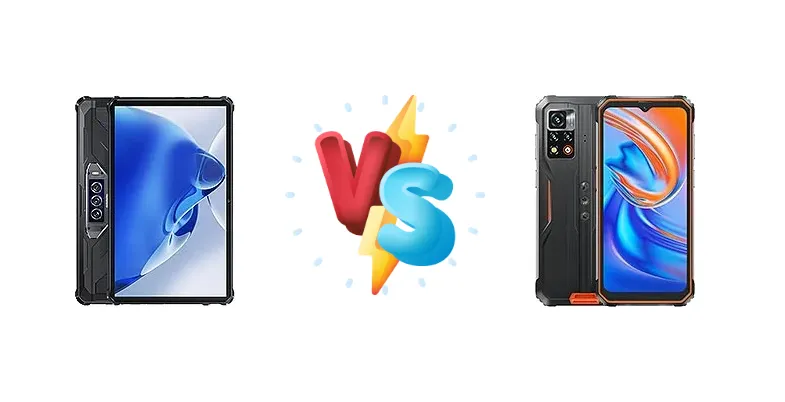
|
🏆 Quick Verdict
For users prioritizing longevity and minimizing charging frequency, the Oukitel RT7 5G is the clear winner. Its 166:39h endurance significantly outpaces the BV9200. However, if rapid replenishment is crucial, the Blackview BV9200’s 66W charging and wireless charging capabilities offer a compelling advantage.
| PHONES | ||
|---|---|---|
| Phone Names | Oukitel RT7 5G | Blackview BV9200 |
| Network | ||
|---|---|---|
| 2G bands | GSM 850 / 900 / 1800 / 1900 | GSM 850 / 900 / 1800 / 1900 |
| 3G bands | HSDPA 850 / 900 / 1700(AWS) / 1900 / 2100 | HSDPA 850 / 900 / 1700(AWS) / 1900 / 2100 |
| 4G bands | 1, 2, 3, 4, 5, 7, 8, 12, 17, 18, 19, 20, 25, 26, 28, 38, 39, 40, 41, 66 | 1, 2, 3, 4, 5, 7, 8, 12, 13, 17, 18, 19, 20, 25, 26, 28, 34, 38, 39, 40, 41, 66 |
| Speed | HSPA, LTE | HSPA, LTE |
| Technology | GSM / HSPA / LTE | GSM / CDMA / HSPA / LTE |
| - | CDMA 800 / 1900 | |
| Launch | ||
|---|---|---|
| Announced | 2023, August | 2022, December 28 |
| Status | Available. Released 2023, September | Available. Released 2023, January 09 |
| Body | ||
|---|---|---|
| Dimensions | 249.1 x 167.8 x 19.8 mm (9.81 x 6.61 x 0.78 in) | 174.5 x 81.8 x 13.6 mm (6.87 x 3.22 x 0.54 in) |
| SIM | Nano-SIM + Nano-SIM | Nano-SIM + Nano-SIM |
| Weight | 1212 g (2.67 lb) | 310 g (10.93 oz) |
| - | IP68/IP69K dust/water resistant (up to 1.5m for 30 min) Drop-to-concrete resistance from up to 1.8m MIL-STD-810H compliant | |
| Display | ||
|---|---|---|
| Protection | Mohs level 5 | Corning Gorilla Glass 5 |
| Resolution | 1200 x 1920 pixels, 16:10 ratio (~224 ppi density) | 1080 x 2408 pixels, 20:9 ratio (~400 ppi density) |
| Size | 10.1 inches, 295.8 cm2 (~70.8% screen-to-body ratio) | 6.6 inches, 104.9 cm2 (~73.5% screen-to-body ratio) |
| Type | IPS LCD, 400 nits | IPS LCD, 120Hz |
| Platform | ||
|---|---|---|
| CPU | Octa-core (2x2.0 GHz Cortex-A76 & 6x2.0 GHz Cortex-A55) | Octa-core (2x2.05 GHz Cortex-A76 & 6x2.0 GHz Cortex-A55) |
| Chipset | Mediatek Dimensity 720 (7 nm) | Mediatek MT6781 Helio G96 (12 nm) |
| GPU | Mali-G57 MC3 | Mali-G52 MC2 |
| OS | Android 13 | Android 12, Doke-OS 3.1 |
| Memory | ||
|---|---|---|
| Card slot | microSDXC (uses shared SIM slot) | microSDXC (dedicated slot) |
| Internal | 256GB 12GB RAM | 256GB 8GB RAM |
| - | UFS 2.1 | |
| Main Camera | ||
|---|---|---|
| Features | LED flash, HDR, panorama | LED flash, HDR, panorama |
| Single | - | 16 MP, (wide), 1/3", 1.0µm |
| Triple | 48 MP, f/1.8, (wide), 1/2", PDAF 20 MP, f/1.8, (night vision), 1/2.78", AF, infrared night vision lights 2 MP (macro) | 50 MP, f/1.8, (wide), 1/2.76", 0.64µm, PDAF 8 MP, f/1.8, 120˚, (ultrawide), AF Auxiliary lens |
| Video | 1080p@30fps | 1440p@30fps, 1080p@30fps |
| Selfie camera | ||
|---|---|---|
| Single | 32 MP, f/2.2, (wide), 1/2.8" | 16 MP, f/2.0, (wide), 1/3", 1.0µm |
| Video | 1080p@30fps | 1080p |
| Sound | ||
|---|---|---|
| 3.5mm jack | - | No |
| 35mm jack | No | No |
| Loudspeaker | Yes, with stereo speakers | Yes, with dual speakers |
| Comms | ||
|---|---|---|
| Bluetooth | 5.1, A2DP, LE | 5.2, A2DP, LE |
| NFC | Yes | Yes |
| Positioning | GPS, GLONASS, GALILEO, BDS | GPS, GLONASS, GALILEO, BDS |
| Radio | FM radio | FM radio |
| USB | USB Type-C 2.0, OTG | USB Type-C, OTG |
| WLAN | Wi-Fi 802.11 a/b/g/n/ac, dual-band | Wi-Fi 802.11 a/b/g/n/ac, dual-band |
| Features | ||
|---|---|---|
| Sensors | Fingerprint (rear-mounted), accelerometer, gyro, proximity, compass | Fingerprint (side-mounted), accelerometer, gyro, proximity, compass, barometer |
| Battery | ||
|---|---|---|
| Charging | 33W wired Reverse wired | 66W wired 30W wireless |
| Type | Li-Po 32000 mAh | 5000 mAh |
| Misc | ||
|---|---|---|
| Colors | Black, Blue | Black, Orange, Green |
| Price | About 470 EUR | About 200 EUR |
| EU LABEL | ||
|---|---|---|
| Battery | 166:39h endurance, 1300 cycles | - |
| Energy | Class D | - |
| Free fall | Class A (208 falls) | - |
| Repairability | Class C | - |
Oukitel RT7 5G
- Exceptional battery life (166:39h endurance)
- Efficient 7nm Dimensity 720 chipset
- Integrated 5G modem for faster connectivity
- Display brightness and quality likely inferior to BV9200
- Slower charging speed (33W)
Blackview BV9200
- Brighter display (481 nits) for outdoor visibility
- Fast 66W wired and 30W wireless charging
- Potentially better image processing
- Less efficient 12nm Helio G96 chipset
- Shorter battery endurance compared to RT7 5G
Display Comparison
The Blackview BV9200 boasts a brighter display, measured at 481 nits, offering superior visibility in direct sunlight compared to the Oukitel RT7 5G (brightness data unavailable). The BV9200’s 1423:1 contrast ratio also suggests richer, more vibrant visuals. While the RT7’s display specs are absent, the BV9200’s panel is likely to provide a more pleasant viewing experience for media consumption and outdoor use. The RT7’s display is likely to be adequate for its target audience, but lacks the measured refinement of the BV9200.
Camera Comparison
Detailed camera specifications are limited, but focusing on the main sensors reveals a potential advantage for the BV9200. While both phones likely feature multiple rear cameras, the BV9200’s emphasis on display quality suggests a greater investment in image processing. The RT7’s camera system is likely functional for basic photography, but the BV9200 may offer more refined image quality and dynamic range. The presence of a 2MP macro camera on both devices is largely inconsequential, offering minimal practical benefit.
Performance
Both phones utilize octa-core CPUs with a similar core configuration (2x2.0 GHz Cortex-A76 & 6x2.0 GHz Cortex-A55), but the chipset choice dictates performance. The Oukitel RT7 5G’s MediaTek Dimensity 720 (7nm) benefits from a more efficient manufacturing process than the Blackview BV9200’s Helio G96 (12nm). This 7nm node translates to better thermal efficiency, potentially reducing throttling during sustained workloads. While both chips offer comparable CPU performance, the Dimensity 720’s integrated 5G modem provides a connectivity advantage. The G96 focuses on gaming, but the RT7’s efficiency may provide a smoother overall experience.
Battery Life
The Oukitel RT7 5G dominates in battery endurance with a staggering 166:39h rating and a claimed 1300 charge cycles. This is a significant advantage for users who prioritize long-term battery health and infrequent charging. The Blackview BV9200, while offering a respectable battery capacity (unspecified), is offset by its faster charging demands. The BV9200’s 66W wired and 30W wireless charging capabilities are considerably faster than the RT7’s 33W wired charging, allowing for quicker top-ups, but at the cost of overall longevity.
Buying Guide
Buy the Oukitel RT7 5G if you need a phone that can genuinely last for days on a single charge, ideal for outdoor adventures, fieldwork, or simply avoiding the constant search for an outlet. Buy the Blackview BV9200 if you prefer a brighter screen for outdoor visibility and value the convenience of both wired and wireless fast charging, even if it means charging more frequently.