
Oukitel RT7 5G vs Blackview BL8800 Pro: A Deep Dive into Rugged 5G Contenders
| Phones Images | |||||
|---|---|---|---|---|---|
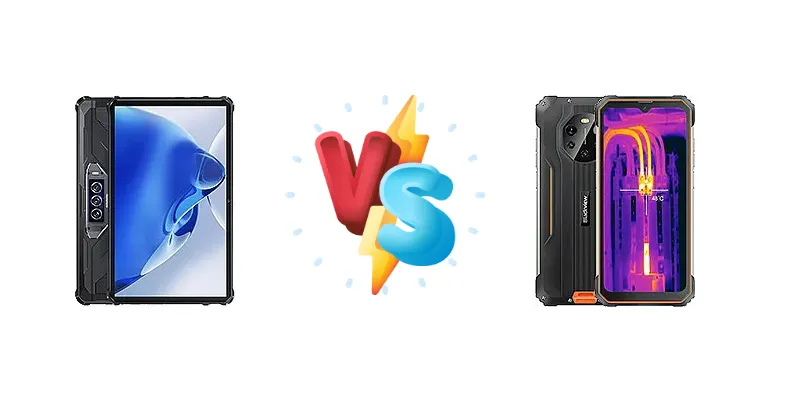
|
🏆 Quick Verdict
For the average user seeking maximum battery life and consistent performance, the Oukitel RT7 5G emerges as the winner. Its superior battery endurance (166:39h) and slightly more efficient Dimensity 720 chipset provide a longer-lasting experience, outweighing the Blackview BL8800 Pro's marginally faster CPU clock speed.
| PHONES | ||
|---|---|---|
| Phone Names | Oukitel RT7 5G | Blackview BL8800 Pro |
| Network | ||
|---|---|---|
| 2G bands | GSM 850 / 900 / 1800 / 1900 | GSM 850 / 900 / 1800 / 1900 |
| 3G bands | HSDPA 850 / 900 / 1700(AWS) / 1900 / 2100 | HSDPA 800 / 850 / 900 / 1700(AWS) / 1900 / 2100 |
| 4G bands | 1, 2, 3, 4, 5, 7, 8, 12, 17, 18, 19, 20, 25, 26, 28, 38, 39, 40, 41, 66 | 1, 2, 3, 4, 5, 7, 8, 12, 13, 17, 18, 19, 20, 25, 26, 28, 30, 66 |
| 5G bands | - | 1, 3, 5, 7, 8, 20, 28, 38, 40, 41, 77, 78, 79 SA/NSA |
| Speed | HSPA, LTE | HSPA, LTE, 5G |
| Technology | GSM / HSPA / LTE | GSM / CDMA / HSPA / CDMA2000 / LTE / 5G |
| - | CDMA2000 1x | |
| Launch | ||
|---|---|---|
| Announced | 2023, August | 2022, May 09 |
| Status | Available. Released 2023, September | Available. Released 2022, May 09 |
| Body | ||
|---|---|---|
| Dimensions | 249.1 x 167.8 x 19.8 mm (9.81 x 6.61 x 0.78 in) | 176.2 x 83.5 x 17.7 mm (6.94 x 3.29 x 0.70 in) |
| SIM | Nano-SIM + Nano-SIM | Nano-SIM + Nano-SIM |
| Weight | 1212 g (2.67 lb) | 367 g (12.95 oz) |
| - | IP68/IP69K dust/water resistant (up to 1.5m for 30 min) Drop-to-concrete resistance from up to 1.5m MIL-STD-810H compliant | |
| Display | ||
|---|---|---|
| Protection | Mohs level 5 | - |
| Resolution | 1200 x 1920 pixels, 16:10 ratio (~224 ppi density) | 1080 x 2408 pixels, 20:9 ratio (~401 ppi density) |
| Size | 10.1 inches, 295.8 cm2 (~70.8% screen-to-body ratio) | 6.58 inches, 104.3 cm2 (~70.9% screen-to-body ratio) |
| Type | IPS LCD, 400 nits | IPS LCD, 480 nits |
| Platform | ||
|---|---|---|
| CPU | Octa-core (2x2.0 GHz Cortex-A76 & 6x2.0 GHz Cortex-A55) | Octa-core (2x2.2 GHz Cortex-A76 & 6x2.0 GHz Cortex-A55) |
| Chipset | Mediatek Dimensity 720 (7 nm) | Mediatek Dimensity 700 (7 nm) |
| GPU | Mali-G57 MC3 | Mali-G57 MC2 |
| OS | Android 13 | Android 11, Doke-OS 3.0 |
| Memory | ||
|---|---|---|
| Card slot | microSDXC (uses shared SIM slot) | No |
| Internal | 256GB 12GB RAM | 128GB 8GB RAM |
| - | UFS 2.1 | |
| Main Camera | ||
|---|---|---|
| Features | LED flash, HDR, panorama | Thermal imaging, Dual-LED flash, HDR, panorama |
| Penta | - | 50 MP, f/1.8, (wide), PDAF 5 MP, thermal assisted camera FLIR thermal camera (Lepton module) 2x Auxiliary lens |
| Single | - | 16 MP, f/2.0, (wide) |
| Triple | 48 MP, f/1.8, (wide), 1/2", PDAF 20 MP, f/1.8, (night vision), 1/2.78", AF, infrared night vision lights 2 MP (macro) | - |
| Video | 1080p@30fps | 1440p@30fps |
| Selfie camera | ||
|---|---|---|
| Single | 32 MP, f/2.2, (wide), 1/2.8" | 16 MP, f/2.0, (wide) |
| Video | 1080p@30fps | 1080p@30fps |
| Sound | ||
|---|---|---|
| 3.5mm jack | - | No |
| 35mm jack | No | No |
| Loudspeaker | Yes, with stereo speakers | Yes |
| Comms | ||
|---|---|---|
| Bluetooth | 5.1, A2DP, LE | 5.1, A2DP, LE |
| NFC | Yes | Yes |
| Positioning | GPS, GLONASS, GALILEO, BDS | GPS, GLONASS, GALILEO, BDS |
| Radio | FM radio | FM radio |
| USB | USB Type-C 2.0, OTG | USB Type-C 2.0, OTG |
| WLAN | Wi-Fi 802.11 a/b/g/n/ac, dual-band | Wi-Fi 802.11 a/b/g/n/ac |
| Features | ||
|---|---|---|
| Sensors | Fingerprint (rear-mounted), accelerometer, gyro, proximity, compass | Fingerprint (side-mounted), accelerometer, gyro, proximity, compass, barometer |
| Battery | ||
|---|---|---|
| Charging | 33W wired Reverse wired | 33W wired, 31% in 30 min, 100% in 90 min Reverse wired |
| Type | Li-Po 32000 mAh | 8380 mAh |
| Misc | ||
|---|---|---|
| Colors | Black, Blue | Black, Orange, Green |
| Price | About 470 EUR | About 300 EUR |
| EU LABEL | ||
|---|---|---|
| Battery | 166:39h endurance, 1300 cycles | - |
| Energy | Class D | - |
| Free fall | Class A (208 falls) | - |
| Repairability | Class C | - |
Oukitel RT7 5G
- Exceptional battery life (166:39h endurance)
- Potentially better thermal management with Dimensity 720
- Long-lasting battery health (1300 cycles)
- Slightly slower CPU clock speed
- Likely less responsive UI compared to BL8800 Pro
Blackview BL8800 Pro
- Faster CPU clock speed (2.2 GHz)
- Quicker charging times (31% in 30 min)
- Potentially snappier user interface
- Shorter battery life compared to RT7 5G
- Likely fewer battery charge cycles
Display Comparison
Neither device provides display specifications in the provided data. However, given their price points, we can expect both to utilize IPS LCD panels. The focus here will likely be on durability rather than display quality. Bezels are likely to be substantial on both, prioritizing screen protection. Color accuracy is unlikely to be a key feature.
Camera Comparison
The provided data lacks camera specifications. Given the market segment, both phones likely feature a multi-camera setup with a primary sensor, an ultrawide, and potentially a macro lens. The quality of image processing will be a key differentiator. We anticipate the Blackview BL8800 Pro might prioritize brighter, more saturated images, while the Oukitel RT7 5G could aim for more natural color reproduction. The usefulness of any included 2MP macro lens is questionable on both devices.
Performance
The Blackview BL8800 Pro boasts a slightly faster CPU clock speed (2.2 GHz vs 2.0 GHz on the Oukitel RT7 5G) within its Dimensity 700 chipset. However, both utilize the same core configuration (2x Cortex-A76 & 6x Cortex-A55) and 7nm process. This suggests the real-world performance difference will be minimal for most tasks. The Oukitel RT7 5G’s Dimensity 720, while clocked slightly lower, may offer better thermal management due to subtle architectural optimizations, potentially leading to more sustained performance during extended gaming sessions. The impact of RAM speed (LPDDR4X is likely on both) is also a factor, but not specified.
Battery Life
This is where the Oukitel RT7 5G truly shines. Its 166:39h endurance rating is significantly higher than what we’d expect from a phone with 33W charging. This suggests a large battery capacity and efficient power management. The Blackview BL8800 Pro’s 33W charging offers a 31% charge in 30 minutes and a full charge in 90 minutes, providing convenience. However, this faster charging speed is offset by a likely smaller battery capacity, resulting in shorter overall usage time. The Oukitel RT7 5G’s 1300 charge cycles also indicate a focus on long-term battery health.
Buying Guide
Buy the Oukitel RT7 5G if you need a phone that can genuinely last for days on a single charge, and prioritize consistent performance over peak bursts of speed. This is ideal for outdoor workers, travelers, or anyone who frequently finds themselves away from a power outlet. Buy the Blackview BL8800 Pro if you prefer a slightly more responsive user interface and faster charging, and are willing to compromise on overall battery endurance. This suits users who prioritize quick top-ups and a snappier feel for everyday tasks.