
Oukitel P1 Pro vs Ulefone Power Armor 14 Pro: A Deep Dive into Rugged Smartphone Performance
| Phones Images | |||||
|---|---|---|---|---|---|
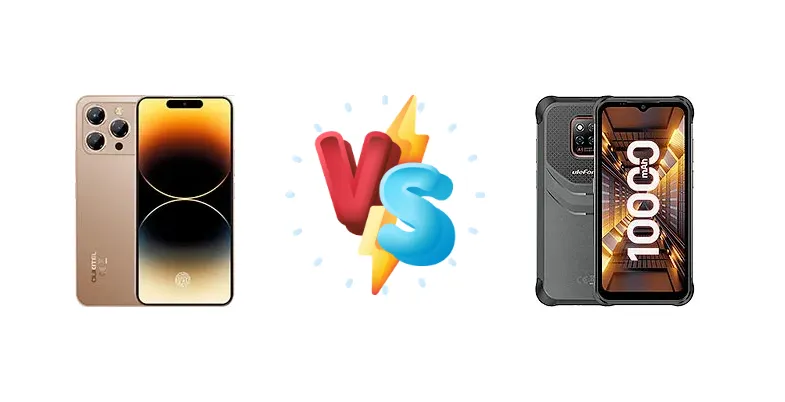
|
🏆 Quick Verdict
For the average user prioritizing longevity and sustained performance, the Oukitel P1 Pro is the better choice. Its Mediatek Helio G100 chipset, built on a 6nm process, provides a performance advantage and significantly longer battery life (52:55h endurance) compared to the Ulefone Power Armor 14 Pro.
| PHONES | ||
|---|---|---|
| Phone Names | Oukitel P1 Pro | Ulefone Power Armor 14 Pro |
| Network | ||
|---|---|---|
| 2G bands | GSM 850 / 900 / 1800 / 1900 | GSM 850 / 900 / 1800 / 1900 |
| 3G bands | HSDPA 850 / 900 / 1700(AWS) / 1900 / 2100 | HSDPA 850 / 900 / 1700(AWS) / 1900 / 2100 |
| 4G bands | 1, 2, 3, 4, 5, 7, 8, 12, 13, 17, 18, 19, 20, 25, 26, 28, 38, 39, 40, 41, 66 | 1, 2, 3, 4, 5, 7, 8, 12, 13, 17, 18, 19, 20, 25, 26, 28, 38, 40 |
| Speed | HSPA, LTE | HSPA, LTE |
| Technology | GSM / CDMA / HSPA / CDMA2000 / LTE | GSM / HSPA / LTE |
| Launch | ||
|---|---|---|
| Announced | 2025, July | 2022, March 09 |
| Status | Available. Released 2025, September | Available. Released 2022, March 09 |
| Body | ||
|---|---|---|
| Dimensions | 162.4 x 76.2 x 8.2 mm (6.39 x 3.00 x 0.32 in) | 175.6 x 82.5 x 17.2 mm (6.91 x 3.25 x 0.68 in) |
| SIM | Nano-SIM + Nano-SIM | Nano-SIM + Nano-SIM |
| Weight | 186.8 g (6.60 oz) | 358.2 g (12.63 oz) |
| - | IP68 dust/water resistant (up to 1.5m for 30 min) Drop-to-concrete resistance from up to 1.5m MIL-STD-810G compliant | |
| Display | ||
|---|---|---|
| Protection | Corning Gorilla Glass 5, Mohs level 6 | Corning Gorilla Glass 3 |
| Resolution | 1080 x 2412 pixels, 20:9 ratio (~394 ppi density) | 720 x 1600 pixels, 20:9 ratio (~269 ppi density) |
| Size | 6.7 inches, 108.0 cm2 (~87.3% screen-to-body ratio) | 6.52 inches, 102.6 cm2 (~70.8% screen-to-body ratio) |
| Type | AMOLED, 120Hz, 500 nits | IPS LCD |
| Platform | ||
|---|---|---|
| CPU | Octa-core (2x2.2 GHz Cortex-A76 & 6x2.0 GHz Cortex-A55) | Octa-core (2x2.0 GHz Cortex-A75 & 6x1.8 GHz Cortex-A55) |
| Chipset | Mediatek Helio G100 (6 nm) | Mediatek MT6769Z Helio G85 (12 nm) |
| GPU | Mali-G57 MC2 | Mali-G52 MC2 |
| OS | Android 15 | Android 12 |
| Memory | ||
|---|---|---|
| Card slot | microSDXC (uses shared SIM slot) | microSDXC (uses shared SIM slot) |
| Internal | 256GB 4GB RAM, 512GB 8GB RAM | 128GB 6GB RAM, 128GB 8GB RAM |
| - | eMMC 5.1 | |
| Main Camera | ||
|---|---|---|
| Features | LED flash, HDR, panorama | LED flash, HDR, panorama |
| Single | - | 16 MP, f/2.2 |
| Triple | 50 MP, f/1.9 (wide), 1/1.56", PDAF 2 MP (macro) Auxiliary lens | 20 MP, f/1.8, 26mm (wide), 1/2.78", 1.0µm, PDAF 2 MP (macro) Auxiliary lens |
| Video | 4K@30fps, 1080p@30fps | 1080p@30fps |
| Selfie camera | ||
|---|---|---|
| Features | - | HDR, panorama |
| Single | 32 MP, f/2.2, (wide), 1/2.74" | 16 MP, f/2.2 |
| Video | 1080p@30fps | 1080p@30fps |
| Sound | ||
|---|---|---|
| 3.5mm jack | - | Yes |
| 35mm jack | No | Yes |
| Loudspeaker | Yes | Yes |
| Comms | ||
|---|---|---|
| Bluetooth | 5.0, A2DP, LE | 5.0, A2DP, LE |
| NFC | Yes | Yes |
| Positioning | GPS, GALILEO, GLONASS, BDS | GPS, GLONASS, GALILEO, BDS |
| Radio | FM radio | FM radio, RDS, recording |
| USB | USB Type-C, OTG | USB Type-C 2.0, OTG |
| WLAN | Wi-Fi 802.11 a/b/g/n/ac, dual-band | Wi-Fi 802.11 a/b/g/n/ac, dual-band |
| Features | ||
|---|---|---|
| Sensors | Fingerprint (under display, optical), accelerometer, gyro, proximity | Fingerprint (side-mounted), accelerometer, proximity, compass |
| Battery | ||
|---|---|---|
| Charging | 18W wired Reverse wired | 18W wired 15W wireless |
| Type | Li-Po 5150 mAh | Li-Po 10000 mAh |
| Misc | ||
|---|---|---|
| Colors | Black, White, Purple | Black |
| Price | $ 239.99 / £ 199.99 / € 219.99 | About 260 EUR |
| EU LABEL | ||
|---|---|---|
| Battery | 52:55h endurance, 1200 cycles | - |
| Energy | Class B | - |
| Free fall | Class A (270 falls) | - |
| Repairability | Class B | - |
Oukitel P1 Pro
- Exceptional battery life (52:55h endurance)
- More powerful and efficient Helio G100 chipset
- Reverse wired charging capability
- No wireless charging
- Display specifications unknown, likely basic
Ulefone Power Armor 14 Pro
- Convenient 15W wireless charging
- Potentially more compact design (speculation)
- Ruggedized build quality
- Less powerful Helio G85 chipset
- Shorter battery life compared to P1 Pro
Display Comparison
Neither device provides display specifications in the provided data. However, given the price point and rugged focus, we can expect both to utilize IPS LCD panels. The absence of details like resolution or refresh rate suggests neither prioritizes a premium visual experience. Bezels are likely to be substantial on both to contribute to drop protection.
Camera Comparison
The provided data lacks camera specifications beyond the chipsets. Given the market segment, both phones likely feature a multi-camera setup with a primary sensor, ultra-wide, and potentially a depth or macro lens. Without sensor size or aperture information, it’s difficult to assess image quality. However, the chipset’s image signal processor (ISP) capabilities will play a role; the G100 in the P1 Pro likely offers more advanced image processing features.
Performance
The Oukitel P1 Pro’s Mediatek Helio G100 (6nm) represents a clear architectural advantage over the Ulefone Power Armor 14 Pro’s Helio G85 (12nm). The smaller 6nm node allows for greater transistor density and improved power efficiency, translating to better sustained performance and reduced heat generation. The G100’s CPU configuration – 2x2.2 GHz Cortex-A76 & 6x2.0 GHz Cortex-A55 – also offers a performance edge over the G85’s 2x2.0 GHz Cortex-A75 & 6x1.8 GHz Cortex-A55. This means the P1 Pro will handle multitasking, gaming, and demanding applications more smoothly.
Battery Life
The Oukitel P1 Pro’s 52:55h endurance is a standout feature, significantly exceeding what’s typically found in this price range. This is likely a result of the efficient Helio G100 chipset and optimized software. While both phones offer 18W wired charging, the P1 Pro’s superior battery capacity and efficiency mean it will spend less time tethered to a charger. The Ulefone Power Armor 14 Pro compensates with 15W wireless charging, offering convenience but at a slower charging speed than the wired option on either device.
Buying Guide
Buy the Oukitel P1 Pro if you need a phone that can genuinely last for days on a single charge and handle demanding tasks without significant throttling. It’s ideal for outdoor workers, travelers, or anyone who frequently finds themselves away from a power outlet. Buy the Ulefone Power Armor 14 Pro if you prioritize the convenience of wireless charging and a slightly more compact form factor, accepting a trade-off in raw processing power and overall battery endurance.