
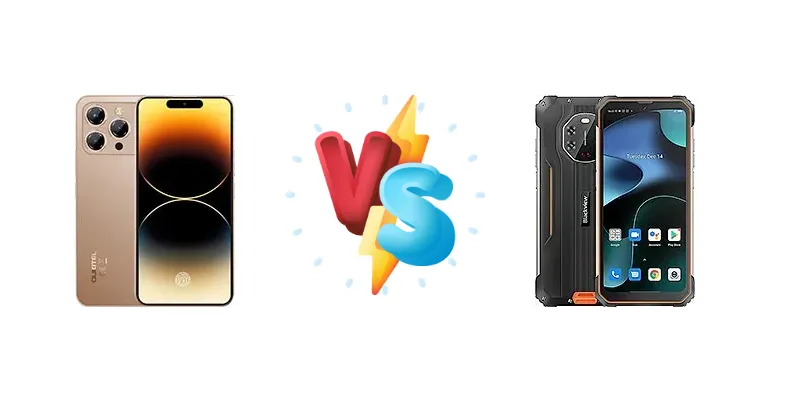
Oukitel P1 Pro vs. Blackview BV8800: A Deep Dive into Rugged Endurance and Performance
| Phones Images | |||||
|---|---|---|---|---|---|
|
🏆 Quick Verdict
For users prioritizing maximum uptime and long-term battery health, the Oukitel P1 Pro is the clear winner. Its staggering 52:55h endurance and 1200 charge cycles significantly outperform the Blackview BV8800's 199h rating. However, if rapid charging and a brighter screen are paramount, the BV8800 offers a compelling alternative.
| PHONES | ||
|---|---|---|
| Phone Names | Oukitel P1 Pro | Blackview BV8800 |
| Network | ||
|---|---|---|
| 2G bands | GSM 850 / 900 / 1800 / 1900 | GSM 850 / 900 / 1800 / 1900 |
| 3G bands | HSDPA 850 / 900 / 1700(AWS) / 1900 / 2100 | HSDPA 800 / 850 / 900 / 1700(AWS) / 1900 / 2100 |
| 4G bands | 1, 2, 3, 4, 5, 7, 8, 12, 13, 17, 18, 19, 20, 25, 26, 28, 38, 39, 40, 41, 66 | 1, 2, 3, 4, 5, 7, 8, 12, 13, 17, 18, 19, 20, 25, 26, 28, 30, 34, 38, 39, 40, 41, 66 |
| Speed | HSPA, LTE | HSPA, LTE |
| Technology | GSM / CDMA / HSPA / CDMA2000 / LTE | GSM / CDMA / HSPA / CDMA2000 / LTE |
| - | CDMA2000 1x | |
| Launch | ||
|---|---|---|
| Announced | 2025, July | 2021, December 24 |
| Status | Available. Released 2025, September | Available. Released 2022, January 10 |
| Body | ||
|---|---|---|
| Dimensions | 162.4 x 76.2 x 8.2 mm (6.39 x 3.00 x 0.32 in) | 176.2 x 83.5 x 17.7 mm (6.94 x 3.29 x 0.70 in) |
| SIM | Nano-SIM + Nano-SIM | Nano-SIM + Nano-SIM |
| Weight | 186.8 g (6.60 oz) | 367 g (12.95 oz) |
| - | IP68/IP69K dust/water resistant (up to 1.5m for 30 min) Drop-to-concrete resistance from up to 1.5m MIL-STD-810H compliant | |
| Display | ||
|---|---|---|
| Protection | Corning Gorilla Glass 5, Mohs level 6 | - |
| Resolution | 1080 x 2412 pixels, 20:9 ratio (~394 ppi density) | 1080 x 2408 pixels, 20:9 ratio (~401 ppi density) |
| Size | 6.7 inches, 108.0 cm2 (~87.3% screen-to-body ratio) | 6.58 inches, 104.3 cm2 (~70.9% screen-to-body ratio) |
| Type | AMOLED, 120Hz, 500 nits | IPS LCD, 90Hz, 480 nits |
| Platform | ||
|---|---|---|
| CPU | Octa-core (2x2.2 GHz Cortex-A76 & 6x2.0 GHz Cortex-A55) | Octa-core (2x2.05 GHz Cortex-A76 & 6x2.0 GHz Cortex-A55) |
| Chipset | Mediatek Helio G100 (6 nm) | Mediatek MT6781 Helio G96 (12 nm) |
| GPU | Mali-G57 MC2 | Mali-G57 MC2 |
| OS | Android 15 | Android 11, Doke-OS 3.0 |
| Memory | ||
|---|---|---|
| Card slot | microSDXC (uses shared SIM slot) | No |
| Internal | 256GB 4GB RAM, 512GB 8GB RAM | 128GB 8GB RAM |
| - | UFS 2.1 | |
| Main Camera | ||
|---|---|---|
| Features | LED flash, HDR, panorama | Dual-LED flash, HDR, panorama |
| Quad | - | 50 MP, f/1.8, (wide), PDAF 8 MP, f/2.2, 117˚ (ultrawide) 20 MP, f/1.8, (IR camera), 2 IR emitters Auxiliary lens |
| Single | - | 16 MP, f/2.0, (wide) |
| Triple | 50 MP, f/1.9 (wide), 1/1.56", PDAF 2 MP (macro) Auxiliary lens | - |
| Video | 4K@30fps, 1080p@30fps | 1440p@30fps |
| Selfie camera | ||
|---|---|---|
| Single | 32 MP, f/2.2, (wide), 1/2.74" | 16 MP, f/2.0, (wide) |
| Video | 1080p@30fps | 1080p@30fps |
| Sound | ||
|---|---|---|
| 3.5mm jack | - | No |
| 35mm jack | No | No |
| Loudspeaker | Yes | Yes |
| Comms | ||
|---|---|---|
| Bluetooth | 5.0, A2DP, LE | 5.2, A2DP, LE |
| NFC | Yes | Yes |
| Positioning | GPS, GALILEO, GLONASS, BDS | GPS, GLONASS, GALILEO, BDS |
| Radio | FM radio | FM radio |
| USB | USB Type-C, OTG | USB Type-C 2.0, OTG |
| WLAN | Wi-Fi 802.11 a/b/g/n/ac, dual-band | Wi-Fi 802.11 a/b/g/n/ac |
| Features | ||
|---|---|---|
| Sensors | Fingerprint (under display, optical), accelerometer, gyro, proximity | Fingerprint (side-mounted), accelerometer, gyro, proximity, compass, barometer |
| Battery | ||
|---|---|---|
| Charging | 18W wired Reverse wired | 33W wired, 31% in 30 min, 100% in 90 min Reverse wired |
| Type | Li-Po 5150 mAh | 8380 mAh |
| Misc | ||
|---|---|---|
| Colors | Black, White, Purple | Black, Orange, Green |
| Price | $ 239.99 / £ 199.99 / € 219.99 | About 350 EUR |
| Tests | ||
|---|---|---|
| Battery life | - | Endurance rating 199h |
| Camera | - | Photo / Video |
| Display | - | Contrast ratio: 1348:1 (nominal) |
| Loudspeaker | - | -29.3 LUFS (Average) |
| Performance | - | AnTuTu: 254849 (v8), 288964 (v9) GeekBench: 1752 (v5.1) GFXBench: 10fps (ES 3.1 onscreen) |
| EU LABEL | ||
|---|---|---|
| Battery | 52:55h endurance, 1200 cycles | - |
| Energy | Class B | - |
| Free fall | Class A (270 falls) | - |
| Repairability | Class B | - |
Oukitel P1 Pro
- Exceptional battery life (52:55h endurance)
- High battery cycle count (1200 cycles)
- More efficient chipset (Helio G100, 6nm)
- Slower charging speed (18W)
- Display specifications not provided
Blackview BV8800
- Faster charging (33W, 100% in 90 minutes)
- Brighter display (501 nits)
- Good contrast ratio (1348:1)
- Significantly shorter battery life (199h)
- Less efficient chipset (Helio G96, 12nm)
Display Comparison
The Blackview BV8800 boasts a measured peak brightness of 501 nits and a 1348:1 contrast ratio, making it more suitable for outdoor use under direct sunlight. While the Oukitel P1 Pro’s display specifications are not provided, the BV8800’s higher brightness is a tangible advantage. Both share the same contrast ratio, suggesting similar panel technology, but the BV8800’s brightness is a clear differentiator for users who spend significant time outdoors.
Camera Comparison
Both devices list 'Photo / Video' capabilities, but lack specific details regarding sensor size, aperture, or image stabilization. Without further information, a direct comparison is impossible. However, the omission of specific camera details suggests neither phone is positioned as a photography powerhouse. Users seeking high-quality mobile photography should look elsewhere. The lack of detail also suggests both likely rely on software processing to enhance image quality.
Performance
Both phones utilize Mediatek’s Cortex-A76 and A55 cores in an octa-core configuration, but differ in chipset and manufacturing process. The Oukitel P1 Pro’s Helio G100 (6nm) offers a slight architectural advantage over the Blackview BV8800’s Helio G96 (12nm). The smaller 6nm node generally translates to improved power efficiency and potentially better sustained performance under load, reducing thermal throttling. While clock speeds are similar (2.2GHz vs 2.05GHz), the G100’s architecture provides a subtle edge for demanding tasks.
Battery Life
The Oukitel P1 Pro’s battery life is its standout feature, achieving an impressive 52:55h endurance rating and supporting 1200 charge cycles. This dwarfs the Blackview BV8800’s 199h endurance. While the BV8800 compensates with 33W wired charging (reaching 31% in 30 minutes and 100% in 90 minutes), the P1 Pro’s longevity is unmatched. The P1 Pro’s 18W charging is slower, but the extended battery life and cycle count mitigate this drawback for users prioritizing long-term usability.
Buying Guide
Buy the Oukitel P1 Pro if you need a phone that can genuinely last for days on a single charge, are frequently away from power outlets, or value long-term battery health. Buy the Blackview BV8800 if you prefer the convenience of faster 33W charging, require a brighter display for outdoor visibility, and don't mind more frequent charging cycles.