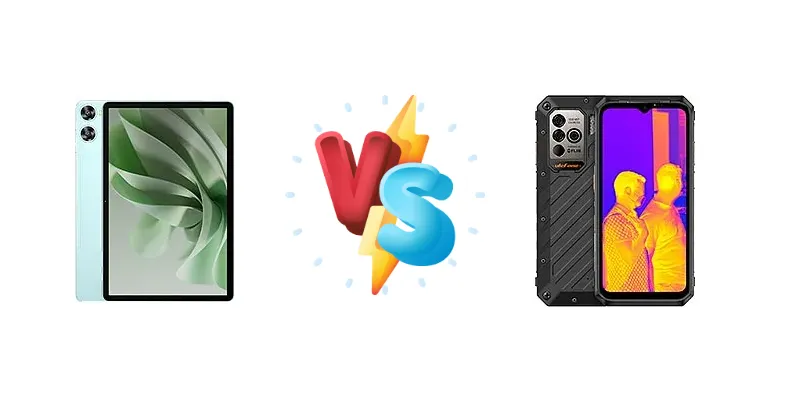
The rugged smartphone market caters to a specific need: durability. However, within that niche, priorities diverge. The Oukitel OT9 prioritizes exceptional battery endurance, boasting a claimed 110-hour lifespan. Conversely, the Ulefone Power Armor 19T focuses on delivering a more responsive experience with a modern chipset and significantly faster charging, making it a compelling choice for users who demand performance alongside robustness.
🏆 Quick Verdict
For the average user prioritizing longevity and minimizing charging frequency, the Oukitel OT9 is the clear winner. Its 110-hour endurance is unmatched. However, if you value a snappier user experience, faster app loading, and quick top-ups, the Ulefone Power Armor 19T’s Helio G99 chipset and 66W charging are worth the trade-off.
| Network |
|---|
| 2G bands | N/A | GSM 850 / 900 / 1800 / 1900 |
| 3G bands | N/A | HSDPA 800 / 850 / 900 / 1700(AWS) / 1900 / 2100 |
| 4G bands | N/A | 1, 2, 3, 4, 5, 7, 8, 12, 13, 17, 18, 19, 20, 25, 26, 28, 34, 38, 39, 40, 41, 66, 71 |
| EDGE | No | - |
| GPRS | No | - |
| Speed | - | HSPA, LTE |
| Technology | No cellular connectivity | GSM / CDMA / HSPA / CDMA2000 / LTE |
| | - | CDMA2000 1x |
| Launch |
|---|
| Announced | 2024, November 01 | 2023, March 06 |
| Status | Available. Released 2024, November 01 | Available. Released 2023, March 06 |
| Body |
|---|
| Dimensions | 258.2 x 169.5 x 8.6 mm (10.17 x 6.67 x 0.34 in) | 175.2 x 83.4 x 18.8 mm (6.90 x 3.28 x 0.74 in) |
| SIM | No | Nano-SIM + Nano-SIM |
| Weight | 520 g (1.15 lb) | 409 g (14.43 oz) |
| | - | IP68/IP69K dust/water resistant (up to 1.5m for 30 min)
Drop-to-concrete resistance from up to 1.5m
MIL-STD-810H compliant
Accessory connector (ulefone endoscope, microscope) |
| Display |
|---|
| Protection | Corning Gorilla Glass 5, Mohs level 5 | Corning Gorilla Glass 5 |
| Resolution | 800 x 1280 pixels, 16:10 ratio (~137 ppi density) | 1080 x 2408 pixels, 20:9 ratio (~401 ppi density) |
| Size | 11.0 inches, 350.9 cm2 (~80.2% screen-to-body ratio) | 6.58 inches, 104.3 cm2 (~71.4% screen-to-body ratio) |
| Type | IPS LCD, 400 nits | IPS LCD, 120Hz |
| Platform |
|---|
| CPU | Octa-core (2x1.6 GHz Cortex-A75 & 6x1.6 GHz Cortex-A55) | Octa-core (2x2.2 GHz Cortex-A76 & 6x2.0 GHz Cortex-A55) |
| Chipset | Unisoc T606 (12 nm) | Mediatek Helio G99 (6 nm) |
| GPU | Mali-G57 MP1 | Mali-G57 MC2 |
| OS | Android 14 | Android 12 |
| Memory |
|---|
| Card slot | Unspecified | microSDXC (uses shared SIM slot) |
| Internal | 128GB 4GB RAM | 256GB 12GB RAM |
| Main Camera |
|---|
| Features | LED flash, HDR, panorama | Hexa-LED flash, HDR, panorama |
| Single | 13 MP, f/2.2, (wide), 1/3.06", AF | - |
| Triple | - | 108 MP, f/1.9, (wide), 1/1.52", 0.7µm, PDAF
5 MP (macro)
FLIR thermal camera (Lepton module)
5 MP (for thermal module) |
| Video | 1080p@30fps | 1440p@30fps, 1080p@30fps |
| Selfie camera |
|---|
| Single | 5 MP, f/2.6, (wide), 1/5.0" | 16 MP, f/2.0, (wide), 1.0µm |
| Video | 720p@30fps | 1080p@30fps |
| Sound |
|---|
| 3.5mm jack | - | Yes |
| 35mm jack | Yes | Yes |
| Loudspeaker | Yes, with stereo speakers | Yes |
| Comms |
|---|
| Bluetooth | 5.0, A2DP, LE | 5.2, A2DP, LE |
| NFC | No | Yes |
| Positioning | No | GPS, GLONASS, GALILEO, BDS |
| Radio | No | Wireless FM radio, RDS, recording |
| USB | USB Type-C, OTG | USB Type-C 2.0, OTG, magnetic connector |
| WLAN | Wi-Fi 802.11 a/b/g/n/ac, dual-band | Wi-Fi 802.11 a/b/g/n/ac, dual-band |
| Features |
|---|
| Sensors | Accelerometer | Fingerprint (side-mounted), accelerometer, gyro, proximity, compass |
| Battery |
|---|
| Charging | 10W wired | 66W wired, 52% in 30 min
15W wireless
5W wireless reversed |
| Type | 8000 mAh | Li-Po 9600 mAh |
| Misc |
|---|
| Colors | Green, Gray, Purple | Black |
| Price | About 180 EUR | About 440 EUR |
| EU LABEL |
|---|
| Battery | 110:00h endurance, 1000 cycles | - |
| Energy | Class E | - |
| Free fall | Class E (52 falls) | - |
| Repairability | Class C | - |
Oukitel OT9
- Exceptional battery endurance (110 hours)
- High charge cycle lifespan (1000 cycles)
- Potentially lower price point
- Slow 10W charging
- Less powerful Unisoc T606 chipset
- Likely limited gaming performance
Ulefone Power Armor 19T
- Faster and more efficient Mediatek Helio G99 chipset
- 66W fast charging (52% in 30 minutes)
- Wireless charging (15W & 5W reverse)
- Shorter battery life compared to OT9
- Potentially higher price
- May require more frequent charging
Display Comparison
Neither device’s display specifications are provided, so a direct comparison is limited. However, given the price points, we can assume both utilize IPS LCD panels. The Ulefone, being a newer device, likely benefits from improved color calibration and potentially higher peak brightness. The OT9, focusing on endurance, may prioritize power efficiency over display fidelity.
Camera Comparison
Without detailed camera specifications, a precise comparison is difficult. However, the market segment suggests both phones will feature multi-camera setups. The Ulefone, with its more powerful chipset, likely benefits from more advanced image processing capabilities. The OT9 will likely focus on providing acceptable image quality for casual use, while the 19T may offer more detail and dynamic range. The presence of a 2MP macro lens on either device is likely a marketing feature with limited practical benefit.
Performance
The Ulefone Power Armor 19T’s Mediatek Helio G99 (6nm) represents a significant leap in performance over the Oukitel OT9’s Unisoc T606 (12nm). The G99’s Cortex-A76 cores, clocked at 2.2 GHz, offer substantially higher single-core performance than the OT9’s Cortex-A75 cores at 1.6 GHz. This translates to faster app launches, smoother multitasking, and a more enjoyable gaming experience. The 6nm process node of the G99 also contributes to better thermal efficiency, reducing the likelihood of performance throttling under sustained load. The OT9’s T606 is adequate for basic tasks, but will struggle with demanding applications.
Battery Life
The Oukitel OT9’s standout feature is its claimed 110-hour endurance and 1000 charge cycles. While the actual battery capacity isn’t specified, this suggests a large battery optimized for longevity. The Ulefone Power Armor 19T, while likely having a respectable battery capacity, prioritizes charging speed. Its 66W wired charging can deliver a 52% charge in just 30 minutes, a massive advantage over the OT9’s slow 10W charging. The 19T also includes 15W wireless and 5W reverse wireless charging, features absent on the OT9. The trade-off is clear: the OT9 offers days of use, while the 19T offers convenience and rapid replenishment.
Buying Guide
Buy the Oukitel OT9 if you need a phone that can genuinely last for days on a single charge, ideal for extended outdoor adventures or situations where power access is limited. Buy the Ulefone Power Armor 19T if you prefer a more responsive device for everyday tasks, gaming, and appreciate the convenience of incredibly fast charging, even if it means charging more frequently.
Frequently Asked Questions
❓ How much faster is the Ulefone Power Armor 19T in real-world use compared to the Oukitel OT9?
The Helio G99 in the 19T offers a noticeable performance boost over the Unisoc T606 in the OT9. Expect significantly faster app loading times, smoother multitasking, and a more responsive user interface. Gaming performance will be dramatically improved on the 19T, allowing for playable frame rates in more demanding titles.
❓ Is the 10W charging on the Oukitel OT9 realistically usable in 2024?
While functional, the 10W charging on the OT9 is exceptionally slow by modern standards. A full charge will take several hours. This is acceptable given the phone’s focus on extreme battery life, as the intention is to charge infrequently, but it’s a significant inconvenience if you frequently run low on power.
❓ Does the Ulefone Power Armor 19T’s 66W charging generate excessive heat?
The Helio G99 chipset and the phone’s thermal design should mitigate excessive heat during 66W charging. While some warmth is expected, it shouldn’t be uncomfortable to hold. The 6nm process node contributes to improved thermal efficiency compared to older chipsets.
❓ What type of user would benefit most from the Oukitel OT9’s 1000 charge cycles?
Users who plan to keep their phone for several years and prioritize long-term battery health will greatly benefit from the OT9’s 1000 charge cycles. This indicates a higher quality battery cell designed to retain capacity over extended use, reducing the need for battery replacement.