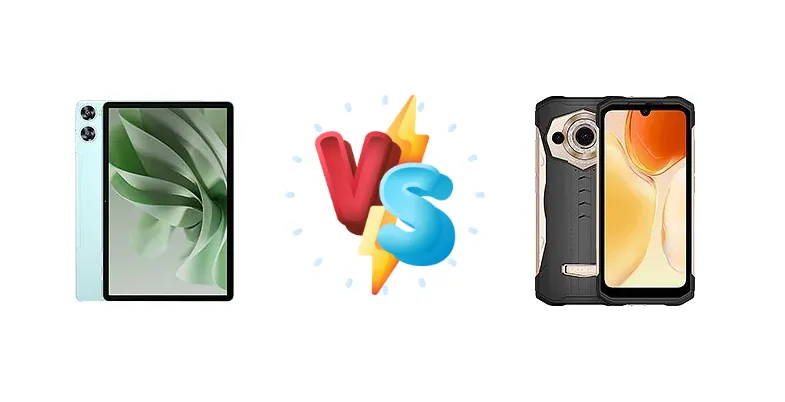
The Oukitel OT9 and Doogee S99 both target the rugged smartphone market, but cater to different priorities. The OT9 emphasizes extreme battery endurance, while the S99 prioritizes processing power and faster charging. This comparison dissects their core specifications to determine which device best suits your needs.
🏆 Quick Verdict
For users prioritizing longevity and minimizing charging frequency, the Oukitel OT9 is the clear winner thanks to its exceptional 110-hour endurance. However, the Doogee S99 offers a significantly faster and more versatile charging experience alongside superior processing capabilities, making it ideal for power users.
| Network |
|---|
| 2G bands | N/A | GSM 850 / 900 / 1800 / 1900 |
| 3G bands | N/A | HSDPA 800 / 850 / 900 / 1700(AWS) / 1900 / 2100 |
| 4G bands | N/A | 1, 2, 3, 4, 5, 7, 8, 12, 13, 17, 18, 19, 20, 25, 26, 28, 34, 38, 39, 40, 41, 66 |
| EDGE | No | - |
| GPRS | No | - |
| Speed | - | HSPA, LTE |
| Technology | No cellular connectivity | GSM / CDMA / HSPA / LTE |
| Launch |
|---|
| Announced | 2024, November 01 | 2022, December 05 |
| Status | Available. Released 2024, November 01 | Available. Released 2022, December 05 |
| Body |
|---|
| Dimensions | 258.2 x 169.5 x 8.6 mm (10.17 x 6.67 x 0.34 in) | 172 x 82 x 15.5 mm (6.77 x 3.23 x 0.61 in) |
| SIM | No | Nano-SIM + Nano-SIM |
| Weight | 520 g (1.15 lb) | - |
| Display |
|---|
| Protection | Corning Gorilla Glass 5, Mohs level 5 | Corning Gorilla Glass |
| Resolution | 800 x 1280 pixels, 16:10 ratio (~137 ppi density) | 1080 x 2340 pixels, 19.5:9 ratio (~409 ppi density) |
| Size | 11.0 inches, 350.9 cm2 (~80.2% screen-to-body ratio) | 6.3 inches, 97.4 cm2 (~69.1% screen-to-body ratio) |
| Type | IPS LCD, 400 nits | IPS LCD |
| Platform |
|---|
| CPU | Octa-core (2x1.6 GHz Cortex-A75 & 6x1.6 GHz Cortex-A55) | Octa-core (2x2.05 GHz Cortex-A76 & 6x2.0 GHz Cortex-A55) |
| Chipset | Unisoc T606 (12 nm) | Mediatek MT6781 Helio G96 (12 nm) |
| GPU | Mali-G57 MP1 | Mali-G57 MC2 |
| OS | Android 14 | Android 12 |
| Memory |
|---|
| Card slot | Unspecified | microSDXC (dedicated slot) |
| Internal | 128GB 4GB RAM | 128GB 8GB RAM |
| Main Camera |
|---|
| Features | LED flash, HDR, panorama | Dual-LED flash, HDR, panorama |
| Single | 13 MP, f/2.2, (wide), 1/3.06", AF | - |
| Triple | - | 108 MP, f/1.9, (wide), 1/1.52", 0.7µm, PDAF
64 MP, f/1.8, (night vision), 2 infrared night vision lights
16 MP, f/1.8, 130˚ (ultrawide) |
| Video | 1080p@30fps | 1440p@30fps, 1080p@30fps |
| Selfie camera |
|---|
| Single | 5 MP, f/2.6, (wide), 1/5.0" | 32 MP, f/2.0, (wide), 1/2.8", 0.8µm |
| Video | 720p@30fps | 1080p@30fps |
| Sound |
|---|
| 35mm jack | Yes | No |
| Loudspeaker | Yes, with stereo speakers | Yes |
| Comms |
|---|
| Bluetooth | 5.0, A2DP, LE | 5.1, A2DP, LE |
| NFC | No | Yes (market/region dependent) |
| Positioning | No | GPS, GLONASS, GALILEO, BDS |
| Radio | No | FM radio |
| USB | USB Type-C, OTG | USB Type-C 2.0, OTG |
| WLAN | Wi-Fi 802.11 a/b/g/n/ac, dual-band | Wi-Fi 802.11 a/b/g/n/ac, dual-band |
| Features |
|---|
| Sensors | Accelerometer | Fingerprint (side-mounted), accelerometer, gyro, proximity, compass |
| Battery |
|---|
| Charging | 10W wired | 33W wired, 45% in 30 min
15W wireless
Reverse wired |
| Type | 8000 mAh | 6000 mAh |
| Misc |
|---|
| Colors | Green, Gray, Purple | Gold, Black |
| Price | About 180 EUR | About 250 EUR |
| EU LABEL |
|---|
| Battery | 110:00h endurance, 1000 cycles | - |
| Energy | Class E | - |
| Free fall | Class E (52 falls) | - |
| Repairability | Class C | - |
Oukitel OT9
- Exceptional 110-hour battery endurance
- 1000 charge cycles promise long-term battery health
- Potentially lower price point due to less powerful chipset
- Slower processor limits performance in demanding tasks
- 10W charging is significantly slower than the competition
Doogee S99
- Faster and more responsive performance with the Helio G96
- 33W wired charging provides rapid replenishment
- 15W wireless and reverse wired charging offer added convenience
- Likely shorter battery life compared to the Oukitel OT9
- Potentially higher price point due to the more powerful chipset
Display Comparison
Neither device's display specifications are provided, so a direct comparison is limited. However, given the price points, we can assume both utilize LCD panels. The focus here shifts to the overall user experience, where the faster processor of the S99 will likely contribute to smoother scrolling and animations. The absence of details like refresh rate or resolution suggests neither phone prioritizes a premium display experience.
Camera Comparison
Without detailed camera specifications beyond the chipsets, a precise camera comparison is impossible. However, the Helio G96 in the Doogee S99 typically supports more advanced image signal processors (ISPs) capable of better noise reduction and dynamic range. This suggests the S99 will likely produce more detailed and vibrant photos, especially in challenging lighting conditions. The OT9’s Unisoc T606 is adequate for basic photography, but will likely struggle in low-light scenarios. The absence of sensor size or aperture information makes a definitive judgment difficult.
Performance
The Doogee S99’s Mediatek Helio G96 chipset represents a substantial performance upgrade over the Oukitel OT9’s Unisoc T606. The G96 features a more modern CPU architecture – Cortex-A76 cores clocked at 2.05 GHz versus the OT9’s Cortex-A75 cores at 1.6 GHz – translating to faster single-core and multi-core performance. This difference is particularly noticeable in demanding tasks like gaming and video editing. While both chipsets are built on a 12nm process, the G96’s superior architecture provides a clear advantage. The S99 will handle multitasking and graphically intensive applications with greater ease.
Battery Life
The Oukitel OT9 boasts an impressive 110-hour endurance rating, a testament to its optimized power management and likely larger battery capacity (though not specified). This is a significant advantage for users who prioritize battery life above all else. Conversely, the Doogee S99 compensates for a potentially smaller battery with its 33W wired charging, capable of reaching 45% charge in just 30 minutes. The addition of 15W wireless charging and reverse wired charging further enhances its versatility. While the OT9 excels in longevity, the S99 offers convenience and rapid replenishment.
Buying Guide
Buy the Oukitel OT9 if you need a phone that can genuinely last for days on a single charge, and are comfortable with slower charging speeds. This is perfect for outdoor adventures, emergency preparedness, or simply avoiding the daily charging routine. Buy the Doogee S99 if you prefer a more responsive user experience, faster app loading times, and the convenience of 33W wired and 15W wireless charging, even if it means charging more frequently.
Frequently Asked Questions
❓ How does the Unisoc T606 in the Oukitel OT9 handle graphically intensive games like PUBG Mobile?
The Unisoc T606 is a capable chipset for casual gaming, but will likely struggle with PUBG Mobile at higher settings. Expect to play at lower graphics settings and potentially experience frame drops during intense action. The Doogee S99’s Helio G96 offers a significantly smoother gaming experience.
❓ Is the 33W charging on the Doogee S99 truly fast, and does it generate significant heat?
33W charging is considered fast charging and will noticeably reduce charging times compared to the Oukitel OT9’s 10W charging. While some heat generation is normal during fast charging, the Doogee S99 likely incorporates thermal management features to mitigate overheating. Reaching 45% in 30 minutes is a practical benefit for users needing a quick power boost.
❓ What is the practical benefit of 1000 charge cycles on the Oukitel OT9?
The 1000 charge cycle rating indicates the battery is designed to retain a significant portion of its original capacity after being fully charged and discharged 1000 times. This translates to a longer overall battery lifespan compared to phones with lower cycle ratings, offering peace of mind for long-term users.