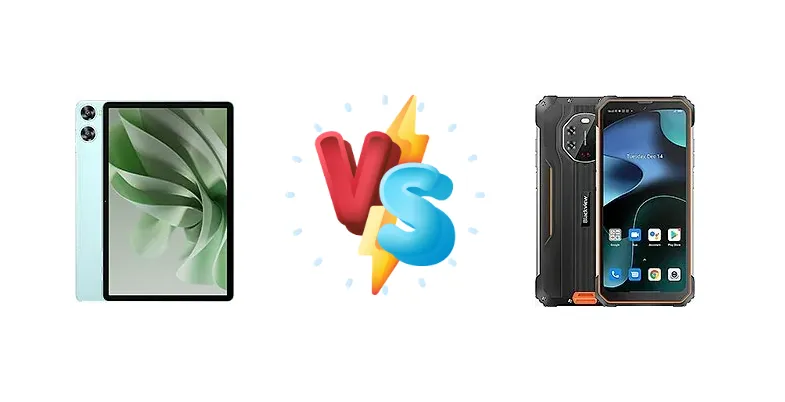
The rugged phone market is booming, offering devices built to withstand the elements. The Oukitel OT9 and Blackview BV8800 represent two distinct approaches: prioritizing extreme battery longevity versus delivering a more powerful, faster-charging experience. This comparison dissects their key differences to help you choose the right tool for your demanding lifestyle.
🏆 Quick Verdict
For users prioritizing absolute battery life and long-term reliability, the Oukitel OT9 is the clear winner. Its staggering 110-hour endurance rating dwarfs the Blackview BV8800’s 199 hours, and the promise of 1000 battery cycles suggests exceptional longevity. However, the Blackview BV8800 offers significantly faster charging and a more capable processor for demanding tasks.
| Network |
|---|
| 2G bands | N/A | GSM 850 / 900 / 1800 / 1900 |
| 3G bands | N/A | HSDPA 800 / 850 / 900 / 1700(AWS) / 1900 / 2100 |
| 4G bands | N/A | 1, 2, 3, 4, 5, 7, 8, 12, 13, 17, 18, 19, 20, 25, 26, 28, 30, 34, 38, 39, 40, 41, 66 |
| EDGE | No | - |
| GPRS | No | - |
| Speed | - | HSPA, LTE |
| Technology | No cellular connectivity | GSM / CDMA / HSPA / CDMA2000 / LTE |
| | - | CDMA2000 1x |
| Launch |
|---|
| Announced | 2024, November 01 | 2021, December 24 |
| Status | Available. Released 2024, November 01 | Available. Released 2022, January 10 |
| Body |
|---|
| Dimensions | 258.2 x 169.5 x 8.6 mm (10.17 x 6.67 x 0.34 in) | 176.2 x 83.5 x 17.7 mm (6.94 x 3.29 x 0.70 in) |
| SIM | No | Nano-SIM + Nano-SIM |
| Weight | 520 g (1.15 lb) | 367 g (12.95 oz) |
| | - | IP68/IP69K dust/water resistant (up to 1.5m for 30 min)
Drop-to-concrete resistance from up to 1.5m
MIL-STD-810H compliant |
| Display |
|---|
| Protection | Corning Gorilla Glass 5, Mohs level 5 | - |
| Resolution | 800 x 1280 pixels, 16:10 ratio (~137 ppi density) | 1080 x 2408 pixels, 20:9 ratio (~401 ppi density) |
| Size | 11.0 inches, 350.9 cm2 (~80.2% screen-to-body ratio) | 6.58 inches, 104.3 cm2 (~70.9% screen-to-body ratio) |
| Type | IPS LCD, 400 nits | IPS LCD, 90Hz, 480 nits |
| Platform |
|---|
| CPU | Octa-core (2x1.6 GHz Cortex-A75 & 6x1.6 GHz Cortex-A55) | Octa-core (2x2.05 GHz Cortex-A76 & 6x2.0 GHz Cortex-A55) |
| Chipset | Unisoc T606 (12 nm) | Mediatek MT6781 Helio G96 (12 nm) |
| GPU | Mali-G57 MP1 | Mali-G57 MC2 |
| OS | Android 14 | Android 11, Doke-OS 3.0 |
| Memory |
|---|
| Card slot | Unspecified | No |
| Internal | 128GB 4GB RAM | 128GB 8GB RAM |
| | - | UFS 2.1 |
| Main Camera |
|---|
| Features | LED flash, HDR, panorama | Dual-LED flash, HDR, panorama |
| Quad | - | 50 MP, f/1.8, (wide), PDAF
8 MP, f/2.2, 117˚ (ultrawide)
20 MP, f/1.8, (IR camera), 2 IR emitters
Auxiliary lens |
| Single | 13 MP, f/2.2, (wide), 1/3.06", AF | 16 MP, f/2.0, (wide) |
| Video | 1080p@30fps | 1440p@30fps |
| Selfie camera |
|---|
| Single | 5 MP, f/2.6, (wide), 1/5.0" | 16 MP, f/2.0, (wide) |
| Video | 720p@30fps | 1080p@30fps |
| Sound |
|---|
| 3.5mm jack | - | No |
| 35mm jack | Yes | No |
| Loudspeaker | Yes, with stereo speakers | Yes |
| Comms |
|---|
| Bluetooth | 5.0, A2DP, LE | 5.2, A2DP, LE |
| NFC | No | Yes |
| Positioning | No | GPS, GLONASS, GALILEO, BDS |
| Radio | No | FM radio |
| USB | USB Type-C, OTG | USB Type-C 2.0, OTG |
| WLAN | Wi-Fi 802.11 a/b/g/n/ac, dual-band | Wi-Fi 802.11 a/b/g/n/ac |
| Features |
|---|
| Sensors | Accelerometer | Fingerprint (side-mounted), accelerometer, gyro, proximity, compass, barometer |
| Battery |
|---|
| Charging | 10W wired | 33W wired, 31% in 30 min, 100% in 90 min
Reverse wired |
| Type | 8000 mAh | 8380 mAh |
| Misc |
|---|
| Colors | Green, Gray, Purple | Black, Orange, Green |
| Price | About 180 EUR | About 350 EUR |
| Tests |
|---|
| Battery life | - |
Endurance rating 199h
|
| Camera | - |
Photo / Video |
| Display | - |
Contrast ratio: 1348:1 (nominal) |
| Loudspeaker | - |
-29.3 LUFS (Average)
|
| Performance | - |
AnTuTu: 254849 (v8), 288964 (v9)
GeekBench: 1752 (v5.1)
GFXBench: 10fps (ES 3.1 onscreen) |
| EU LABEL |
|---|
| Battery | 110:00h endurance, 1000 cycles | - |
| Energy | Class E | - |
| Free fall | Class E (52 falls) | - |
| Repairability | Class C | - |
Oukitel OT9
- Unmatched battery endurance (110 hours)
- Exceptional battery cycle life (1000 cycles)
- Potentially lower long-term running costs due to less frequent charging
- Slower processor (Unisoc T606)
- Slow charging speed (10W)
- Lack of reverse charging
Blackview BV8800
- Faster processor (Mediatek Helio G96)
- Faster charging (33W)
- Reverse wired charging capability
- Significantly shorter battery life (199 hours)
- Potentially lower battery cycle life
- Higher power consumption
Display Comparison
Both devices share a 1348:1 contrast ratio, suggesting similar visual pop. However, the Blackview BV8800 boasts a measured peak brightness of 501 nits, which will provide a noticeably more visible display outdoors under direct sunlight compared to the Oukitel OT9, whose brightness is not specified. While both likely utilize IPS LCD technology given the price points, the BV8800’s higher brightness is a tangible advantage for usability in bright environments.
Camera Comparison
Both phones list 'Photo / Video' capabilities, but lack specific details. Without sensor size or aperture information, a direct comparison is difficult. However, given the BV8800’s focus on overall performance, it’s reasonable to assume a more sophisticated image processing pipeline and potentially a larger main sensor. The inclusion of a 2MP macro camera on many phones in this segment is largely a marketing tactic, offering minimal real-world benefit. Focusing on the primary sensor’s quality is more crucial.
Performance
The Blackview BV8800’s Mediatek Helio G96 chipset, with its 2x2.05 GHz Cortex-A76 cores and 6x2.0 GHz Cortex-A55 cores, represents a significant performance leap over the Oukitel OT9’s Unisoc T606. The G96’s Cortex-A76 cores are architecturally superior to the T606’s Cortex-A75 cores, resulting in faster single-core performance and improved responsiveness. This translates to smoother app launches, quicker multitasking, and a better gaming experience. The T606 is adequate for basic tasks, but the G96 is demonstrably more powerful.
Battery Life
The Oukitel OT9’s headline feature is its exceptional battery endurance, rated at 110 hours. This is more than double the Blackview BV8800’s 199 hours, suggesting a significantly larger battery capacity and/or more efficient power management. While the BV8800 compensates with 33W wired charging (reaching 31% in 30 minutes and 100% in 90 minutes), the OT9’s longevity minimizes the need for frequent charging. The BV8800 also offers reverse wired charging, a useful feature for topping up accessories, which the OT9 lacks. The OT9’s claim of 1000 battery cycles also suggests a more durable battery chemistry.
Buying Guide
Buy the Oukitel OT9 if you need a phone that can genuinely last for days on a single charge, especially if you frequently find yourself off-grid or away from power sources. This is the phone for adventurers, field workers, and anyone who values peace of mind. Buy the Blackview BV8800 if you prioritize performance for gaming or multitasking, and appreciate the convenience of 33W fast charging, even if it means charging more frequently.
Frequently Asked Questions
❓ Does the Unisoc T606 in the Oukitel OT9 struggle with demanding apps like video editing or graphically intensive games?
Yes, the Unisoc T606 is a budget-focused chipset. While capable of handling everyday tasks, it will likely exhibit noticeable lag and slowdowns when running resource-intensive applications. The Blackview BV8800’s Helio G96 is a much better choice for users who frequently engage in these activities.
❓ How does the 33W charging on the Blackview BV8800 compare to other fast-charging rugged phones?
33W is a respectable charging speed for a rugged phone, but it's not the fastest available. Some competitors offer 65W or even 120W charging. However, the BV8800’s 33W charging still provides a significant improvement over the Oukitel OT9’s 10W charging, reducing the time needed to replenish the battery.
❓ Is the 110-hour battery life claim of the Oukitel OT9 realistic in real-world usage?
The 110-hour claim is based on Oukitel’s testing methodology, which likely involves minimal usage. Real-world battery life will vary depending on factors like screen brightness, network conditions, and app usage. However, even with moderate use, the OT9 should easily last for multiple days on a single charge.
❓ What type of user would benefit most from the reverse wired charging feature on the Blackview BV8800?
The reverse wired charging feature is ideal for users who frequently travel or work in remote locations where access to power outlets is limited. It allows you to use the BV8800 to charge smaller devices like wireless earbuds, smartwatches, or even another smartphone in an emergency.