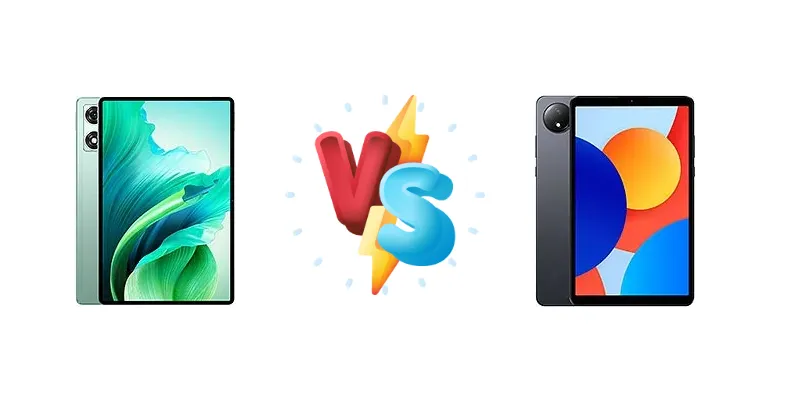
The budget tablet market is heating up, with the Oukitel OT8 and Xiaomi Redmi Pad SE 8.7 vying for attention. The OT8 prioritizes exceptional battery endurance, boasting a claimed 114-hour lifespan, while the Redmi Pad SE 8.7 aims for a balance of performance and affordability with its MediaTek Helio G85 chipset. This comparison dissects their key differences to determine which tablet best suits your needs.
🏆 Quick Verdict
For users prioritizing all-day (and multi-day) battery life above all else, the Oukitel OT8 is the clear winner. However, the Xiaomi Redmi Pad SE 8.7 offers a noticeable performance edge thanks to its faster CPU cores, making it a better choice for gaming and more demanding applications.
| Network |
|---|
| 2G bands | GSM 850 / 900 / 1800 / 1900 | GSM 850 / 900 / 1800 / 1900 |
| 3G bands | HSDPA 900 / 2100 | HSDPA 800 / 850 / 900 / 1700(AWS) / 1900 / 2100 |
| 4G bands | 1, 3, 7, 8, 19, 20, 38, 39, 40, 41 | 1, 2, 3, 4, 5, 7, 8, 13, 18, 19, 20, 26, 28, 38, 40, 41, 66 |
| Speed | HSPA, LTE | HSPA, LTE - cellular model only |
| Technology | GSM / HSPA / LTE | GSM / HSPA / LTE |
| Launch |
|---|
| Announced | 2024, January 06 | 2024, July 29 |
| Status | Available. Released 2024, January | Available. Released 2024, August 08 |
| Body |
|---|
| Build | - | Glass front (Gorilla Glass 3) |
| Dimensions | 256.8 x 168.3 x 7.8 mm (10.11 x 6.63 x 0.31 in) | 211.6 x 125.5 x 8.8 mm (8.33 x 4.94 x 0.35 in) |
| SIM | Nano-SIM + Nano-SIM | Nano-SIM + Nano-SIM (cellular model only) |
| Weight | 515 g (1.14 lb) | 370 / 373 / 375 g (13.05 oz) |
| Display |
|---|
| Protection | Corning Gorilla Glass 5, Mohs level 5 | Corning Gorilla Glass 3 |
| Resolution | 1200 x 1920 pixels, 16:10 ratio (~206 ppi density) | 800 x 1340 pixels, 5:3 ratio (~179 ppi density) |
| Size | 11.0 inches, 350.9 cm2 (~81.2% screen-to-body ratio) | 8.7 inches, 214.9 cm2 (~80.9% screen-to-body ratio) |
| Type | IPS LCD, 350 nits | IPS LCD, 1B colors, 90Hz, 600 nits (HBM) |
| Platform |
|---|
| CPU | Octa-core (2x1.6 GHz Cortex-A75 & 6x1.6 GHz Cortex-A55) | Octa-core (2x2.0 GHz Cortex-A75 & 6x1.8 GHz Cortex-A55) |
| Chipset | Unisoc T606 (12 nm) | Mediatek Helio G85 (12 nm) |
| GPU | Mali-G57 MP1 | Mali-G52 MC2 |
| OS | Android 13 | Android 14, HyperOS |
| Memory |
|---|
| Card slot | microSDXC (uses shared SIM slot) | microSDXC (dedicated slot) |
| Internal | 256GB 6GB RAM | 64GB 4GB RAM, 128GB 4GB RAM, 128GB 6GB RAM |
| Main Camera |
|---|
| Features | LED flash, panorama, HDR | LED flash |
| Single | 13 MP, f/2.2, (wide), 1/3.06", AF | 8 MP, f/2.0, (wide), 1/4.0", 1.12µm |
| Video | 1080p@30fps | 1080p@30fps |
| Selfie camera |
|---|
| Features | HDR | - |
| Single | 8 MP, f/2.2, (wide), 1/4.0" | 5 MP, f/2.2, (wide), 1/5.0", 1.12µm |
| Video | 720p@30fps | 1080p@30fps |
| Sound |
|---|
| 35mm jack | Yes | Yes |
| Loudspeaker | Yes, with stereo speakers (4 speakers) | Yes, with stereo speakers |
| Comms |
|---|
| Bluetooth | 5.0, A2DP, LE | 5.3, A2DP, LE |
| Infrared port | - | Yes |
| NFC | No | No |
| Positioning | GPS, GLONASS, GALILEO, BDS | GPS, GALILEO, GLONASS, BDS - cellular model only |
| Radio | No | FM radio |
| USB | USB Type-C 2.0 | USB Type-C 2.0 |
| WLAN | Wi-Fi 802.11 a/b/g/n/ac, dual-band | Wi-Fi 802.11 a/b/g/n/ac, dual-band |
| Features |
|---|
| Sensors | Accelerometer | Accelerometer, proximity (accessories only), compass |
| Battery |
|---|
| Charging | 18W wired | 18W wired (Int'l)
10W wired (India) |
| Type | Li-Po 8800 mAh | 6650 mAh |
| Misc |
|---|
| Colors | Gray, Green, Purple | Aurora Green (Forest Green), Sky Blue (Ocean Blue), Graphite Gray (Urban Grey) |
| Models | - | 220233L2G |
| Price | About 170 EUR | About 120 EUR |
| SAR | - | 0.90 W/kg (head) 0.65 W/kg (body) |
| SAR EU | - | 0.40 W/kg (head) 0.99 W/kg (body) |
| EU LABEL |
|---|
| Battery | 114:00h endurance, 1000 cycles | - |
| Energy | Class E | - |
| Free fall | Class C (104 falls) | - |
| Repairability | Class B | - |
Oukitel OT8
- Exceptional battery life (114h endurance)
- High charge cycle count (1000 cycles)
- Efficient Unisoc T606 chipset for prolonged use
- Slower processor compared to the Redmi Pad SE
- Potentially longer charging times due to larger battery
Xiaomi Redmi Pad SE 8.7
- Faster MediaTek Helio G85 processor for smoother performance
- Better gaming capabilities
- More responsive multitasking
- Shorter battery life compared to the Oukitel OT8
- Potential for faster battery degradation (unknown cycle count)
Display Comparison
Both tablets share a similar 8.7-inch display size, but detailed display specs like resolution, panel type (IPS vs. LCD), and color gamut are missing. However, the focus here is on performance and battery, so display differences are less critical. Bezels are likely comparable given the price points. Without further data, it's safe to assume both offer adequate viewing experiences for media consumption, but won't compete with higher-end tablets in terms of color accuracy or brightness.
Camera Comparison
Neither tablet is positioned as a photography powerhouse. Detailed camera specs are unavailable, but given the market segment, expect basic image quality suitable for casual snapshots. Focusing on the chipsets, the Helio G85 in the Redmi Pad SE likely has a slightly more capable ISP (Image Signal Processor) for faster image processing, but the difference will be minimal. Without knowing sensor sizes or lens apertures, a definitive camera comparison is impossible.
Performance
The core difference lies in the chipsets. The Xiaomi Redmi Pad SE 8.7’s MediaTek Helio G85 features 2x2.0 GHz Cortex-A75 cores and 6x1.8 GHz Cortex-A55 cores, offering a clock speed advantage over the Oukitel OT8’s Unisoc T606 (2x1.6 GHz Cortex-A75 & 6x1.6 GHz Cortex-A55). This translates to snappier app launches and smoother multitasking on the Redmi Pad SE. While both are 12nm chips, the higher clock speeds of the Helio G85 provide a tangible performance boost. The Unisoc T606 in the OT8 prioritizes efficiency, contributing to its exceptional battery life. The Redmi Pad SE's GPU is also likely more capable, offering a better gaming experience.
Battery Life
The Oukitel OT8’s standout feature is its incredible 114-hour endurance claim and 1000 charge cycles. This suggests a significantly larger battery capacity than the Redmi Pad SE, coupled with aggressive power management. While both tablets offer 18W wired charging (though the Redmi Pad SE has a 10W variant in India), the OT8’s larger battery will take longer to fully charge. The Redmi Pad SE’s faster processor will consume more power, meaning shorter battery life despite potentially similar charging speeds. For users who value longevity over quick top-ups, the OT8 is the clear winner.
Buying Guide
Buy the Oukitel OT8 if you need a tablet that can reliably last through extended travel, long workdays without access to power, or frequent video consumption without constant charging. Buy the Xiaomi Redmi Pad SE 8.7 if you prefer a more responsive experience for gaming, multitasking, and general app usage, and are willing to compromise on ultimate battery longevity. The Redmi Pad SE is also a better fit for users who frequently use apps optimized for MediaTek chipsets.
Frequently Asked Questions
❓ Does the Unisoc T606 in the Oukitel OT8 struggle with demanding games like Genshin Impact?
Yes, the Unisoc T606 is a budget-focused chipset. While it can handle less intensive games, Genshin Impact and similar titles will likely require significant graphics settings reductions and may still experience frame rate drops. The Redmi Pad SE 8.7 with its Helio G85 is a better choice for gaming.
❓ Is the 10W charging variant of the Redmi Pad SE 8.7 a significant drawback for users in India?
Yes, the 10W charging in the Indian variant of the Redmi Pad SE 8.7 is considerably slower than the 18W charging available in international models. This means significantly longer charging times, potentially negating some of the convenience of the faster processor. Users in India should factor this into their decision.
❓ How does the 1000 charge cycle claim of the Oukitel OT8 translate to real-world battery health?
A 1000 charge cycle claim suggests the battery is designed to retain a significant portion of its capacity even after extensive use. However, battery degradation is inevitable. While 1000 cycles is impressive, the actual capacity retention after that point will depend on usage patterns and charging habits. It's a strong indicator of long-term durability, but not a guarantee of indefinite battery life.