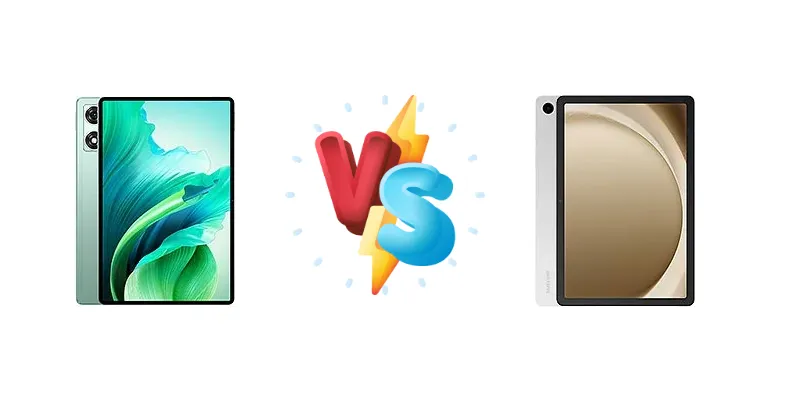
The tablet market offers a wide spectrum of choices, from premium flagships to budget-friendly options. The Oukitel OT8 and Samsung Galaxy Tab A9+ represent distinct approaches within the affordable segment. The OT8 aggressively targets users prioritizing maximum uptime, while the A9+ aims for a balance of performance, connectivity, and a more refined user experience.
🏆 Quick Verdict
For users who absolutely need the longest possible battery life and are willing to compromise on raw processing power, the Oukitel OT8 is the clear winner. However, the Samsung Galaxy Tab A9+ offers a more responsive experience thanks to its Snapdragon 695 chipset and 5G capabilities, making it the better choice for most users.
| Network |
|---|
| 2G bands | GSM 850 / 900 / 1800 / 1900 | GSM 850 / 900 / 1800 / 1900 |
| 3G bands | HSDPA 900 / 2100 | HSDPA 850 / 900 / 1700(AWS) / 1900 / 2100 |
| 4G bands | 1, 3, 7, 8, 19, 20, 38, 39, 40, 41 | 1, 2, 3, 4, 5, 7, 8, 12, 13, 17, 20, 26, 28, 38, 40, 41, 66 |
| 5G bands | - | 1, 3, 5, 7, 8, 20, 28, 38, 40, 41, 66, 77, 78 SA/NSA/Sub6 |
| Speed | HSPA, LTE | HSPA, LTE, 5G - cellular model only |
| Technology | GSM / HSPA / LTE | GSM / HSPA / LTE / 5G |
| Launch |
|---|
| Announced | 2024, January 06 | 2023, October 05 |
| Status | Available. Released 2024, January | Available. Released 2023, October 17 |
| Body |
|---|
| Dimensions | 256.8 x 168.3 x 7.8 mm (10.11 x 6.63 x 0.31 in) | 257.1 x 168.7 x 6.9 mm (10.12 x 6.64 x 0.27 in) |
| SIM | Nano-SIM + Nano-SIM | Nano-SIM + eSIM (cellular model only) |
| Weight | 515 g (1.14 lb) | 480 g or 492 g (1.06 lb) |
| Display |
|---|
| Protection | Corning Gorilla Glass 5, Mohs level 5 | - |
| Resolution | 1200 x 1920 pixels, 16:10 ratio (~206 ppi density) | 1200 x 1920 pixels, 16:10 ratio (~206 ppi density) |
| Size | 11.0 inches, 350.9 cm2 (~81.2% screen-to-body ratio) | 11.0 inches, 350.9 cm2 (~80.9% screen-to-body ratio) |
| Type | IPS LCD, 350 nits | TFT LCD, 90Hz |
| Platform |
|---|
| CPU | Octa-core (2x1.6 GHz Cortex-A75 & 6x1.6 GHz Cortex-A55) | Octa-core (2x2.2 GHz Kryo 660 Gold & 6x1.8 GHz Kryo 660 Silver) |
| Chipset | Unisoc T606 (12 nm) | Qualcomm SM6375 Snapdragon 695 5G (6 nm) |
| GPU | Mali-G57 MP1 | Adreno 619 |
| OS | Android 13 | Android 13, upgradable to Android 15, One UI 7 |
| Memory |
|---|
| Card slot | microSDXC (uses shared SIM slot) | microSDXC (dedicated slot) |
| Internal | 256GB 6GB RAM | 64GB 4GB RAM, 128GB 4GB RAM, 128GB 8GB RAM, 256GB 8GB RAM |
| Main Camera |
|---|
| Features | LED flash, panorama, HDR | - |
| Single | 13 MP, f/2.2, (wide), 1/3.06", AF | 8 MP, AF |
| Video | 1080p@30fps | 1080p@30fps |
| Selfie camera |
|---|
| Features | HDR | - |
| Single | 8 MP, f/2.2, (wide), 1/4.0" | 5 MP |
| Video | 720p@30fps | 1080p@30fps |
| Sound |
|---|
| 35mm jack | Yes | Yes |
| Loudspeaker | Yes, with stereo speakers (4 speakers) | Yes, with stereo speakers (4 speakers) |
| Comms |
|---|
| Bluetooth | 5.0, A2DP, LE | 5.1, A2DP, LE |
| NFC | No | No |
| Positioning | GPS, GLONASS, GALILEO, BDS | GPS, GLONASS, GALILEO, BDS, QZSS - cellular model only |
| Radio | No | No |
| USB | USB Type-C 2.0 | USB Type-C 2.0 |
| WLAN | Wi-Fi 802.11 a/b/g/n/ac, dual-band | Wi-Fi 802.11 a/b/g/n/ac, dual-band, Wi-Fi Direct |
| Features |
|---|
| Sensors | Accelerometer | Accelerometer, gyro, proximity (accessories only), compass |
| Battery |
|---|
| Charging | 18W wired | 15W wired |
| Type | Li-Po 8800 mAh | Li-Po 7040 mAh |
| Misc |
|---|
| Colors | Gray, Green, Purple | Graphite, Silver, Navy |
| Models | - | SM-X210, SM-X215, SM-X216B |
| Price | About 170 EUR | $ 199.99 |
| SAR | - | 0.42 W/kg (body) |
| SAR EU | - | 1.19 W/kg (body) |
| EU LABEL |
|---|
| Battery | 114:00h endurance, 1000 cycles | - |
| Energy | Class E | - |
| Free fall | Class C (104 falls) | - |
| Repairability | Class B | - |
Oukitel OT8
- Exceptional battery life (114h endurance)
- Potentially longer battery lifespan (1000 cycles)
- Slightly faster charging (18W)
- Less powerful processor (Unisoc T606)
- Likely lower build quality
- Missing display details suggest cost-cutting measures
Samsung Galaxy Tab A9+
- More powerful processor (Snapdragon 695)
- 5G connectivity for faster data speeds
- More efficient 6nm chipset
- Likely shorter battery life than Oukitel OT8
- Slower charging speed (15W)
- Potentially higher price
Display Comparison
Neither device boasts a cutting-edge display. Details on panel type, resolution, and brightness are missing for the OT8, suggesting a focus on cost reduction. The Tab A9+ likely features a standard LCD panel. The key difference lies in processing power impacting UI smoothness, not display quality. Both will likely suffice for media consumption, but neither will impress enthusiasts.
Camera Comparison
Camera performance is unlikely to be a deciding factor for either device, given their market segment. Details are lacking for the OT8's camera setup. The Tab A9+’s camera specifications are also not provided, but Samsung generally prioritizes image processing over raw sensor size in this price range. Expect adequate performance for casual snapshots, but neither tablet will challenge dedicated cameras.
Performance
The Samsung Galaxy Tab A9+ holds a significant advantage in processing power. Its Qualcomm Snapdragon 695 (6nm) is built on a smaller, more efficient node than the Oukitel OT8’s Unisoc T606 (12nm). The Snapdragon 695’s Kryo 660 Gold cores, clocked at 2.2 GHz, outperform the Cortex-A75 cores in the T606 (1.6 GHz). This translates to faster app loading times, smoother multitasking, and a more responsive user interface. While both are octa-core CPUs, the architectural differences and fabrication process give Samsung a clear edge. The 6nm process also implies better thermal management, reducing the likelihood of throttling during sustained workloads.
Battery Life
The Oukitel OT8’s standout feature is its exceptional battery endurance, rated at 114 hours. This is likely achieved through a large battery capacity (details missing) and the relatively power-efficient Unisoc T606 chipset. While the Tab A9+’s battery capacity is unknown, its Snapdragon 695, despite being more powerful, is also more efficient than the T606 due to the 6nm process. However, the OT8’s 1000-cycle battery claim suggests a focus on long-term battery health. The Tab A9+ charges at 15W, while the OT8 supports 18W charging, but the difference is marginal and won't drastically alter charging times.
Buying Guide
Buy the Oukitel OT8 if you need a tablet primarily for extended media consumption, reading, or tasks where battery life is paramount and you don't require demanding app performance. Buy the Samsung Galaxy Tab A9+ if you prefer a more versatile tablet with faster processing, 5G connectivity for on-the-go use, and a smoother overall experience for multitasking and gaming.
Frequently Asked Questions
❓ How much faster is the Snapdragon 695 in the Tab A9+ compared to the Unisoc T606 in the OT8 for gaming?
The Snapdragon 695 offers a noticeable performance uplift for gaming. Its more powerful CPU and GPU, combined with the 6nm process, will result in higher frame rates and smoother gameplay in demanding titles. While the OT8 can handle casual games, the A9+ is better suited for more graphically intensive experiences.
❓ Does the Oukitel OT8's 1000-cycle battery claim mean it will last significantly longer over its lifespan?
Yes, the 1000-cycle claim suggests the battery is designed to retain a higher percentage of its original capacity after 1000 full charge cycles compared to a standard battery. This means the OT8 should maintain usable battery life for a longer period, even with frequent charging.
❓ Is the 5G connectivity on the Samsung Galaxy Tab A9+ worth the extra cost if I primarily use Wi-Fi?
If you primarily use Wi-Fi, the 5G connectivity may not be essential. However, it provides a valuable fallback option for connectivity on the go, especially in areas with limited Wi-Fi access. It also future-proofs the device to some extent.