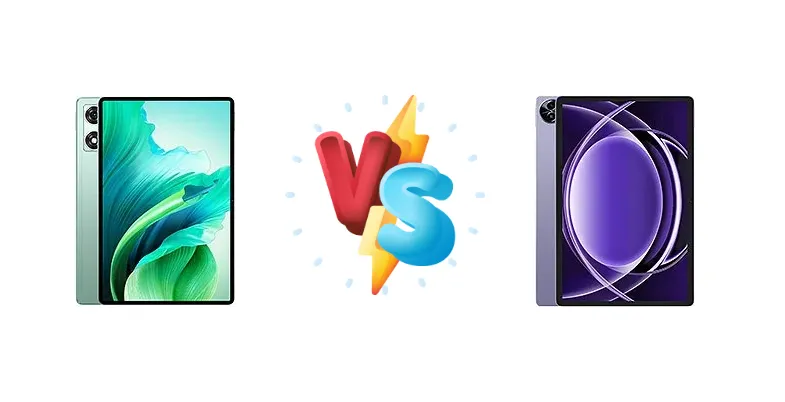
The tablet market is heating up with increasingly capable devices at competitive prices. We're pitting the Oukitel OT8, known for its impressive battery endurance claims, against the Realme Pad 2 Lite, which boasts a more modern and efficient chipset. This comparison will dissect their strengths and weaknesses to determine which tablet delivers the best overall experience.
🏆 Quick Verdict
For most users, the Realme Pad 2 Lite is the superior choice. Its Mediatek Helio G99 chipset, fabricated on a 6nm process, provides a noticeable performance advantage over the Oukitel OT8’s Unisoc T606. While the Oukitel boasts exceptional battery endurance, the Realme’s efficiency and faster charging make it a more practical daily driver.
| Network |
|---|
| 2G bands | GSM 850 / 900 / 1800 / 1900 | GSM 850 / 900 / 1800 / 1900 |
| 3G bands | HSDPA 900 / 2100 | HSDPA 850 / 900 / 2100 |
| 4G bands | 1, 3, 7, 8, 19, 20, 38, 39, 40, 41 | 1, 3, 5, 7, 8, 20, 28, 38, 40, 41 |
| Speed | HSPA, LTE | HSPA, LTE |
| Technology | GSM / HSPA / LTE | GSM / HSPA / LTE |
| Launch |
|---|
| Announced | 2024, January 06 | 2024, September 13 |
| Status | Available. Released 2024, January | Available. Released 2024, September 26 |
| Body |
|---|
| Dimensions | 256.8 x 168.3 x 7.8 mm (10.11 x 6.63 x 0.31 in) | 258 x 169.5 x 8.3 mm (10.16 x 6.67 x 0.33 in) |
| SIM | Nano-SIM + Nano-SIM | No |
| Weight | 515 g (1.14 lb) | 525 g (1.16 lb) |
| Display |
|---|
| Protection | Corning Gorilla Glass 5, Mohs level 5 | - |
| Resolution | 1200 x 1920 pixels, 16:10 ratio (~206 ppi density) | 1200 x 1920 pixels, 16:10 ratio (~207 ppi density) |
| Size | 11.0 inches, 350.9 cm2 (~81.2% screen-to-body ratio) | 10.95 inches, 347.7 cm2 (~79.5% screen-to-body ratio) |
| Type | IPS LCD, 350 nits | IPS LCD, 1B colors, 90Hz, 450 nits (peak) |
| Platform |
|---|
| CPU | Octa-core (2x1.6 GHz Cortex-A75 & 6x1.6 GHz Cortex-A55) | Octa-core (2x2.2 GHz Cortex-A76 & 6x2.0 GHz Cortex-A55) |
| Chipset | Unisoc T606 (12 nm) | Mediatek Helio G99 (6 nm) |
| GPU | Mali-G57 MP1 | Mali-G57 MC2 |
| OS | Android 13 | Android 14, Realme UI 5.0 for Pad |
| Memory |
|---|
| Card slot | microSDXC (uses shared SIM slot) | Unspecified |
| Internal | 256GB 6GB RAM | 128GB 4GB RAM, 128GB 8GB RAM |
| Main Camera |
|---|
| Features | LED flash, panorama, HDR | Panorama |
| Single | 13 MP, f/2.2, (wide), 1/3.06", AF | 8 MP, f/2.0 |
| Video | 1080p@30fps | 1080p@30fps |
| Selfie camera |
|---|
| Features | HDR | Panorama |
| Single | 8 MP, f/2.2, (wide), 1/4.0" | 5 MP, f/2.2 |
| Video | 720p@30fps | 1080p@30fps |
| Sound |
|---|
| 35mm jack | Yes | No |
| Loudspeaker | Yes, with stereo speakers (4 speakers) | Yes, with stereo speakers (4 speakers) |
| Comms |
|---|
| Bluetooth | 5.0, A2DP, LE | 5.2, A2DP, LE |
| NFC | No | No |
| Positioning | GPS, GLONASS, GALILEO, BDS | GPS, GALILEO, GLONASS, BDS |
| Radio | No | No |
| USB | USB Type-C 2.0 | USB Type-C |
| WLAN | Wi-Fi 802.11 a/b/g/n/ac, dual-band | Wi-Fi 802.11 a/b/g/n/ac, dual-band |
| Features |
|---|
| Sensors | Accelerometer | Accelerometer |
| Battery |
|---|
| Charging | 18W wired | 15W wired |
| Type | Li-Po 8800 mAh | 8300 mAh |
| Misc |
|---|
| Colors | Gray, Green, Purple | Nebula Purple, Space Grey |
| Models | - | RMP2402 |
| Price | About 170 EUR | About 160 EUR |
| EU LABEL |
|---|
| Battery | 114:00h endurance, 1000 cycles | - |
| Energy | Class E | - |
| Free fall | Class C (104 falls) | - |
| Repairability | Class B | - |
Oukitel OT8
- Exceptional battery endurance (114h claimed)
- Long battery lifespan (1000 charge cycles)
- Potentially lower price point
- Less powerful Unisoc T606 chipset
- Older 12nm manufacturing process
- Likely less refined display
Realme Pad 2 Lite
- More powerful Mediatek Helio G99 chipset
- Efficient 6nm manufacturing process
- Faster and more responsive user experience
- Lower claimed battery endurance
- Slower charging speed (15W)
- Potentially higher price
Display Comparison
Neither device's display specifications are provided, so we must infer. Given the price points, both likely utilize IPS LCD panels. However, the Realme Pad 2 Lite, being a newer device, may benefit from improved color calibration and potentially higher brightness. The Oukitel OT8, while potentially offering a larger screen size, may suffer from wider bezels and a less refined viewing experience. Without specific data, it's difficult to definitively declare a winner, but Realme's recent display improvements suggest an edge.
Camera Comparison
Neither device is positioned as a photography powerhouse, and detailed camera specs are absent. We can assume both feature basic camera setups. Without sensor size or aperture information, it’s impossible to make a meaningful comparison. However, Realme generally invests more in image processing algorithms, potentially leading to slightly better image quality in favorable lighting conditions. The absence of detailed camera specs suggests neither device should be purchased primarily for its photographic capabilities.
Performance
The Realme Pad 2 Lite’s Mediatek Helio G99 (6nm) significantly outperforms the Oukitel OT8’s Unisoc T606 (12nm). The 6nm process allows for greater transistor density and improved power efficiency, translating to better sustained performance and less thermal throttling. The Helio G99’s Cortex-A76 cores, clocked at 2.2 GHz, are also more powerful than the OT8’s Cortex-A75 cores at 1.6 GHz. This difference will be most noticeable in demanding applications like gaming and video editing. The Realme Pad 2 Lite will offer a snappier and more responsive experience.
Battery Life
The Oukitel OT8 claims an impressive 114-hour endurance and 1000 charge cycles, suggesting a large battery capacity and robust battery health management. However, the Realme Pad 2 Lite’s more efficient Helio G99 chipset, despite its lower 15W charging rate compared to the Oukitel’s 18W, may offer comparable real-world battery life with faster overall usage. The 6nm process significantly reduces power consumption. While the Oukitel excels in standby time, the Realme’s efficiency makes it more practical for active users.
Buying Guide
Buy the Oukitel OT8 if your primary need is *extreme* battery life and you prioritize longevity over raw performance. This tablet is ideal for users who frequently travel or lack consistent access to power. Buy the Realme Pad 2 Lite if you value a smoother, more responsive user experience, faster app loading times, and a more efficient chipset for everyday tasks and light gaming. It’s the better option for students, media consumers, and anyone who wants a versatile tablet.
Frequently Asked Questions
❓ Will the Unisoc T606 in the Oukitel OT8 struggle with multitasking?
Yes, the Unisoc T606 is a budget-oriented chipset. While capable of handling basic tasks, it may exhibit noticeable slowdowns when running multiple apps simultaneously or switching between them frequently. The Realme Pad 2 Lite’s Helio G99 will provide a much smoother multitasking experience.
❓ Is the 15W charging on the Realme Pad 2 Lite slow compared to other tablets?
15W charging is relatively slow by modern tablet standards, but the Helio G99’s efficiency means the Realme Pad 2 Lite doesn’t require as much frequent charging. The overall time to fully charge will be longer than with faster charging solutions, but the efficient chipset mitigates the impact.
❓ How does the 6nm process of the Helio G99 impact gaming performance on the Realme Pad 2 Lite?
The 6nm process allows the Helio G99 to maintain higher clock speeds for longer periods without overheating. This translates to more consistent frame rates and less thermal throttling during gaming sessions, providing a smoother and more enjoyable gaming experience compared to the Oukitel OT8.