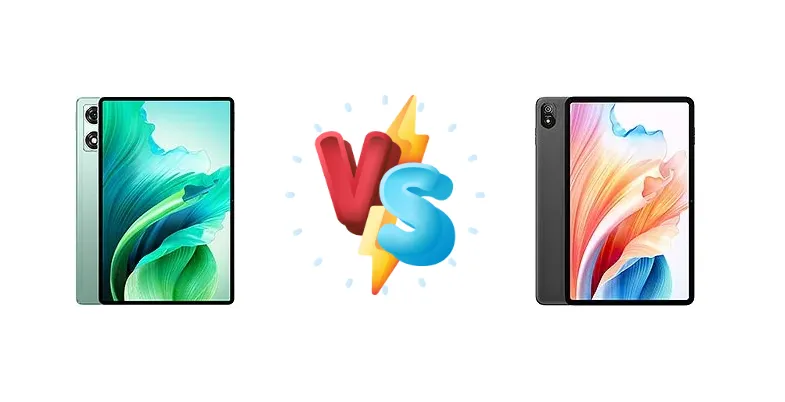
The tablet market is heating up with increasingly capable devices at competitive prices. The Oukitel OT8 focuses on exceptional battery endurance, boasting a claimed 114-hour lifespan, while the Blackview Tab 18 prioritizes processing power with the more modern MediaTek Helio G99 chipset. This comparison dissects these key differences to determine which tablet best suits your needs.
🏆 Quick Verdict
For most users, the Blackview Tab 18 emerges as the superior choice. Its Helio G99 chipset, built on a 6nm process, delivers significantly better performance than the Oukitel OT8’s Unisoc T606. While the OT8 excels in battery longevity, the Tab 18’s faster 33W charging mitigates any concerns about power depletion.
| Network |
|---|
| 2G bands | GSM 850 / 900 / 1800 / 1900 | GSM 850 / 900 / 1800 / 1900 |
| 3G bands | HSDPA 900 / 2100 | HSDPA 900 / 2100 |
| 4G bands | 1, 3, 7, 8, 19, 20, 38, 39, 40, 41 | 1, 3, 7, 8, 20, 40 |
| Speed | HSPA, LTE | HSPA, LTE |
| Technology | GSM / HSPA / LTE | GSM / HSPA / LTE |
| Launch |
|---|
| Announced | 2024, January 06 | 2023, November |
| Status | Available. Released 2024, January | Available. Released 2023, November |
| Body |
|---|
| Dimensions | 256.8 x 168.3 x 7.8 mm (10.11 x 6.63 x 0.31 in) | 277.6 x 173.2 x 7.9 mm (10.93 x 6.82 x 0.31 in) |
| SIM | Nano-SIM + Nano-SIM | Nano-SIM + Nano-SIM |
| Weight | 515 g (1.14 lb) | 632 g (1.39 lb) |
| Display |
|---|
| Protection | Corning Gorilla Glass 5, Mohs level 5 | - |
| Resolution | 1200 x 1920 pixels, 16:10 ratio (~206 ppi density) | 1200 x 2000 pixels, 5:3 ratio (~194 ppi density) |
| Size | 11.0 inches, 350.9 cm2 (~81.2% screen-to-body ratio) | 12.0 inches, 409.9 cm2 (~85.2% screen-to-body ratio) |
| Type | IPS LCD, 350 nits | IPS LCD, 350 nits |
| Platform |
|---|
| CPU | Octa-core (2x1.6 GHz Cortex-A75 & 6x1.6 GHz Cortex-A55) | Octa-core (2x2.2 GHz Cortex-A76 & 6x2.0 GHz Cortex-A55) |
| Chipset | Unisoc T606 (12 nm) | Mediatek Helio G99 (6 nm) |
| GPU | Mali-G57 MP1 | Mali-G57 MC2 |
| OS | Android 13 | Android 13, Doke OS_P 4.0 |
| Memory |
|---|
| Card slot | microSDXC (uses shared SIM slot) | microSDXC (uses shared SIM slot) |
| Internal | 256GB 6GB RAM | 256GB 12GB RAM |
| Main Camera |
|---|
| Features | LED flash, panorama, HDR | LED flash |
| Single | 13 MP, f/2.2, (wide), 1/3.06", AF | 16 MP |
| Video | 1080p@30fps | 1080p@30fps |
| Selfie camera |
|---|
| Features | HDR | - |
| Single | 8 MP, f/2.2, (wide), 1/4.0" | 8 MP |
| Video | 720p@30fps | Yes |
| Sound |
|---|
| 35mm jack | Yes | No |
| Loudspeaker | Yes, with stereo speakers (4 speakers) | Yes, with stereo speakers (4 speakers) |
| Comms |
|---|
| Bluetooth | 5.0, A2DP, LE | 5.1, A2DP, LE |
| NFC | No | No |
| Positioning | GPS, GLONASS, GALILEO, BDS | GPS, GLONASS, GALILEO, BDS |
| Radio | No | FM Radio |
| USB | USB Type-C 2.0 | USB Type-C, OTG |
| WLAN | Wi-Fi 802.11 a/b/g/n/ac, dual-band | Wi-Fi 802.11 a/b/g/n/ac, dual-band |
| Features |
|---|
| Sensors | Accelerometer | Fingerprint (side-mounted), accelerometer, gyro, proximity, compass |
| Battery |
|---|
| Charging | 18W wired | 33W wired |
| Type | Li-Po 8800 mAh | 8800 mAh |
| Misc |
|---|
| Colors | Gray, Green, Purple | Turquoise Green, Glacier Blue, Space Grey |
| Price | About 170 EUR | - |
| EU LABEL |
|---|
| Battery | 114:00h endurance, 1000 cycles | - |
| Energy | Class E | - |
| Free fall | Class C (104 falls) | - |
| Repairability | Class B | - |
Oukitel OT8
- Exceptional battery endurance (114 hours claimed)
- High charge cycle count (1000 cycles)
- Potentially lower price point
- Less powerful Unisoc T606 chipset
- Slower 18W charging
- Likely less responsive user experience
Blackview Tab 18
- More powerful MediaTek Helio G99 chipset
- Faster 33W wired charging
- Improved multitasking and gaming performance
- Potentially shorter battery life compared to OT8
- May be slightly more expensive
- Faster charging may generate more heat
Display Comparison
Neither device's display specifications are provided, so a direct comparison is limited. However, given the Tab 18's focus on performance, it's reasonable to expect a higher-quality panel with potentially a higher refresh rate. The OT8 likely targets cost-effectiveness, potentially resulting in a lower-resolution or less color-accurate display. Bezels are likely similar given the price points of both devices.
Camera Comparison
Without detailed camera specifications, a precise comparison is impossible. However, it’s safe to assume both tablets feature modest camera systems geared towards casual use. The absence of information suggests neither device will excel in photography. Focusing on the chipset, the G99 in the Tab 18 includes an ISP capable of handling more complex image processing, potentially resulting in slightly better image quality in favorable conditions. The OT8's T606 will likely offer a more basic image processing pipeline.
Performance
The Blackview Tab 18’s MediaTek Helio G99 chipset represents a substantial upgrade over the Oukitel OT8’s Unisoc T606. The G99, fabricated on a 6nm process, offers improved power efficiency and significantly higher clock speeds (2.2 GHz Cortex-A76 vs 1.6 GHz Cortex-A75). This translates to faster app loading times, smoother multitasking, and a more enjoyable gaming experience. The G99’s architecture, with its newer Cortex-A76 cores, provides a noticeable performance boost over the older A75 cores in the T606. While both are octa-core CPUs, the architectural differences are critical.
Battery Life
The Oukitel OT8’s standout feature is its claimed 114-hour endurance and 1000 charge cycles. This suggests a large battery capacity optimized for longevity. However, the Blackview Tab 18 compensates for potentially lower endurance with significantly faster 33W wired charging, compared to the OT8’s 18W. This means the Tab 18 can regain a substantial charge in a much shorter timeframe. While the OT8 may last longer on a single charge, the Tab 18’s faster charging reduces downtime and offers greater convenience.
Buying Guide
Buy the Oukitel OT8 if your primary use case revolves around extended offline media consumption – think long flights or remote locations – and you prioritize maximizing time between charges above all else. Buy the Blackview Tab 18 if you need a tablet capable of smoother multitasking, gaming, and a more responsive user experience, and value faster charging to quickly replenish power.
Frequently Asked Questions
❓ Will the Blackview Tab 18’s Helio G99 chipset experience thermal throttling during extended gaming sessions?
While the Helio G99 is a capable chipset, sustained high loads can generate heat. However, the 6nm process node is more efficient than the 12nm node of the Unisoc T606, suggesting the Tab 18 will likely manage heat better and experience less throttling than the OT8 under similar conditions. Active cooling solutions are unlikely in this price segment, so throttling is still possible.
❓ How long will it realistically take to fully charge the Oukitel OT8 with its 18W charging?
Given the likely large battery capacity required to achieve 114 hours of endurance, a full charge with 18W charging will likely take between 3-5 hours. While the endurance is impressive, the charging speed is a significant trade-off. The Blackview Tab 18’s 33W charging will significantly reduce this charging time.
❓ Is the difference in CPU architecture (Cortex-A75 vs Cortex-A76) noticeable in everyday tasks?
Yes, the Cortex-A76 cores in the Blackview Tab 18’s Helio G99 offer a noticeable improvement in single-core performance compared to the Cortex-A75 cores in the Oukitel OT8’s Unisoc T606. This translates to snappier app launches, smoother scrolling, and a more responsive overall user experience, even in everyday tasks like browsing and email.