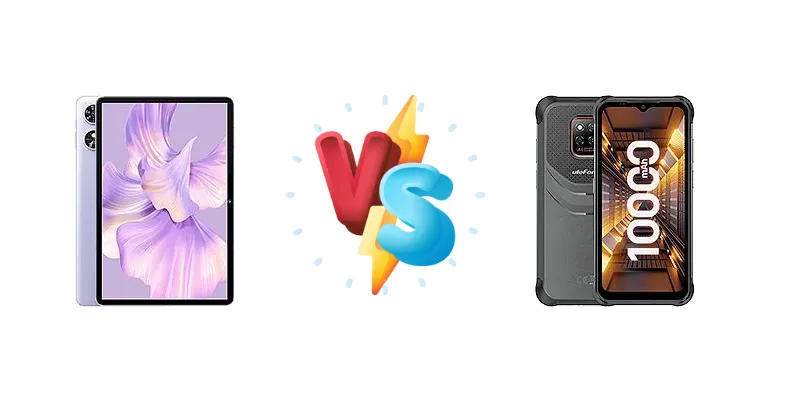
The rugged smartphone market caters to a specific need: durability. Both the Oukitel OT6 and Ulefone Power Armor 14 Pro aim to deliver on that promise, but they diverge significantly in their approach to processing power and charging capabilities. The OT6 prioritizes extreme longevity, while the 14 Pro focuses on a more responsive user experience.
🏆 Quick Verdict
For the average user needing a reliable, durable phone, the Ulefone Power Armor 14 Pro is the better choice. Its Helio G85 chipset provides a substantial performance uplift over the OT6’s RK3562, and the inclusion of 18W wired and 15W wireless charging offers significantly faster replenishment than the OT6’s 10W wired charging.
| Network |
|---|
| 2G bands | N/A | GSM 850 / 900 / 1800 / 1900 |
| 3G bands | N/A | HSDPA 850 / 900 / 1700(AWS) / 1900 / 2100 |
| 4G bands | N/A | 1, 2, 3, 4, 5, 7, 8, 12, 13, 17, 18, 19, 20, 25, 26, 28, 38, 40 |
| EDGE | No | - |
| GPRS | No | - |
| Speed | - | HSPA, LTE |
| Technology | No cellular connectivity | GSM / HSPA / LTE |
| Launch |
|---|
| Announced | 2024, March | 2022, March 09 |
| Status | Available. Released 2024, March | Available. Released 2022, March 09 |
| Body |
|---|
| Dimensions | 246.1 x 162.8 x 9.6 mm (9.69 x 6.41 x 0.38 in) | 175.6 x 82.5 x 17.2 mm (6.91 x 3.25 x 0.68 in) |
| SIM | No | Nano-SIM + Nano-SIM |
| Weight | 553 g (1.22 lb) | 358.2 g (12.63 oz) |
| | - | IP68 dust/water resistant (up to 1.5m for 30 min)
Drop-to-concrete resistance from up to 1.5m
MIL-STD-810G compliant |
| Display |
|---|
| Protection | Mohs level 4 | Corning Gorilla Glass 3 |
| Resolution | 800 x 1280 pixels, 16:10 ratio (~149 ppi density) | 720 x 1600 pixels, 20:9 ratio (~269 ppi density) |
| Size | 10.1 inches, 295.8 cm2 (~73.8% screen-to-body ratio) | 6.52 inches, 102.6 cm2 (~70.8% screen-to-body ratio) |
| Type | IPS LCD, 330 nits | IPS LCD |
| Platform |
|---|
| CPU | Quad-core 2.0 GHz Cortex-A53 | Octa-core (2x2.0 GHz Cortex-A75 & 6x1.8 GHz Cortex-A55) |
| Chipset | RK3562 (22 nm) | Mediatek MT6769Z Helio G85 (12 nm) |
| GPU | Mali-G52 2EE | Mali-G52 MC2 |
| OS | Android 13 | Android 12 |
| Memory |
|---|
| Card slot | microSDXC | microSDXC (uses shared SIM slot) |
| Internal | 64GB 4GB RAM | 128GB 6GB RAM, 128GB 8GB RAM |
| | - | eMMC 5.1 |
| Main Camera |
|---|
| Features | LED flash | LED flash, HDR, panorama |
| Single | 5 MP, f/2.0, AF | 16 MP, f/2.2 |
| Triple | - | 20 MP, f/1.8, 26mm (wide), 1/2.78", 1.0µm, PDAF
2 MP (macro)
Auxiliary lens |
| Video | Yes | 1080p@30fps |
| Selfie camera |
|---|
| Features | - | HDR, panorama |
| Single | 2 MP, f/2.8 | 16 MP, f/2.2 |
| Video | Yes | 1080p@30fps |
| Sound |
|---|
| 3.5mm jack | - | Yes |
| 35mm jack | Yes | Yes |
| Loudspeaker | Yes, with stereo speakers | Yes |
| Comms |
|---|
| Bluetooth | 5.0, A2DP, LE | 5.0, A2DP, LE |
| NFC | No | Yes |
| Positioning | No | GPS, GLONASS, GALILEO, BDS |
| Radio | No | FM radio, RDS, recording |
| USB | USB Type-C | USB Type-C 2.0, OTG |
| WLAN | Wi-Fi 802.11 a/b/g/n/ac/6, dual-band | Wi-Fi 802.11 a/b/g/n/ac, dual-band |
| Features |
|---|
| Sensors | Accelerometer | Fingerprint (side-mounted), accelerometer, proximity, compass |
| Battery |
|---|
| Charging | 10W wired | 18W wired
15W wireless |
| Type | 8000 mAh | Li-Po 10000 mAh |
| Misc |
|---|
| Colors | Green, Gray, Purple | Black |
| Price | About 90 EUR | About 260 EUR |
| EU LABEL |
|---|
| Battery | 112:48h endurance, 1000 cycles | - |
| Energy | Class E | - |
| Free fall | Class C (104 falls) | - |
| Repairability | Class B | - |
Oukitel OT6
- Exceptional battery endurance (112:48h)
- Long battery lifespan (1000 cycles)
- Rugged design for durability
- Slow 10W charging
- Underpowered RK3562 chipset
- Limited performance for demanding tasks
Ulefone Power Armor 14 Pro
- Faster 18W wired and 15W wireless charging
- More powerful Mediatek Helio G85 chipset
- Improved performance for gaming and multitasking
- Likely better camera capabilities
- Potentially shorter battery life compared to OT6
- May be more expensive than the OT6
- Rugged design may add bulk
Display Comparison
Neither device’s display specifications are provided, so a direct comparison is limited. However, given the price points, we can assume both utilize IPS LCD panels. The Ulefone, being a more recent release, likely benefits from improved color calibration and potentially higher peak brightness. The OT6, focusing on longevity, may prioritize power efficiency over display fidelity.
Camera Comparison
Without detailed camera specifications, a precise comparison is difficult. However, the market segment suggests the Ulefone Power Armor 14 Pro likely features a more capable primary sensor. The OT6 likely relies on a simpler camera setup focused on basic image capture. The absence of information regarding OIS or aperture sizes makes a definitive assessment impossible, but the 14 Pro’s chipset suggests more advanced image processing capabilities.
Performance
The Ulefone Power Armor 14 Pro’s Mediatek Helio G85 (12nm) represents a significant leap in processing power compared to the Oukitel OT6’s RK3562 (22nm). The Helio G85’s octa-core configuration – featuring two Cortex-A75 cores clocked at 2.0 GHz and six Cortex-A55 cores at 1.8 GHz – provides a much more responsive experience for multitasking and gaming. The RK3562’s quad-core Cortex-A53 at 2.0 GHz is geared towards basic functionality and will struggle with more demanding applications. The 12nm process node of the Helio G85 also contributes to better thermal efficiency, reducing the likelihood of throttling under sustained load.
Battery Life
The Oukitel OT6 boasts an impressive 112:48h endurance rating and a 1000-cycle battery lifespan, indicating a focus on long-term battery health and extended usage between charges. However, its 10W wired charging is comparatively slow. The Ulefone Power Armor 14 Pro, while potentially having a smaller battery capacity (not specified), compensates with faster 18W wired and 15W wireless charging. This allows for quicker top-ups, making it more convenient for users who prefer not to wait hours for a full charge. The wireless charging capability is a significant advantage for the 14 Pro.
Buying Guide
Buy the Oukitel OT6 if your primary need is absolute battery endurance and you prioritize days of use over app responsiveness. This phone is ideal for infrequent users or those working in areas with limited access to power. Buy the Ulefone Power Armor 14 Pro if you require a more modern, capable smartphone experience with faster charging and the ability to handle demanding tasks like gaming or video editing, even within a rugged form factor.
Frequently Asked Questions
❓ Is the Helio G85 in the Ulefone Power Armor 14 Pro capable of playing demanding games like PUBG or Call of Duty?
Yes, the Helio G85 is a gaming-focused chipset. While it won't deliver flagship-level performance, it's capable of running PUBG and Call of Duty at medium to high settings with acceptable frame rates. The RK3562 in the Oukitel OT6 would struggle with these titles.
❓ How long does it realistically take to fully charge the Oukitel OT6 with its 10W charging?
With 10W charging, a full charge from 0% on the Oukitel OT6 will likely take between 4-6 hours, depending on background processes. This is a significant drawback compared to the Ulefone Power Armor 14 Pro’s faster charging options.
❓ Does the Ulefone Power Armor 14 Pro's wireless charging work with any Qi-compatible charger?
Yes, the Ulefone Power Armor 14 Pro supports standard Qi wireless charging, meaning it will work with most Qi-compatible wireless chargers available on the market. However, charging speeds may vary depending on the charger's output.
❓ Given the RK3562's age, will the Oukitel OT6 receive software updates?
Software update support for the Oukitel OT6 is uncertain. The RK3562 is an older chipset, and Oukitel may prioritize newer devices for updates. Users should not expect frequent or long-term software support.