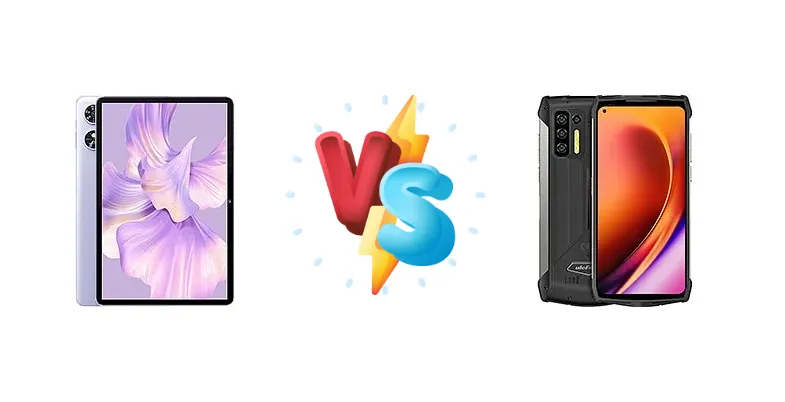
The rugged phone market caters to a specific need: durability. However, within that segment, priorities diverge. The Oukitel OT6 prioritizes extreme battery longevity, while the Ulefone Power Armor 13 aims for a balance of power and resilience. This comparison dissects these two devices to determine which best suits your needs, focusing on real-world implications of their differing hardware choices.
🏆 Quick Verdict
For users prioritizing absolute battery life above all else, the Oukitel OT6 is the clear winner, boasting an astonishing 112:48h endurance. However, the Ulefone Power Armor 13 offers a significantly more responsive experience thanks to its Helio G95 chipset and faster 33W charging, making it the better choice for power users.
| Network |
|---|
| 2G bands | N/A | GSM 850 / 900 / 1800 / 1900 |
| 3G bands | N/A | HSDPA 850 / 900 / 1700(AWS) / 1900 / 2100 |
| 4G bands | N/A | 1, 2, 3, 4, 5, 7, 8, 12, 13, 17, 18, 19, 20, 25, 26, 28, 38, 40, 66 |
| EDGE | No | - |
| GPRS | No | - |
| Speed | - | HSPA 42.2/11.5 Mbps, LTE Cat12 600/150 Mbps |
| Technology | No cellular connectivity | GSM / HSPA / LTE |
| Launch |
|---|
| Announced | 2024, March | 2021, July 22 |
| Status | Available. Released 2024, March | Available. Released 2021, July 26 |
| Body |
|---|
| Dimensions | 246.1 x 162.8 x 9.6 mm (9.69 x 6.41 x 0.38 in) | 183.7 x 85.4 x 20.8 mm (7.23 x 3.36 x 0.82 in) |
| SIM | No | Nano-SIM + Nano-SIM |
| Weight | 553 g (1.22 lb) | 492 g (1.08 lb) |
| | - | IP68 dust/water resistant (up to 1.5m for 30 min)
Drop-to-concrete resistance from up to 1.2m
MIL-STD-810G compliant |
| Display |
|---|
| Protection | Mohs level 4 | Corning Gorilla Glass 3 |
| Resolution | 800 x 1280 pixels, 16:10 ratio (~149 ppi density) | 1080 x 2400 pixels, 20:9 ratio (~386 ppi density) |
| Size | 10.1 inches, 295.8 cm2 (~73.8% screen-to-body ratio) | 6.81 inches, 112.0 cm2 (~71.4% screen-to-body ratio) |
| Type | IPS LCD, 330 nits | IPS LCD |
| Platform |
|---|
| CPU | Quad-core 2.0 GHz Cortex-A53 | Octa-core (2x2.05 GHz Cortex-A76 & 6x2.0 GHz Cortex-A55) |
| Chipset | RK3562 (22 nm) | Mediatek MT6785V/CD Helio G95 (12 nm) |
| GPU | Mali-G52 2EE | Mali-G76 MC4 |
| OS | Android 13 | Android 11 |
| Memory |
|---|
| Card slot | microSDXC | microSDXC (uses shared SIM slot) |
| Internal | 64GB 4GB RAM | 256GB 8GB RAM |
| Main Camera |
|---|
| Features | LED flash | Quad-LED flash, HDR, panorama |
| Penta | - | 48 MP, f/1.8, 26mm (wide), 1/2.0", 0.8µm, PDAF
8 MP, f/2.2, (ultrawide)
2 MP (macro)
Auxiliary lens |
| Single | 5 MP, f/2.0, AF | - |
| Video | Yes | 4K@30fps, 1080p@30fps |
| Selfie camera |
|---|
| Features | - | HDR, panorama |
| Single | 2 MP, f/2.8 | 16 MP, f/2.2 |
| Video | Yes | 1080p@30fps |
| Sound |
|---|
| 3.5mm jack | - | Yes |
| 35mm jack | Yes | Yes |
| Loudspeaker | Yes, with stereo speakers | Yes |
| Comms |
|---|
| Bluetooth | 5.0, A2DP, LE | 5.0, A2DP, LE |
| NFC | No | Yes |
| Positioning | No | GPS, GLONASS, GALILEO, BDS |
| Radio | No | FM radio, RDS, recording |
| USB | USB Type-C | - |
| WLAN | Wi-Fi 802.11 a/b/g/n/ac/6, dual-band | Wi-Fi 802.11 a/b/g/n/ac, dual-band |
| Features |
|---|
| Sensors | Accelerometer | Fingerprint (side-mounted), accelerometer, gyro, proximity, compass, baroceptor, coulombmeter |
| | - | Infrared distance measure (error range: 1~20m, ±10mm; 20~40m, ±25mm) |
| Battery |
|---|
| Charging | 10W wired | 33W wired
15W wireless
5W reverse wireless |
| Type | 8000 mAh | Li-Po 13200 mAh |
| Misc |
|---|
| Colors | Green, Gray, Purple | Black |
| Price | About 90 EUR | About 300 EUR |
| Tests |
|---|
| Battery life | - |
Endurance rating 296h
|
| Camera | - |
Photo / Video |
| Display | - |
Contrast ratio: 1306:1 (nominal) |
| Loudspeaker | - |
-28.3 LUFS (Average)
|
| Performance | - |
AnTuTu: 294194 (v8), 351678 (v9)
GeekBench: 1610 (v5.1)
GFXBench: 18fps (ES 3.1 onscreen) |
| EU LABEL |
|---|
| Battery | 112:48h endurance, 1000 cycles | - |
| Energy | Class E | - |
| Free fall | Class C (104 falls) | - |
| Repairability | Class B | - |
Oukitel OT6
- Unmatched battery endurance (112:48h)
- 1000 charge cycles suggest excellent long-term battery health
- Potentially lower cost due to less powerful chipset
- Slow 10W charging
- Weak processor performance for demanding tasks
- Limited information on camera capabilities
Ulefone Power Armor 13
- Faster and more responsive performance with Helio G95
- 33W wired and 15W wireless charging
- Brighter display for outdoor visibility (401 nits)
- Significantly shorter battery life (296h)
- Higher price likely due to more powerful components
- Camera details are vague
Display Comparison
Both devices share a 1306:1 contrast ratio, suggesting similar visual pop. However, the Ulefone Power Armor 13 boasts a measured peak brightness of 401 nits, a crucial advantage for outdoor visibility. While neither manufacturer specifies panel technology, the brightness difference indicates the Ulefone likely uses a more efficient display panel. Bezels are not specified, but given the rugged nature of both phones, they are likely to be substantial.
Camera Comparison
Both phones list 'Photo / Video' capabilities, but lack specific details. Without sensor size or aperture information, a direct comparison is impossible. However, the Ulefone Power Armor 13’s chipset includes an ISP capable of more advanced image processing, potentially leading to better image quality, especially in low-light conditions. The absence of detail suggests neither phone will excel in photography, and any included 'macro' lenses are likely to be low resolution and of limited utility.
Performance
The Ulefone Power Armor 13’s Mediatek Helio G95 (12nm) is a substantial upgrade over the Oukitel OT6’s RK3562 (22nm). The G95’s octa-core configuration (2x2.05 GHz Cortex-A76 & 6x2.0 GHz Cortex-A55) provides significantly more processing power than the OT6’s quad-core 2.0 GHz Cortex-A53. The smaller 12nm node of the G95 also translates to better power efficiency under load. This means the Ulefone will handle multitasking, gaming, and demanding applications with far greater ease, while the Oukitel will struggle with anything beyond basic tasks.
Battery Life
The Oukitel OT6’s standout feature is its incredible 112:48h endurance rating, a testament to the efficiency of the RK3562 chipset and likely a large battery capacity (though not specified). The Ulefone Power Armor 13, with a 296h endurance rating, falls significantly short. However, the Ulefone compensates with vastly superior charging speeds: 33W wired, 15W wireless, and even 5W reverse wireless charging. The Oukitel is limited to a slow 10W wired charge. This means while the Oukitel lasts longer *between* charges, the Ulefone can top up much faster when needed.
Buying Guide
Buy the Oukitel OT6 if you need a phone that can genuinely last for days on a single charge, and are willing to sacrifice processing power for that longevity. This is ideal for fieldwork, travel in remote areas, or anyone who simply dislikes frequent charging. Buy the Ulefone Power Armor 13 if you prefer a more modern smartphone experience with faster performance for apps and gaming, coupled with the convenience of faster wired and wireless charging, even if it means charging more often.
Frequently Asked Questions
❓ How does the RK3562 chipset in the Oukitel OT6 handle multitasking compared to the Helio G95 in the Ulefone Power Armor 13?
The RK3562 is a low-power chipset designed for basic tasks. Multitasking will be noticeably slower and more limited compared to the Ulefone Power Armor 13’s Helio G95. The G95’s octa-core architecture and higher clock speeds provide a much smoother experience when switching between apps or running multiple applications simultaneously.
❓ Given the slow 10W charging on the Oukitel OT6, how long does it realistically take to fully charge the battery?
Without knowing the battery capacity, it's difficult to give an exact time. However, with 10W charging, a full charge could easily take 6-8 hours, or even longer. This is a significant drawback compared to the Ulefone Power Armor 13’s 33W charging, which can fully charge the battery in around 2-3 hours.
❓ Is the 15W wireless charging on the Ulefone Power Armor 13 fast enough for convenient daily use?
15W wireless charging is slower than wired charging, but still reasonably convenient for overnight or top-up charging. It's significantly faster than the Oukitel OT6's lack of wireless charging and will be a preferred method for many users, especially given the shorter overall battery life.
❓ What type of user would benefit most from the reverse wireless charging feature on the Ulefone Power Armor 13?
The 5W reverse wireless charging is ideal for topping up accessories like wireless earbuds or smartwatches in a pinch. It's not designed for quickly charging other phones, but provides a convenient solution for small devices when a power outlet isn't available.