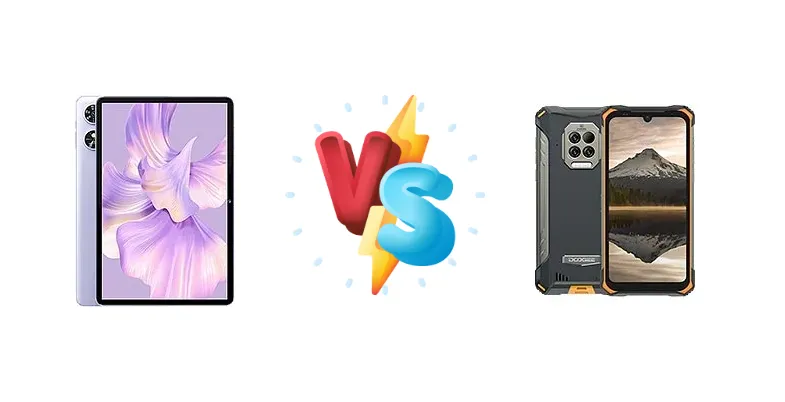
The rugged smartphone market caters to a specific need: durability. Both the Oukitel OT6 and Doogee S86 Pro aim to deliver that, but they take different approaches. The OT6 prioritizes extreme battery longevity, while the S86 Pro focuses on providing a more responsive user experience with a more powerful chipset and faster charging. This comparison dissects these choices to help you determine which aligns best with your priorities.
🏆 Quick Verdict
For users prioritizing absolute battery life and long-term device ownership, the Oukitel OT6 is the clear winner. Its 112:48h endurance significantly outlasts the S86 Pro. However, if you value a smoother, more responsive interface and faster charging, the Doogee S86 Pro is the better choice, despite the battery trade-off.
| Network |
|---|
| 2G bands | N/A | GSM 850 / 900 / 1800 / 1900 |
| 3G bands | N/A | HSDPA 850 / 900 / 1700(AWS) / 1900 / 2100 |
| 4G bands | N/A | 1, 2, 3, 4, 5, 7, 8, 12, 13, 17, 19, 20, 25, 26, 28, 66 |
| EDGE | No | - |
| GPRS | No | - |
| Speed | - | HSPA, LTE |
| Technology | No cellular connectivity | GSM / HSPA / LTE |
| Launch |
|---|
| Announced | 2024, March | 2021, June 04 |
| Status | Available. Released 2024, March | Available. Released 2021, June 15 |
| Body |
|---|
| Dimensions | 246.1 x 162.8 x 9.6 mm (9.69 x 6.41 x 0.38 in) | 164.6 x 81.2 x 16.8 mm (6.48 x 3.20 x 0.66 in) |
| SIM | No | Nano-SIM + Nano-SIM |
| Weight | 553 g (1.22 lb) | 323 g (11.39 oz) |
| Display |
|---|
| Protection | Mohs level 4 | Corning Gorilla Glass |
| Resolution | 800 x 1280 pixels, 16:10 ratio (~149 ppi density) | 720 x 1560 pixels, 19.5:9 ratio (~282 ppi density) |
| Size | 10.1 inches, 295.8 cm2 (~73.8% screen-to-body ratio) | 6.1 inches, 91.3 cm2 (~68.3% screen-to-body ratio) |
| Type | IPS LCD, 330 nits | IPS LCD |
| Platform |
|---|
| CPU | Quad-core 2.0 GHz Cortex-A53 | Octa-core (4x2.0 GHz Cortex-A73 & 4x2.0 GHz Cortex-A53) |
| Chipset | RK3562 (22 nm) | Mediatek MT6771 Helio P60 (12 nm) |
| GPU | Mali-G52 2EE | Mali-G72 MP3 |
| OS | Android 13 | Android 10 |
| Memory |
|---|
| Card slot | microSDXC | microSDXC (uses shared SIM slot) |
| Internal | 64GB 4GB RAM | 128GB 8GB RAM |
| Main Camera |
|---|
| Features | LED flash | Quad-LED flash, HDR, panorama |
| Single | 5 MP, f/2.0, AF | - |
| Triple | - | 16 MP, f/2.0, (wide), PDAF
8 MP, f/2.2, 130˚, (ultrawide)
2 MP (macro) |
| Video | Yes | 1080p |
| Selfie camera |
|---|
| Single | 2 MP, f/2.8 | 8 MP, f/2.2, (wide) |
| Video | Yes | 1080p |
| Sound |
|---|
| 35mm jack | Yes | Yes |
| Loudspeaker | Yes, with stereo speakers | Yes |
| Comms |
|---|
| Bluetooth | 5.0, A2DP, LE | 5.0, A2DP, LE |
| NFC | No | Yes |
| Positioning | No | GPS, GLONASS, BDS, GALILEO |
| Radio | No | FM radio |
| USB | USB Type-C | USB Type-C 2.0, OTG |
| WLAN | Wi-Fi 802.11 a/b/g/n/ac/6, dual-band | Wi-Fi 802.11 a/b/g/n |
| Features |
|---|
| Sensors | Accelerometer | Fingerprint (side-mounted), accelerometer, gyro, proximity, compass, infrared thermometer (surface temperature) |
| Battery |
|---|
| Charging | 10W wired | 24W wired |
| Type | 8000 mAh | 8500 mAh |
| Misc |
|---|
| Colors | Green, Gray, Purple | Black, Orange, Red |
| Price | About 90 EUR | About 230 EUR |
| EU LABEL |
|---|
| Battery | 112:48h endurance, 1000 cycles | - |
| Energy | Class E | - |
| Free fall | Class C (104 falls) | - |
| Repairability | Class B | - |
Oukitel OT6
- Exceptional battery life (112:48h endurance)
- Long-term battery health (1000 charge cycles)
- Power-efficient RK3562 chipset
- Slow 10W charging
- Less powerful processor for demanding tasks
- Limited display details suggest a basic screen
Doogee S86 Pro
- Faster 24W wired charging
- More powerful Mediatek Helio P60 chipset
- Octa-core processor for smoother multitasking
- Shorter battery life compared to Oukitel OT6
- Less information on battery health longevity
- Potentially higher thermal throttling under sustained load
Display Comparison
Neither device's display specifications are provided, so a direct comparison is impossible. However, given the price points and target market, it's reasonable to assume both utilize LCD panels. The absence of details like resolution, refresh rate, or brightness suggests neither phone is aiming for display excellence. Users should expect functional, rather than stunning, visual experiences.
Camera Comparison
Without detailed camera specifications, a comprehensive comparison is limited. However, the market segment suggests both phones will feature modest camera systems. The absence of information regarding sensor size or optical image stabilization (OIS) indicates neither phone is a photography powerhouse. Users should expect acceptable image quality in good lighting conditions, but performance will likely degrade significantly in low-light scenarios. The inclusion of a 2MP macro lens on either device is likely a marketing gimmick, offering minimal practical benefit.
Performance
The Doogee S86 Pro’s Mediatek Helio P60 chipset represents a significant architectural advantage over the Oukitel OT6’s RK3562. The P60 utilizes an octa-core configuration (4x2.0 GHz Cortex-A73 & 4x2.0 GHz Cortex-A53) built on a more efficient 12nm process, compared to the OT6’s quad-core 2.0 GHz Cortex-A53 on a 22nm node. This translates to noticeably faster application loading times, smoother multitasking, and improved performance in graphically intensive tasks. While both have Cortex-A53 cores, the A73 cores in the P60 provide a substantial performance boost. The RK3562 prioritizes power efficiency, making it suitable for basic tasks, but it will struggle with demanding applications.
Battery Life
The Oukitel OT6’s standout feature is its exceptional battery endurance, rated at 112:48h. This is significantly longer than what’s typically offered by smartphones in this price range. The 10W wired charging is slow by modern standards, but the focus is clearly on maximizing runtime. Conversely, the Doogee S86 Pro offers 24W wired charging, enabling significantly faster top-ups. While the battery capacity isn’t specified, the faster charging speed suggests a smaller battery, prioritizing quicker replenishment over extended longevity. The OT6’s 1000 charge cycles also suggest a focus on long-term battery health.
Buying Guide
Buy the Oukitel OT6 if you need a phone that can reliably last for days on a single charge, are frequently away from power outlets, or require a device for emergency preparedness. Buy the Doogee S86 Pro if you prefer a more fluid multitasking experience, frequently use demanding apps, or value the convenience of 24W fast charging over maximum battery runtime.
Frequently Asked Questions
❓ Is the RK3562 chipset in the Oukitel OT6 sufficient for playing modern mobile games?
The RK3562 is a power-efficient chipset designed for basic tasks. While it can handle some lighter games, it will likely struggle with graphically demanding titles. Expect low frame rates and potential lag in modern mobile games. The Doogee S86 Pro’s Helio P60 is a much better choice for gaming.
❓ How long does it realistically take to fully charge the Doogee S86 Pro with the 24W charger?
While the exact 0-100% charge time isn't specified, 24W charging should significantly reduce charging times compared to the Oukitel OT6’s 10W charging. Expect a full charge in approximately 2-3 hours, depending on usage during charging. This is a key advantage for users who prioritize quick top-ups.
❓ Does the Oukitel OT6's long battery life come at the cost of significant weight or thickness?
The context data doesn't provide dimensions. However, larger battery capacities often necessitate larger phone bodies. It's reasonable to assume the Oukitel OT6 is slightly heavier and thicker than the Doogee S86 Pro to accommodate its significantly larger battery.