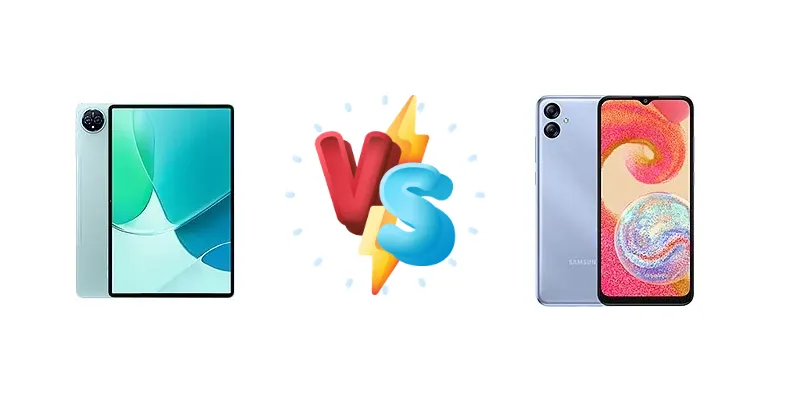
The sub-$150 smartphone market is fiercely competitive. Both the Oukitel OT12 and Samsung Galaxy A04e aim to deliver essential smartphone functionality at an accessible price point. However, they take different approaches to achieving this, primarily through differing chipset choices. This comparison dissects those choices and reveals which phone offers the best value for your money.
🏆 Quick Verdict
For the average user prioritizing brand reliability and a generally smoother, if less powerful, experience, the Samsung Galaxy A04e is the safer bet. However, the Oukitel OT12 offers a potentially more responsive CPU experience thanks to its Cortex-A75 cores, making it a compelling option for those willing to trade brand recognition for raw processing power.
| Network |
|---|
| 2G bands | GSM 850 / 900 / 1800 / 1900 | GSM 850 / 900 / 1800 / 1900 |
| 3G bands | HSDPA 900 / 2100 | HSDPA 850 / 900 / 2100 |
| 4G bands | 1, 3, 5, 7, 8, 19, 20, 38, 39, 40, 41 | 1, 3, 5, 7, 8, 20, 28, 38, 40, 41 |
| Speed | HSPA, LTE | HSPA, LTE |
| Technology | GSM / HSPA / LTE | GSM / HSPA / LTE |
| Launch |
|---|
| Announced | 2024, September | 2022, October 21 |
| Status | Available. Released 2024, September | Available. Released 2022, November 07 |
| Body |
|---|
| Build | - | Glass front, plastic back, plastic frame |
| Dimensions | 258.2 x 169.5 x 8.6 mm (10.17 x 6.67 x 0.34 in) | 164.2 x 75.9 x 9.1 mm (6.46 x 2.99 x 0.36 in) |
| SIM | Nano-SIM + Nano-SIM | · Nano-SIM· Nano-SIM + Nano-SIM |
| Weight | 535 g (1.18 lb) | 188 g (6.63 oz) |
| Display |
|---|
| Protection | Corning Gorilla Glass 5 | - |
| Resolution | 800 x 1280 pixels, 16:10 ratio (~137 ppi density) | 720 x 1600 pixels, 20:9 ratio (~270 ppi density) |
| Size | 11.0 inches, 350.9 cm2 (~80.2% screen-to-body ratio) | 6.5 inches, 102.0 cm2 (~81.8% screen-to-body ratio) |
| Type | IPS LCD, 400 nits | PLS LCD |
| Platform |
|---|
| CPU | Octa-core (2x1.6 GHz Cortex-A75 & 6x1.6 GHz Cortex-A55) | Octa-core (4x2.3 GHz Cortex-A53 & 4x1.8 GHz Cortex-A53) |
| Chipset | Unisoc T606 (12 nm) | Mediatek MT6765 Helio P35 (12 nm) |
| GPU | Mali-G57 MP1 | PowerVR GE8320 |
| OS | Android 14 | Android 12, One UI Core 4.1 |
| Memory |
|---|
| Card slot | microSDXC (uses shared SIM slot) | microSDXC (dedicated slot) |
| Internal | 256GB 4GB RAM | 32GB 2GB RAM, 32GB 3GB RAM, 32GB 4GB RAM, 64GB 2GB RAM, 64GB 3GB RAM, 64GB 4GB RAM, 128GB 4GB RAM |
| Main Camera |
|---|
| Dual | 13 MP, f/2.2, (wide), 1/3.06", PDAF
other unspecified camera | 13 MP, f/2.2, (wide), AF
Auxiliary lens |
| Features | LED flash | LED flash |
| Single | - | 5 MP, f/2.2 |
| Video | 1080p@30fps | 1080p@30fps |
| Selfie camera |
|---|
| Single | 5 MP, f/2.2, (wide), 1/5.0" | 5 MP, f/2.2 |
| Video | 720p@30fps | Yes |
| Sound |
|---|
| 3.5mm jack | - | Yes |
| 35mm jack | Yes | Yes |
| Loudspeaker | Yes, with stereo speakers | Yes |
| Comms |
|---|
| Bluetooth | 5.0, A2DP, LE | 5.0, A2DP, LE |
| NFC | No | No |
| Positioning | GPS, GLONASS, GALILEO, BDS | GPS, GLONASS, GALILEO, BDS |
| Radio | FM radio | Unspecified |
| USB | USB Type-C 2.0, OTG | USB Type-C 2.0, OTG |
| WLAN | Wi-Fi 802.11 a/b/g/n/ac, dual-band | Wi-Fi 802.11 b/g/n, Wi-Fi Direct |
| Features |
|---|
| Sensors | Accelerometer | Accelerometer, proximity |
| Battery |
|---|
| Charging | 10W wired | - |
| Type | Li-Po 8000 mAh | Li-Po 5000 mAh |
| Misc |
|---|
| Colors | Gray, Green, Purple | Black, Copper, Light Blue |
| Models | - | SM-A042F, SM-A042F/DS, SM-A042M, SM-A042M/DS |
| Price | About 180 EUR | ₹ 7,999 |
| SAR EU | - | 0.29 W/kg (head) 1.11 W/kg (body) |
Oukitel OT12
- Potentially faster CPU performance due to Cortex-A75 cores
- Unisoc T606 offers a more modern CPU architecture
- May offer better value for performance-focused users
- Less established brand reputation
- Slower 10W charging
- Software updates may be less frequent
Samsung Galaxy A04e
- Strong brand recognition and reliability (Samsung)
- Potentially better software optimization and support
- Likely more refined camera image processing
- Helio P35 chipset is older and less efficient
- CPU performance may feel slower in demanding tasks
- May be slightly more expensive for comparable specs
Display Comparison
Neither device boasts a standout display. Both utilize 12nm chipsets, suggesting a focus on cost-effectiveness over premium display features. Specifics like panel type (IPS vs. TFT) and resolution are missing, but we can assume both are aiming for 720p+ resolutions to balance clarity and battery life. Bezels are likely to be substantial on both, typical of this price bracket. Color accuracy will likely be standard for budget phones, prioritizing power efficiency over color fidelity.
Camera Comparison
Camera performance is likely to be similar, leaning towards basic functionality. Both phones likely feature a primary camera alongside depth and macro sensors (the latter often being of limited utility). Without specific sensor size or aperture information, it’s difficult to make a definitive judgment. However, the image processing algorithms employed by Samsung are generally more refined, potentially leading to more pleasing results in good lighting conditions. The Oukitel may struggle more with dynamic range and low-light performance. We anticipate both phones will feature a 2MP macro camera, which is unlikely to deliver significant detail.
Performance
The core difference lies in the chipsets. The Oukitel OT12’s Unisoc T606 features two Cortex-A75 cores clocked at 1.6 GHz alongside six Cortex-A55 cores, also at 1.6 GHz. This architecture provides a performance boost for single-threaded tasks compared to the Samsung Galaxy A04e’s MediaTek Helio P35. The Helio P35 utilizes four Cortex-A53 cores at 2.3 GHz and another four at 1.8 GHz. While the P35 has a higher clock speed, the A75 cores in the T606 are significantly more efficient and powerful per clock cycle. This translates to potentially faster app loading and smoother multitasking on the Oukitel, despite the A04e having a higher peak clock speed. However, the A04e's software optimization from Samsung may mitigate some of the T606's raw CPU advantage.
Battery Life
Battery life will depend heavily on usage patterns. Both phones likely feature batteries in the 4000-5000 mAh range (spec not provided). The Oukitel OT12’s 10W charging is significantly slower than what’s becoming standard, even in this price segment. The A04e’s charging speed is not specified, but Samsung typically offers slightly faster charging solutions. The T606’s efficiency may offset the slower charging to some extent, providing comparable real-world battery endurance, but topping up the Oukitel will take considerably longer.
Buying Guide
Buy the Oukitel OT12 if you need a phone for basic tasks like messaging, social media, and light web browsing, and you prioritize a potentially snappier CPU for quick app launches. Buy the Samsung Galaxy A04e if you prefer a phone from a well-established brand with a generally optimized software experience, even if it means sacrificing some raw CPU performance. The A04e is better suited for users who value long-term software support and a wider ecosystem of accessories.
Frequently Asked Questions
❓ Will the Unisoc T606 in the Oukitel OT12 struggle with demanding games like PUBG Mobile?
While the T606 is a capable chip for basic tasks, demanding games like PUBG Mobile will likely require significant graphics settings reductions to achieve playable frame rates. Expect to play on low settings and potentially experience occasional stuttering. The Helio P35 in the A04e will likely perform similarly, if not slightly worse.
❓ How important is Samsung's One UI software experience on the Galaxy A04e compared to the software on the Oukitel OT12?
Samsung's One UI is known for its polish, features, and relatively frequent updates (though updates for the A04e will still be limited). The Oukitel OT12 likely runs a more basic version of Android with fewer pre-installed features and potentially slower software updates. This difference in software experience can significantly impact usability and long-term support.
❓ Is the 10W charging on the Oukitel OT12 a significant drawback?
Yes, 10W charging is considerably slower than the 15W or 25W charging found on many competing devices. Expect a full charge to take over 3 hours, which can be inconvenient for users who need to quickly top up their battery.