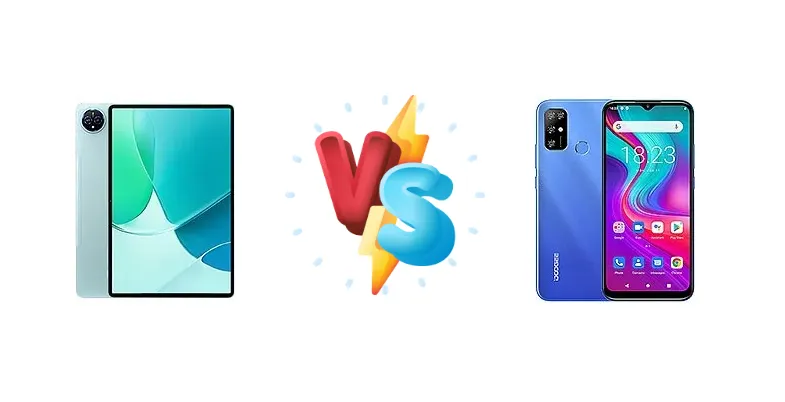
The Oukitel OT12 and Doogee X96 Pro represent the fiercely competitive sub-$150 smartphone market. Both devices rely on Unisoc chipsets, but a significant architectural difference separates them. This comparison dissects those differences, focusing on how they impact everyday performance and user experience.
🏆 Quick Verdict
For the average user prioritizing responsiveness and future-proofing, the Oukitel OT12 is the better choice. Its Unisoc T606, built on a 12nm process, offers a more efficient and capable CPU architecture than the Doogee X96 Pro’s older 28nm Unisoc SC9863A, despite similar clock speeds.
| Network |
|---|
| 2G bands | GSM 850 / 900 / 1800 / 1900 | GSM 850 / 900 / 1800 / 1900 |
| 3G bands | HSDPA 900 / 2100 | HSDPA 850 / 900 / 1900 / 2100 |
| 4G bands | 1, 3, 5, 7, 8, 19, 20, 38, 39, 40, 41 | 1, 3, 5, 7, 8, 20, 40, 41 |
| Speed | HSPA, LTE | HSPA, LTE |
| Technology | GSM / HSPA / LTE | GSM / HSPA / LTE |
| Launch |
|---|
| Announced | 2024, September | 2021, May |
| Status | Available. Released 2024, September | Available. Released 2021, May |
| Body |
|---|
| Dimensions | 258.2 x 169.5 x 8.6 mm (10.17 x 6.67 x 0.34 in) | 165.2 x 76.7 x 9.7 mm (6.50 x 3.02 x 0.38 in) |
| SIM | Nano-SIM + Nano-SIM | Nano-SIM + Nano-SIM |
| Weight | 535 g (1.18 lb) | 198 g (6.98 oz) |
| Display |
|---|
| Protection | Corning Gorilla Glass 5 | - |
| Resolution | 800 x 1280 pixels, 16:10 ratio (~137 ppi density) | 720 x 1600 pixels, 20:9 ratio (~269 ppi density) |
| Size | 11.0 inches, 350.9 cm2 (~80.2% screen-to-body ratio) | 6.52 inches, 102.6 cm2 (~81.0% screen-to-body ratio) |
| Type | IPS LCD, 400 nits | IPS LCD |
| Platform |
|---|
| CPU | Octa-core (2x1.6 GHz Cortex-A75 & 6x1.6 GHz Cortex-A55) | Octa-core (4x1.6 GHz Cortex-A55 & 4x1.2 GHz Cortex-A55) |
| Chipset | Unisoc T606 (12 nm) | Unisoc SC9863A (28 nm) |
| GPU | Mali-G57 MP1 | IMG8322 |
| OS | Android 14 | Android 11 |
| Memory |
|---|
| Card slot | microSDXC (uses shared SIM slot) | microSDXC (dedicated slot) |
| Internal | 256GB 4GB RAM | 64GB 4GB RAM |
| Main Camera |
|---|
| Dual | 13 MP, f/2.2, (wide), 1/3.06", PDAF
other unspecified camera | - |
| Features | LED flash | LED flash |
| Quad | - | 13 MP, f/2.2, (wide), PDAF
2 MP (macro)
Auxiliary lenses |
| Video | 1080p@30fps | 1080p |
| Selfie camera |
|---|
| Single | 5 MP, f/2.2, (wide), 1/5.0" | 8 MP, f/2.0, (wide) |
| Video | 720p@30fps | 720p |
| Sound |
|---|
| 35mm jack | Yes | Yes |
| Loudspeaker | Yes, with stereo speakers | Yes |
| Comms |
|---|
| Bluetooth | 5.0, A2DP, LE | 4.2, A2DP |
| NFC | No | No |
| Positioning | GPS, GLONASS, GALILEO, BDS | GPS, GLONASS, BDS |
| Radio | FM radio | FM radio |
| USB | USB Type-C 2.0, OTG | microUSB 2.0, OTG |
| WLAN | Wi-Fi 802.11 a/b/g/n/ac, dual-band | Wi-Fi 802.11 b/g/n |
| Features |
|---|
| Sensors | Accelerometer | Fingerprint (rear-mounted), accelerometer, proximity, compass |
| Battery |
|---|
| Charging | 10W wired | 10W wired |
| Type | Li-Po 8000 mAh | 5400 mAh |
| Misc |
|---|
| Colors | Gray, Green, Purple | Black, Blue, Green, Red |
| Price | About 180 EUR | About 140 EUR |
Oukitel OT12
- More efficient Unisoc T606 chipset
- Modern CPU architecture (Cortex-A75 cores)
- Potentially longer battery life due to efficiency
- Limited information available on display specs
- 10W charging is slow
Doogee X96 Pro
- Potentially lower price point
- Octa-core processor
- Basic smartphone functionality
- Less efficient Unisoc SC9863A chipset
- Older 28nm fabrication process
- Likely more throttling under load
Display Comparison
Neither Oukitel nor Doogee provide display specifications beyond the basic panel type. Given the price point, both likely utilize IPS LCDs with 720p+ resolutions. The absence of data prevents a detailed comparison of brightness, color accuracy, or refresh rates. However, the focus here is on internal components, making display differences less critical.
Camera Comparison
Both phones are expected to feature basic camera setups geared towards casual photography. Without detailed sensor information, it’s difficult to make a meaningful comparison. It’s highly probable both devices include a primary sensor, a depth sensor, and potentially a macro lens. Given the market segment, image quality will likely be similar, with limited dynamic range and low-light performance. Focusing on the chipset difference is more relevant than speculating on camera capabilities without concrete data.
Performance
The core difference lies in the chipsets. The Oukitel OT12’s Unisoc T606 (12nm) features a more modern CPU configuration: two Cortex-A75 cores for performance and six Cortex-A55 cores for efficiency. This contrasts with the Doogee X96 Pro’s Unisoc SC9863A (28nm), which uses four Cortex-A55 cores at 1.6GHz and another four at 1.2GHz. The 12nm fabrication process of the T606 is significantly more efficient than the 28nm process of the SC9863A, translating to better thermal management and potentially longer battery life under load. While both are octa-core, the A75 cores in the OT12 provide a noticeable performance uplift in CPU-intensive tasks. The older SC9863A will likely exhibit more throttling under sustained workloads.
Battery Life
Both devices offer 10W wired charging, indicating a similar charging experience. Battery capacity is not specified, but the more efficient Unisoc T606 in the Oukitel OT12 will likely result in longer real-world battery life despite potentially having a similar capacity to the Doogee X96 Pro. The 28nm SC9863A is inherently less power-efficient, meaning the Doogee will drain its battery faster during active use.
Buying Guide
Buy the Oukitel OT12 if you need a phone for daily tasks like browsing, social media, and light multitasking, and value a slightly more responsive experience. Buy the Doogee X96 Pro if you prioritize a potentially lower price point and are willing to accept a less efficient chipset that may struggle with more demanding applications or prolonged use.
Frequently Asked Questions
❓ Will the Doogee X96 Pro struggle with multitasking compared to the Oukitel OT12?
Yes, the Doogee X96 Pro’s Unisoc SC9863A, with its less powerful CPU cores and older architecture, will likely exhibit more lag and slowdown when switching between multiple apps compared to the Oukitel OT12’s Unisoc T606. The T606’s Cortex-A75 cores provide a significant performance boost for multitasking.
❓ Is the 10W charging on either phone sufficient for daily use?
10W charging is quite slow by modern standards. Expect a full charge to take several hours. Neither phone prioritizes fast charging, so users should plan to charge overnight. The difference in chipset efficiency may slightly impact overall charging time, but the impact will be minimal.
❓ Can either of these phones handle basic mobile gaming?
Both phones can handle basic 2D games and less demanding 3D titles. However, the Doogee X96 Pro will likely experience more frame drops and stuttering in games due to its less powerful chipset. The Oukitel OT12 will offer a smoother, albeit still limited, gaming experience.