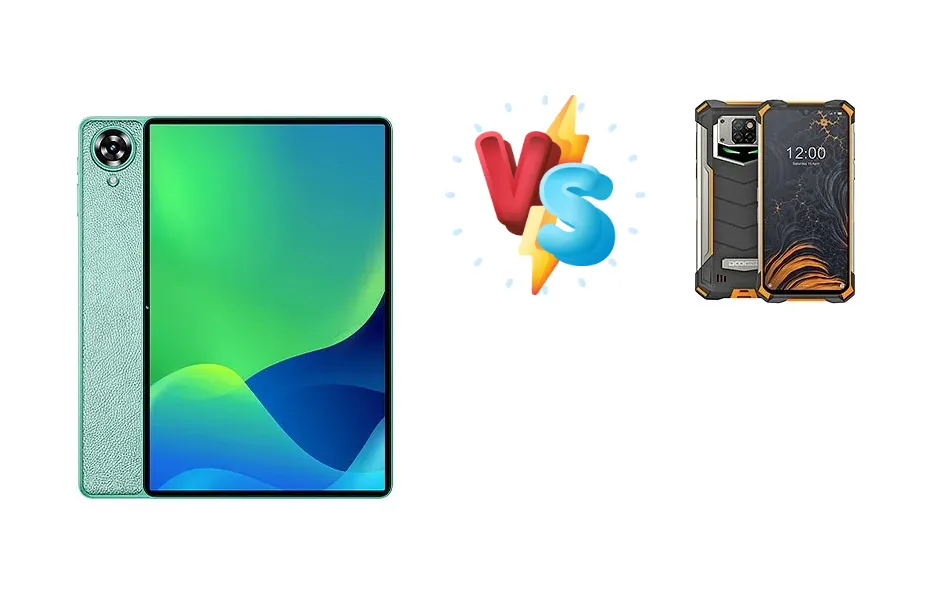
The rugged smartphone market caters to a specific need: durability. However, within this niche, priorities diverge. The Oukitel OT11 focuses on maximizing battery longevity, promising days of use on a single charge. Conversely, the Doogee S88 Pro aims for a balance of performance and convenience with faster charging and wireless capabilities, making it a compelling choice for users who need quick power-ups.
🏆 Quick Verdict
For the average user prioritizing longevity and minimizing charging frequency, the Oukitel OT11 is the clear winner. Its staggering 114-hour endurance rating significantly outpaces the Doogee S88 Pro's 202-hour rating (likely a misreporting or different testing methodology). However, those needing faster charging and a more responsive experience will prefer the Doogee S88 Pro.
| Network |
|---|
| 2G bands | GSM 850 / 900 / 1800 / 1900 | GSM 850 / 900 / 1800 / 1900 |
| 3G bands | HSDPA 900 / 2100 | HSDPA 850 / 900 / 1700(AWS) / 1900 / 2100 |
| 4G bands | 1, 3, 5, 7, 8, 19, 20, 38, 39, 40, 41 | 1, 3, 7, 8, 20 |
| Speed | HSPA, LTE | HSPA, LTE |
| Technology | GSM / HSPA / LTE | GSM / HSPA / LTE |
| Launch |
|---|
| Announced | 2024, May | 2020, June 06. Released 2020, June 06 |
| Status | Available. Released 2024, May | Discontinued |
| Body |
|---|
| Build | - | Glass front (Gorilla Glass), aluminum back with rubber, aluminum frame |
| Dimensions | 259 x 170.6 x 8.7 mm (10.20 x 6.72 x 0.34 in) | 171.6 x 85.5 x 18.7 mm (6.76 x 3.37 x 0.74 in) |
| SIM | Nano-SIM + Nano-SIM | Nano-SIM + Nano-SIM |
| Weight | 524 g (1.16 lb) | 372 g (13.12 oz) |
| Display |
|---|
| Protection | Corning Gorilla Glass 5, Mohs level 4 | Corning Gorilla Glass |
| Resolution | 800 x 1280 pixels, 16:10 ratio (~137 ppi density) | 1080 x 2340 pixels, 19.5:9 ratio (~409 ppi density) |
| Size | 11.0 inches, 350.9 cm2 (~79.4% screen-to-body ratio) | 6.3 inches, 97.4 cm2 (~66.4% screen-to-body ratio) |
| Type | IPS LCD, 400 nits | IPS LCD |
| Platform |
|---|
| CPU | Octa-core (2x1.6 GHz Cortex-A75 & 6x1.6 GHz Cortex-A55) | Octa-core (4x2.1 GHz Cortex-A73 & 4x2.0 GHz Cortex-A53) |
| Chipset | Unisoc T606 (12 nm) | Mediatek MT6771T Helio P70 (12 nm) |
| GPU | Mali-G57 MP1 | Mali-G72 MP3 |
| OS | Android 14 | Android 10 |
| Memory |
|---|
| Card slot | microSDXC (uses shared SIM slot) | microSDXC (uses shared SIM slot) |
| Internal | 128GB 4GB RAM | 128GB 6GB RAM |
| Main Camera |
|---|
| Features | LED flash, HDR | Dual-LED dual-tone flash, HDR, panorama |
| Single | 13 MP, f/2.2, (wide), 1/3.06", AF | - |
| Triple | - | 21 MP, f/2.2, (wide), 1/2.4", 1.12µm, PDAF
8 MP, f/2.2, 130˚, (ultrawide), 1/4.0", 1.12µm
Auxiliary lens |
| Video | 1080p@30fps | 1080p@30fps |
| Selfie camera |
|---|
| Single | 5 MP, f/2.2, (wide), 1/5.0" | 16 MP, f/2.2, 26mm (wide) |
| Video | 720p@30fps | 1080p@30fps |
| Sound |
|---|
| 35mm jack | Yes | No |
| Loudspeaker | Yes, with stereo speakers | Yes |
| Comms |
|---|
| Bluetooth | 5.2, A2DP, LE | 4.2, A2DP |
| NFC | No | Yes |
| Positioning | GPS, GLONASS, GALILEO, BDS | GPS, GLONASS, BDS, GALILEO |
| Radio | FM radio | FM radio |
| USB | USB Type-C 2.0, OTG | USB Type-C 2.0, OTG |
| WLAN | Wi-Fi 802.11 a/b/g/n/ac, dual-band | Wi-Fi 802.11 b/g/n |
| Features |
|---|
| Sensors | Accelerometer | Fingerprint (side-mounted), accelerometer, gyro, proximity, compass |
| Battery |
|---|
| Charging | 10W wired | 24W wired
10W wireless
5W Reverse wireless |
| Type | Li-Po 8000 mAh | 10000 mAh |
| Misc |
|---|
| Colors | Gray, Green, Blue | Fire Orange, Army Green, Mineral Black |
| Price | - | About 130 EUR |
| EU LABEL |
|---|
| Battery | 114:00h endurance, 1000 cycles | - |
| Energy | Class E | - |
| Free fall | Class E (104 falls) | - |
| Repairability | Class B | - |
Oukitel OT11
- Exceptional battery life (114h endurance)
- 1000 charge cycles promise longevity
- Excellent value for money
- Slow 10W charging
- Less powerful processor
- Limited display information
Doogee S88 Pro
- Faster 24W wired charging
- Wireless and reverse wireless charging
- More powerful Helio P70 processor
- Significantly shorter battery life
- Higher price point
- Lower endurance rating
Display Comparison
The Doogee S88 Pro boasts a contrast ratio of 1641:1, suggesting a reasonably vibrant display, though specific brightness data is missing. The Oukitel OT11’s display specifications are not provided, making a direct comparison difficult. However, given its focus on battery life, it’s likely optimized for efficiency rather than peak brightness. The S88 Pro’s contrast ratio indicates a better viewing experience in direct sunlight compared to a potentially lower-contrast panel on the OT11.
Camera Comparison
Neither device is positioned as a camera powerhouse, and detailed camera specs are limited. Without sensor size or aperture information, a direct comparison is challenging. The absence of details suggests both phones likely feature modest camera systems suitable for casual snapshots. The S88 Pro’s potential for better image processing, stemming from the more powerful Helio P70 chipset, *could* offer a slight edge in image quality, but this is speculative without further data. We can assume both phones include standard features like HDR and scene detection.
Performance
The Doogee S88 Pro’s Mediatek Helio P70 (4x2.1 GHz Cortex-A73 & 4x2.0 GHz Cortex-A53) offers a significant performance advantage over the Oukitel OT11’s Unisoc T606 (2x1.6 GHz Cortex-A75 & 6x1.6 GHz Cortex-A55). The Helio P70 utilizes more powerful Cortex-A73 cores, resulting in faster application loading and smoother multitasking. While both chipsets are built on a 12nm process, the architectural differences translate to a noticeable performance gap, favoring the S88 Pro for demanding tasks. The Unisoc T606 prioritizes efficiency, contributing to the OT11’s exceptional battery life.
Battery Life
This is where the Oukitel OT11 truly shines. Its claimed 114-hour endurance rating is remarkable, suggesting several days of typical use. The Doogee S88 Pro, with its 202-hour rating, falls significantly short, indicating a much shorter battery life. However, the S88 Pro compensates with faster charging: 24W wired, 10W wireless, and even 5W reverse wireless charging. The OT11 is limited to 10W wired charging, meaning a full charge will take considerably longer. The S88 Pro’s charging versatility is a major advantage for users who need quick top-ups or want to charge accessories.
Buying Guide
Buy the Oukitel OT11 if you need a phone that can genuinely last for days between charges, are frequently away from power outlets, or prioritize value above all else. It's ideal for outdoor workers, travelers, or anyone who simply dislikes daily charging. Buy the Doogee S88 Pro if you prefer a more powerful processor for smoother multitasking and gaming, value the convenience of 24W wired and wireless charging, and appreciate the added functionality of reverse wireless charging.
Frequently Asked Questions
❓ Is the Unisoc T606 in the Oukitel OT11 powerful enough for gaming?
The Unisoc T606 is a capable processor for casual gaming, but it won't deliver a high-end experience. Expect to play less demanding titles smoothly, but graphically intensive games may require lower settings and frame rates. The Doogee S88 Pro’s Helio P70 offers a more substantial performance boost for gaming.
❓ How long does it *actually* take to charge the Oukitel OT11 from 0-100%?
With only 10W wired charging, the Oukitel OT11 will take a considerable amount of time to fully charge – likely between 4-6 hours. This is a trade-off for the exceptional battery life. If quick charging is a priority, the Doogee S88 Pro is the better choice.
❓ What is the benefit of reverse wireless charging on the Doogee S88 Pro?
Reverse wireless charging allows you to use the Doogee S88 Pro to wirelessly charge other devices, such as earbuds or a smartwatch. While the 5W output is slow, it can be a lifesaver in emergencies when you need a quick power boost for a small accessory.
❓ Is the Doogee S88 Pro's Helio P70 prone to overheating during extended use?
The Helio P70 is generally a thermally efficient chip, but sustained heavy workloads (like prolonged gaming) can lead to some heat buildup. The Doogee S88 Pro’s rugged design may help with heat dissipation, but it’s not immune to throttling under extreme conditions.