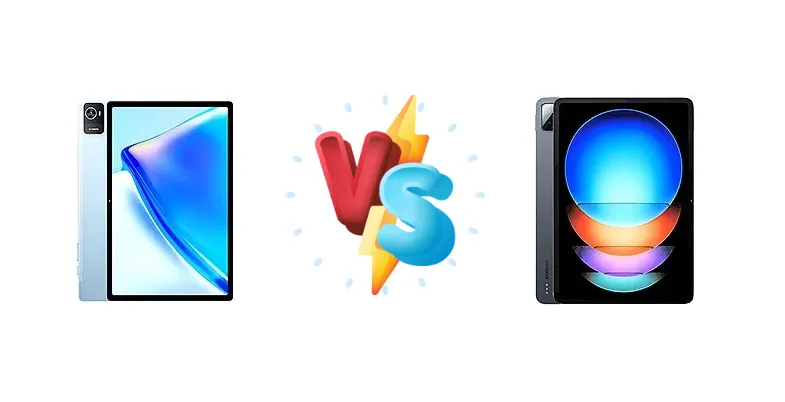
The tablet market offers a wide spectrum of choices, from ultra-portable, long-lasting devices to powerhouse slates designed for demanding tasks. We pit the Oukitel OKT3, focused on extreme battery endurance, against the Xiaomi Pad 6S Pro 12.4, a flagship contender boasting the latest Snapdragon 8 Gen 2 processor, to determine which tablet reigns supreme for different user needs.
🏆 Quick Verdict
For users prioritizing all-day (and multi-day) battery life above all else, the Oukitel OKT3 is the clear winner. However, the Xiaomi Pad 6S Pro 12.4 delivers a significantly superior experience for gaming, content creation, and demanding applications thanks to its Snapdragon 8 Gen 2 chipset and vibrant display.
| Network |
|---|
| 2G bands | GSM 850 / 900 / 1800 / 1900 | N/A |
| 3G bands | HSDPA 850 / 900 / 1700(AWS) / 1900 / 2100 | N/A |
| 4G bands | LTE | - |
| EDGE | - | N/A |
| GPRS | - | N/A |
| Speed | HSPA, LTE | - |
| Technology | GSM / HSPA / LTE | No cellular connectivity |
| Launch |
|---|
| Announced | 2023, June | 2024, February 22 |
| Status | Available. Released 2023, June | Available. Released 2024, February 22 |
| Body |
|---|
| Build | - | Glass front (Gorilla Glass 5), aluminum frame, aluminum back |
| Dimensions | 7.4 mm thickness | 278.7 x 191.6 x 6.3 mm (10.97 x 7.54 x 0.25 in) |
| SIM | Nano-SIM + Nano-SIM | No |
| Weight | 509 g (1.12 lb) | 590 g (1.30 lb) |
| Display |
|---|
| Protection | Mohs level 5 | Corning Gorilla Glass 5 |
| Resolution | 1200 x 1920 pixels, 16:10 ratio (~215 ppi density) | 2032 x 3048 pixels, 3:2 ratio (~295 ppi density) |
| Size | 10.51 inches, 320.3 cm2 | 12.4 inches, 457.8 cm2 (~85.7% screen-to-body ratio) |
| Type | IPS LCD | IPS LCD, 68B colors, 144Hz, HDR10, Dolby Vision, 900 nits (peak) |
| Platform |
|---|
| CPU | Octa-core (2x2.0 GHz Cortex-A75 & 6x1.8 GHz Cortex-A55) | Octa-core (1x3.2 GHz Cortex-X3 & 2x2.8 GHz Cortex-A715 & 2x2.8 GHz Cortex-A710 & 3x2.0 GHz Cortex-A510) |
| Chipset | Unisoc Tiger T616 (12 nm) | Qualcomm SM8550-AB Snapdragon 8 Gen 2 (4 nm) |
| GPU | Mali-G57 MP1 | Adreno 740 |
| OS | Android 13 | Android 14, up to 3 major Android upgrades, HyperOS |
| Memory |
|---|
| Card slot | microSDXC (uses shared SIM slot) | No |
| Internal | 256GB 8GB RAM | 256GB 8GB RAM, 256GB 12GB RAM, 512GB 12GB RAM, 1TB 16GB RAM |
| Main Camera |
|---|
| Dual | 16 MP, f/2.2, (wide), 1/3.1"
2 MP (macro) | 50 MP, f/1.8, (wide), 1/2.76", 0.64µm, PDAF
Auxiliary lens |
| Features | LED flash, HDR, panorama | LED flash, HDR, panorama |
| Video | 1080p@30fps | 4K@30/60fps, 1080p@30/60fps |
| Selfie camera |
|---|
| Single | 8 MP, f/2.0, (wide) | 32 MP, f/2.2, (wide), 1/3.6", 0.61µm |
| Video | 1080p@30fps | 1080p@30fps |
| Sound |
|---|
| 35mm jack | Yes | No |
| Loudspeaker | Yes, with stereo speakers (4 speakers) | Yes, with stereo speakers (6 speakers) |
| Comms |
|---|
| Bluetooth | Yes | 5.3, A2DP, LE, LHDC |
| NFC | No | Yes (file transfer only) |
| Positioning | GPS, GLONASS, GALILEO, BDS | No |
| Radio | Unspecified | No |
| USB | USB Type-C 2.0, OTG | USB Type-C 3.2, accessory connector |
| WLAN | Yes | Wi-Fi 802.11 a/b/g/n/a/6/7, dual-band, Wi-Fi Direct |
| Features |
|---|
| Sensors | Unspecified | Fingerprint (side-mounted), accelerometer, gyro, proximity (accessories only), compass |
| Battery |
|---|
| Charging | Reverse wired | 120W wired, PD3.0, QC4, 45% in 10 min, 100% in 35 min |
| Type | Li-Po 8250 mAh | 10000 mAh |
| Misc |
|---|
| Colors | Gray, Silver, Blue | Black, Blue, Green |
| Models | - | 24018RPACG |
| Price | About 220 EUR | About 700 EUR |
| SAR EU | - | 0.99 W/kg (body) |
| EU LABEL |
|---|
| Battery | 95:00h endurance, 1000 cycles | - |
| Energy | Class F | - |
| Free fall | Class C (90 falls) | - |
| Repairability | Class B | - |
Oukitel OKT3
- Exceptional 95-hour battery life
- Reverse wired charging for convenience
- Potentially lower price point
- Significantly weaker performance compared to the Xiaomi
- Display specifications are unknown and likely inferior
- Camera performance likely limited
Xiaomi Pad 6S Pro 12.4
- Flagship Snapdragon 8 Gen 2 processor for top-tier performance
- Bright and high-contrast 12.4-inch display
- Ultra-fast 120W charging
- Significantly shorter battery life than the Oukitel
- Higher price point
- May experience thermal throttling under sustained load
Display Comparison
The Xiaomi Pad 6S Pro 12.4 immediately distinguishes itself with a significantly brighter display, reaching a measured 848 nits. This, combined with its 1378:1 contrast ratio, provides a far more immersive viewing experience, especially in brightly lit environments. The Oukitel OKT3’s display specifications are not provided, suggesting a more basic panel likely lacking the color accuracy and brightness of the Xiaomi. The Xiaomi’s larger screen size (12.4 inches vs. unspecified for the Oukitel) also contributes to a more expansive visual experience.
Camera Comparison
Given the context data, camera performance isn't a primary focus for either device. However, the Xiaomi Pad 6S Pro 12.4 is likely to offer a more refined camera system due to its flagship positioning and access to Qualcomm’s image signal processor. The Oukitel OKT3’s camera specifications are unknown, but its focus on battery life suggests cost-cutting measures may have been applied to the camera module. Without further details, it’s safe to assume the Xiaomi will deliver better image quality and features.
Performance
The performance gap is substantial. The Xiaomi Pad 6S Pro 12.4’s Snapdragon 8 Gen 2 (4nm) is a flagship chipset built on a more efficient process node than the Oukitel OKT3’s Unisoc Tiger T616 (12nm). The Snapdragon 8 Gen 2’s octa-core configuration – featuring a Cortex-X3 prime core alongside A715 and A710 performance cores – offers a massive leap in CPU and GPU performance. The Oukitel’s Cortex-A75 and A55 cores, while capable, are several generations behind and will struggle with demanding tasks. This translates to smoother multitasking, faster app loading times, and a far superior gaming experience on the Xiaomi.
Battery Life
The Oukitel OKT3’s headline feature is its exceptional battery endurance, rated at 95 hours. This is significantly longer than the Xiaomi Pad 6S Pro 12.4’s active use score of 11 hours 14 minutes. However, the Xiaomi compensates with incredibly fast 120W wired charging, achieving 45% charge in just 10 minutes and a full charge in 35 minutes. The Oukitel offers reverse wired charging, a useful feature for topping up other devices, but lacks the rapid charging capabilities of the Xiaomi. The Oukitel’s 1000 charge cycles suggest a focus on long-term battery health, while the Xiaomi prioritizes minimizing downtime.
Buying Guide
Buy the Oukitel OKT3 if you need a tablet primarily for extended media consumption, reading, or basic productivity tasks where access to a charger is limited. Its 95-hour endurance and reverse wired charging make it ideal for travelers or those who dislike frequent charging. Buy the Xiaomi Pad 6S Pro 12.4 if you prioritize performance for gaming, video editing, or running resource-intensive applications, and value a high-quality display with fast charging capabilities.
Frequently Asked Questions
❓ How does the Unisoc Tiger T616 handle graphically intensive games compared to the Snapdragon 8 Gen 2?
The Unisoc Tiger T616 will struggle with demanding titles at high settings. The Snapdragon 8 Gen 2 offers a vastly superior GPU, enabling smooth gameplay at maximum settings and higher resolutions. Expect significant frame rate drops and reduced graphical fidelity on the Oukitel OKT3.
❓ Is the 120W charging on the Xiaomi Pad 6S Pro 12.4 likely to degrade the battery health faster than the Oukitel's slower charging?
While faster charging can theoretically contribute to slightly faster battery degradation over the long term, the Xiaomi employs sophisticated charging algorithms and battery management systems to mitigate this effect. The Oukitel’s focus on 1000 charge cycles suggests a conservative approach to battery health, but the convenience of the Xiaomi’s rapid charging is a significant benefit.
❓ Can the Oukitel OKT3 effectively run multiple apps simultaneously, like video conferencing while browsing?
The Oukitel OKT3’s Unisoc Tiger T616 and limited RAM (spec not provided, but likely lower than the Xiaomi) will likely struggle with heavy multitasking. Expect slowdowns and app crashes when running multiple demanding applications concurrently. The Xiaomi Pad 6S Pro 12.4, with its Snapdragon 8 Gen 2 and ample RAM, handles multitasking with ease.