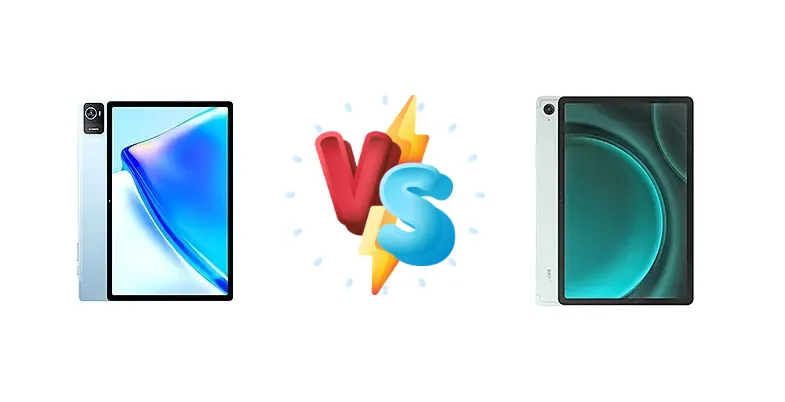
The tablet market offers a wide spectrum of choices, from premium flagships to budget-friendly options. We're pitting the Oukitel OKT3, a tablet focused on extreme battery endurance, against the Samsung Galaxy Tab S9 FE, a more mainstream offering prioritizing performance and features. This comparison will help you determine which tablet best suits your needs and budget.
🏆 Quick Verdict
For users prioritizing all-day (and multi-day) battery life above all else, the Oukitel OKT3 is the clear winner. However, the Samsung Galaxy Tab S9 FE delivers a significantly smoother and more responsive experience thanks to its superior chipset, making it the better choice for demanding tasks and users.
| Network |
|---|
| 2G bands | GSM 850 / 900 / 1800 / 1900 | GSM 850 / 900 / 1800 / 1900 |
| 3G bands | HSDPA 850 / 900 / 1700(AWS) / 1900 / 2100 | HSDPA 850 / 900 / 1700(AWS) / 1900 / 2100 |
| 4G bands | LTE | 1, 2, 3, 4, 5, 7, 8, 12, 13, 17, 20, 26, 28, 32, 38, 40, 41, 66 |
| 5G bands | - | 1, 3, 5, 7, 8, 20, 28, 38, 40, 41, 66, 77, 78 SA/NSA/Sub6 |
| Speed | HSPA, LTE | HSPA, LTE, 5G - cellular model only |
| Technology | GSM / HSPA / LTE | GSM / HSPA / LTE / 5G |
| Launch |
|---|
| Announced | 2023, June | 2023, October 04 |
| Status | Available. Released 2023, June | Available. Released 2023, October 16 |
| Body |
|---|
| Build | - | Glass front, aluminum back, aluminum frame |
| Dimensions | 7.4 mm thickness | 254.3 x 165.8 x 6.5 mm (10.01 x 6.53 x 0.26 in) |
| SIM | Nano-SIM + Nano-SIM | Nano-SIM + eSIM (cellular model only) |
| Weight | 509 g (1.12 lb) | 523 g or 524 g (1.15 lb) |
| Display |
|---|
| Protection | Mohs level 5 | - |
| Resolution | 1200 x 1920 pixels, 16:10 ratio (~215 ppi density) | 1440 x 2304 pixels, 16:10 ratio (~249 ppi density) |
| Size | 10.51 inches, 320.3 cm2 | 10.9 inches, 344.5 cm2 (~81.7% screen-to-body ratio) |
| Type | IPS LCD | IPS LCD, 90Hz |
| Platform |
|---|
| CPU | Octa-core (2x2.0 GHz Cortex-A75 & 6x1.8 GHz Cortex-A55) | Octa-core (4x2.4 GHz Cortex-A78 & 4x2.0 GHz Cortex-A55) |
| Chipset | Unisoc Tiger T616 (12 nm) | Exynos 1380 (5 nm) |
| GPU | Mali-G57 MP1 | Mali-G68 MP5 |
| OS | Android 13 | Android 13, up to 4 major Android upgrades, One UI 6 |
| Memory |
|---|
| Card slot | microSDXC (uses shared SIM slot) | microSDXC (dedicated slot) |
| Internal | 256GB 8GB RAM | 128GB 6GB RAM, 128GB 8GB RAM, 256GB 8GB RAM |
| Main Camera |
|---|
| Dual | 16 MP, f/2.2, (wide), 1/3.1"
2 MP (macro) | - |
| Features | LED flash, HDR, panorama | - |
| Single | - | 8 MP, (wide) |
| Video | 1080p@30fps | 4K@30fps, 1080p@30fps |
| Selfie camera |
|---|
| Single | 8 MP, f/2.0, (wide) | 12 MP, (ultrawide) |
| Video | 1080p@30fps | Yes |
| Sound |
|---|
| 35mm jack | Yes | No |
| Loudspeaker | Yes, with stereo speakers (4 speakers) | Yes, with stereo speakers |
| Comms |
|---|
| Bluetooth | Yes | 5.3, A2DP, LE |
| NFC | No | No |
| Positioning | GPS, GLONASS, GALILEO, BDS | GPS, GALILEO, GLONASS, BDS, QZSS - cellular model only |
| Radio | Unspecified | No |
| USB | USB Type-C 2.0, OTG | USB Type-C 2.0, magnetic connector |
| WLAN | Yes | Wi-Fi 802.11 a/b/g/n/ac/6, dual-band, Wi-Fi Direct |
| Features |
|---|
| Sensors | Unspecified | Fingerprint (side-mounted), accelerometer, gyro, compass, proximity (accessories only) |
| Battery |
|---|
| Charging | Reverse wired | 45W wired, QC2.0 |
| Type | Li-Po 8250 mAh | Li-Po 8000 mAh |
| Misc |
|---|
| Colors | Gray, Silver, Blue | Mint, Silver, Gray, Lavender |
| Models | - | SM-X510, SM-X516B |
| Price | About 220 EUR | About 300 EUR |
| SAR | - | 1.55 W/kg (body) |
| SAR EU | - | 0.59 W/kg (body) |
| EU LABEL |
|---|
| Battery | 95:00h endurance, 1000 cycles | - |
| Energy | Class F | - |
| Free fall | Class C (90 falls) | - |
| Repairability | Class B | - |
Oukitel OKT3
- Exceptional battery life (95-hour endurance)
- Reverse wired charging for convenient device top-ups
- High battery cycle count (1000 cycles) for longevity
- Less powerful processor (Unisoc Tiger T616)
- Likely lower build quality and display quality
Samsung Galaxy Tab S9 FE
- Faster and more efficient processor (Exynos 1380)
- 45W fast charging with QC2.0 support
- Superior display quality (likely Samsung LCD)
- Shorter battery life compared to the OKT3
- Higher price point
Display Comparison
Neither device's display specifications are provided, so we must infer. Given the OKT3's focus on value, it likely features an IPS LCD panel. The Tab S9 FE, being a Samsung product, almost certainly utilizes a high-quality LCD panel, potentially with a higher refresh rate. The Tab S9 FE likely benefits from Samsung’s display expertise, offering superior color accuracy and viewing angles. Bezels are likely thinner on the Tab S9 FE, contributing to a more modern aesthetic.
Camera Comparison
Without specific camera details, a direct comparison is difficult. However, given Samsung’s camera expertise, the Tab S9 FE is expected to offer a more refined camera experience with better image processing. The OKT3 likely features a more basic camera setup focused on functionality rather than quality. The absence of details suggests neither device will excel in photography, but the Tab S9 FE is likely to produce more usable images in various lighting conditions.
Performance
The Samsung Galaxy Tab S9 FE’s Exynos 1380 (5nm) chipset represents a significant leap in performance over the Oukitel OKT3’s Unisoc Tiger T616 (12nm). The 5nm fabrication process allows for greater transistor density and improved power efficiency, translating to more processing power with less heat. The Tab S9 FE’s CPU configuration – 4x2.4 GHz Cortex-A78 & 4x2.0 GHz Cortex-A55 – is architecturally superior to the OKT3’s 2x2.0 GHz Cortex-A75 & 6x1.8 GHz Cortex-A55, offering faster single-core and multi-core performance. This difference will be most noticeable in demanding applications like gaming and video editing. The Tab S9 FE also likely benefits from faster RAM (likely LPDDR5x) compared to the OKT3.
Battery Life
The Oukitel OKT3 boasts a remarkable 95-hour endurance rating, suggesting a very large battery capacity. While the Tab S9 FE’s battery capacity is unknown, its 45W wired charging with QC2.0 support provides a significant advantage in terms of recharge speed. The OKT3 offers reverse wired charging, a useful feature for topping up other devices, but the Tab S9 FE’s faster charging will minimize downtime. The OKT3’s 1000 charge cycles suggest a focus on long-term battery health, potentially mitigating capacity degradation over time.
Buying Guide
Buy the Oukitel OKT3 if you need a tablet primarily for extended media consumption, reading, or basic productivity tasks where battery life is paramount and you're willing to trade off processing power. Buy the Samsung Galaxy Tab S9 FE if you prefer a more versatile tablet capable of handling multitasking, gaming, and creative applications with greater ease, and value faster charging and a more refined user experience.
Frequently Asked Questions
❓ Does the Exynos 1380 in the Tab S9 FE tend to overheat during prolonged gaming sessions?
The Exynos 1380, built on a 5nm process, is generally efficient and well-managed in terms of thermal performance. While it may get warm during extended gaming, it's unlikely to experience significant throttling like older or less efficient chipsets. Samsung's thermal management solutions further contribute to stable performance.
❓ How does the Unisoc Tiger T616 handle multitasking on the Oukitel OKT3?
The Unisoc Tiger T616 is a capable processor for basic multitasking, such as switching between apps and browsing the web. However, it may struggle with demanding multitasking scenarios involving multiple resource-intensive applications simultaneously. Expect some slowdowns when pushing the processor to its limits.
❓ Is the reverse wired charging on the Oukitel OKT3 useful for charging a smartphone?
Yes, the reverse wired charging feature can be useful for providing a small boost to a smartphone's battery. However, the charging speed will be limited by the OKT3's output capabilities and the smartphone's charging requirements. It's best suited for emergency top-ups rather than full charges.
❓ What type of storage does the Samsung Galaxy Tab S9 FE use, and is it expandable?
The Samsung Galaxy Tab S9 FE utilizes UFS 3.1 storage, which is significantly faster than the eMMC storage often found in budget tablets. This results in quicker app loading times and smoother overall performance. It also supports microSD card expansion, allowing you to increase storage capacity as needed.