
Oukitel G5 vs. Ulefone Power Armor 13: A Deep Dive into Battery and Performance
| Phones Images | |||||
|---|---|---|---|---|---|
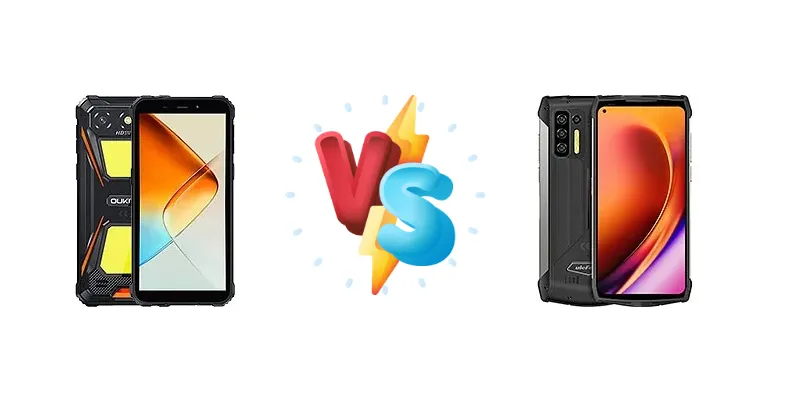
|
🏆 Quick Verdict
For users prioritizing maximum uptime and minimal charging, the Oukitel G5 is the clear winner thanks to its astounding 59:23h endurance. However, the Ulefone Power Armor 13 offers a significantly smoother experience for gaming and demanding tasks, justifying its higher price for performance-focused users.
| PHONES | ||
|---|---|---|
| Phone Names | Oukitel G5 | Ulefone Power Armor 13 |
| Network | ||
|---|---|---|
| 2G bands | GSM 850 / 900 / 1800 / 1900 | GSM 850 / 900 / 1800 / 1900 |
| 3G bands | HSDPA 850 / 900 / 1700(AWS) / 1900 / 2100 | HSDPA 850 / 900 / 1700(AWS) / 1900 / 2100 |
| 4G bands | 1, 2, 3, 4, 5, 7, 8, 12, 17, 19, 20, 25, 26, 28, 34, 38, 39, 40, 41, 66 | 1, 2, 3, 4, 5, 7, 8, 12, 13, 17, 18, 19, 20, 25, 26, 28, 38, 40, 66 |
| Speed | HSPA, LTE | HSPA 42.2/11.5 Mbps, LTE Cat12 600/150 Mbps |
| Technology | GSM / HSPA / LTE | GSM / HSPA / LTE |
| Launch | ||
|---|---|---|
| Announced | 2025, May | 2021, July 22 |
| Status | Available. Released 2025, May | Available. Released 2021, July 26 |
| Body | ||
|---|---|---|
| Dimensions | 166 x 81.1 x 15 mm (6.54 x 3.19 x 0.59 in) | 183.7 x 85.4 x 20.8 mm (7.23 x 3.36 x 0.82 in) |
| SIM | Nano-SIM + Nano-SIM | Nano-SIM + Nano-SIM |
| Weight | 300 g (10.58 oz) | 492 g (1.08 lb) |
| - | IP68 dust/water resistant (up to 1.5m for 30 min) Drop-to-concrete resistance from up to 1.2m MIL-STD-810G compliant | |
| Display | ||
|---|---|---|
| Protection | Corning Gorilla Glass 5, Mohs level 4 | Corning Gorilla Glass 3 |
| Resolution | 576 x 1152 pixels, 18:9 ratio (~215 ppi density) | 1080 x 2400 pixels, 20:9 ratio (~386 ppi density) |
| Size | 6.0 inches, 92.9 cm2 (~69.0% screen-to-body ratio) | 6.81 inches, 112.0 cm2 (~71.4% screen-to-body ratio) |
| Type | IPS LCD, 450 nits | IPS LCD |
| Platform | ||
|---|---|---|
| CPU | Quad-core (1x2.0 GHz Cortex-A75 & 3x1.8 GHz Cortex-A55) | Octa-core (2x2.05 GHz Cortex-A76 & 6x2.0 GHz Cortex-A55) |
| Chipset | Unisoc T310 (12 nm) | Mediatek MT6785V/CD Helio G95 (12 nm) |
| GPU | PowerVR GE8300 | Mali-G76 MC4 |
| OS | Android 14 | Android 11 |
| Memory | ||
|---|---|---|
| Card slot | microSDXC (uses shared SIM slot) | microSDXC (uses shared SIM slot) |
| Internal | 64GB 4GB RAM | 256GB 8GB RAM |
| Main Camera | ||
|---|---|---|
| Features | LED flash | Quad-LED flash, HDR, panorama |
| Penta | - | 48 MP, f/1.8, 26mm (wide), 1/2.0", 0.8µm, PDAF 8 MP, f/2.2, (ultrawide) 2 MP (macro) Auxiliary lens |
| Single | 13 MP, f/2.2, (wide), 1/3.06", AF | - |
| Video | Yes | 4K@30fps, 1080p@30fps |
| Selfie camera | ||
|---|---|---|
| Features | - | HDR, panorama |
| Single | 5 MP, f/2.2, (wide) | 16 MP, f/2.2 |
| Video | 720p@30fps | 1080p@30fps |
| Sound | ||
|---|---|---|
| 3.5mm jack | - | Yes |
| 35mm jack | Yes | Yes |
| Loudspeaker | Yes | Yes |
| Comms | ||
|---|---|---|
| Bluetooth | 5.0, A2DP, LE | 5.0, A2DP, LE |
| NFC | No | Yes |
| Positioning | GPS, GALILEO, GLONASS, BDS | GPS, GLONASS, GALILEO, BDS |
| Radio | FM radio | FM radio, RDS, recording |
| USB | USB Type-C 2.0 | - |
| WLAN | Wi-Fi 802.11 a/b/g/n/ac, dual-band | Wi-Fi 802.11 a/b/g/n/ac, dual-band |
| Features | ||
|---|---|---|
| Sensors | Accelerometer, proximity, compass | Fingerprint (side-mounted), accelerometer, gyro, proximity, compass, baroceptor, coulombmeter |
| - | Infrared distance measure (error range: 1~20m, ±10mm; 20~40m, ±25mm) | |
| Battery | ||
|---|---|---|
| Charging | 10W wired | 33W wired 15W wireless 5W reverse wireless |
| Type | Li-Po 6300 mAh | Li-Po 13200 mAh |
| Misc | ||
|---|---|---|
| Colors | Black, Orange, Green | Black |
| Price | - | About 300 EUR |
| Tests | ||
|---|---|---|
| Battery life | - | Endurance rating 296h |
| Camera | - | Photo / Video |
| Display | - | Contrast ratio: 1306:1 (nominal) |
| Loudspeaker | - | -28.3 LUFS (Average) |
| Performance | - | AnTuTu: 294194 (v8), 351678 (v9) GeekBench: 1610 (v5.1) GFXBench: 18fps (ES 3.1 onscreen) |
| EU LABEL | ||
|---|---|---|
| Battery | 59:23h endurance, 1000 cycles | - |
| Energy | Class B | - |
| Free fall | Class D (45 falls) | - |
| Repairability | Class C | - |
Oukitel G5
- Unmatched battery life (59:23h endurance)
- Exceptional battery longevity (1000 charge cycles)
- Highly affordable
- Slow 10W charging
- Limited processing power for demanding tasks
- Basic display specifications
Ulefone Power Armor 13
- Faster and more responsive performance (Helio G95)
- Faster charging options (33W wired, 15W wireless)
- Ruggedized design for increased durability
- Significantly shorter battery life (296h endurance)
- Higher price point
- Camera performance likely similar to G5
Display Comparison
The Ulefone Power Armor 13 boasts a measured peak brightness of 401 nits and a 1306:1 contrast ratio, providing a more vibrant and visible display in outdoor conditions compared to the Oukitel G5, which lacks detailed display specifications. While both share the same contrast ratio, the higher brightness of the Ulefone is a tangible advantage. The lack of information on the G5’s panel type suggests a more basic LCD, while the Power Armor 13 likely utilizes an IPS panel for wider viewing angles.
Camera Comparison
Both devices list 'Photo / Video' capabilities, but lack specific details. Given the price points, image quality is unlikely to be a primary differentiator. The absence of sensor size or megapixel counts makes a direct comparison impossible. However, the Ulefone Power Armor 13, being a more recent model, may benefit from improved image processing algorithms. It's safe to assume neither phone will excel in low-light photography.
Performance
The Ulefone Power Armor 13’s MediaTek Helio G95, an octa-core processor with 2x2.05 GHz Cortex-A76 and 6x2.0 GHz Cortex-A55 cores, represents a substantial performance leap over the Oukitel G5’s Unisoc T310. The G5’s quad-core configuration (1x2.0 GHz Cortex-A75 & 3x1.8 GHz Cortex-A55) is geared towards efficiency, not speed. The Helio G95’s architecture allows for smoother multitasking, faster app loading times, and a more enjoyable gaming experience. While both chipsets are built on a 12nm process, the G95’s superior core count and architecture deliver significantly better performance.
Battery Life
The Oukitel G5’s standout feature is its incredible 59:23h endurance rating, coupled with a claimed 1000 charge cycles, suggesting exceptional longevity. The Ulefone Power Armor 13, with a 296h endurance rating, falls significantly behind in sustained usage. However, the Power Armor 13 compensates with significantly faster charging: 33W wired, 15W wireless, and even 5W reverse wireless charging, compared to the G5’s slow 10W wired charging. This means while the G5 lasts longer, the Power Armor 13 can replenish its battery much quicker when needed.
Buying Guide
Buy the Oukitel G5 if you need a phone that can reliably last for days on a single charge, and your usage primarily consists of calls, texts, and light social media. It's ideal for travelers, outdoor workers, or anyone who dislikes frequent charging. Buy the Ulefone Power Armor 13 if you prefer a more responsive experience for gaming, video streaming, and multitasking, and value faster charging speeds and the added durability of a ruggedized design.