
Oukitel G5 vs. Cubot KingKong 7: A Deep Dive into Rugged Phone Performance and Battery Life
| Phones Images | |||||
|---|---|---|---|---|---|
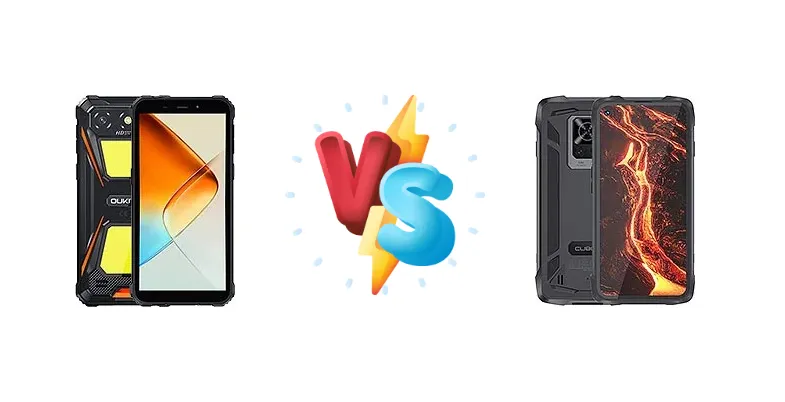
|
🏆 Quick Verdict
For the average user needing a phone that lasts for days, the Oukitel G5 is the clear winner. Its exceptional 59:23h endurance overshadows the KingKong 7’s faster processor. However, users who frequently multitask or play demanding games will find the Cubot KingKong 7’s Helio P60 a more suitable choice.
| PHONES | ||
|---|---|---|
| Phone Names | Oukitel G5 | Cubot KingKong 7 |
| Network | ||
|---|---|---|
| 2G bands | GSM 850 / 900 / 1800 / 1900 | GSM 850 / 900 / 1800 / 1900 |
| 3G bands | HSDPA 850 / 900 / 1700(AWS) / 1900 / 2100 | HSDPA 850 / 900 / 1700(AWS) / 1900 / 2100 |
| 4G bands | 1, 2, 3, 4, 5, 7, 8, 12, 17, 19, 20, 25, 26, 28, 34, 38, 39, 40, 41, 66 | 1, 2, 3, 4, 5, 7, 8, 12, 13, 17, 18, 19, 20, 25, 26, 28, 38, 40, 41, 66 |
| Speed | HSPA, LTE | HSPA, LTE |
| Technology | GSM / HSPA / LTE | GSM / CDMA / HSPA / LTE |
| Launch | ||
|---|---|---|
| Announced | 2025, May | 2022 |
| Status | Available. Released 2025, May | Available. Released 2022 |
| Body | ||
|---|---|---|
| Dimensions | 166 x 81.1 x 15 mm (6.54 x 3.19 x 0.59 in) | 166.8 x 83.5 x 14 mm (6.57 x 3.29 x 0.55 in) |
| SIM | Nano-SIM + Nano-SIM | Nano-SIM + Nano-SIM |
| Weight | 300 g (10.58 oz) | 267 g (9.42 oz) |
| Display | ||
|---|---|---|
| Protection | Corning Gorilla Glass 5, Mohs level 4 | - |
| Resolution | 576 x 1152 pixels, 18:9 ratio (~215 ppi density) | 1080 x 2300 pixels (~400 ppi density) |
| Size | 6.0 inches, 92.9 cm2 (~69.0% screen-to-body ratio) | 6.36 inches, 100.4 cm2 (~72.1% screen-to-body ratio) |
| Type | IPS LCD, 450 nits | IPS LCD |
| Platform | ||
|---|---|---|
| CPU | Quad-core (1x2.0 GHz Cortex-A75 & 3x1.8 GHz Cortex-A55) | Octa-core (4x2.0 GHz Cortex-A73 & 4x2.0 GHz Cortex-A53) |
| Chipset | Unisoc T310 (12 nm) | Mediatek MT6771V/CA Helio P60 (12 nm) |
| GPU | PowerVR GE8300 | Mali-G72 MP3 |
| OS | Android 14 | Android 11 |
| Memory | ||
|---|---|---|
| Card slot | microSDXC (uses shared SIM slot) | microSDXC (uses shared SIM slot) |
| Internal | 64GB 4GB RAM | 128GB 8GB RAM |
| Main Camera | ||
|---|---|---|
| Features | LED flash | LED flash |
| Single | 13 MP, f/2.2, (wide), 1/3.06", AF | - |
| Triple | - | 64 MP, (wide), AF 16 MP, (ultrawide) 5 MP (macro) |
| Video | Yes | Yes |
| Selfie camera | ||
|---|---|---|
| Single | 5 MP, f/2.2, (wide) | 32 MP |
| Video | 720p@30fps | Yes |
| Sound | ||
|---|---|---|
| 35mm jack | Yes | Unspecified |
| Loudspeaker | Yes | Yes |
| Comms | ||
|---|---|---|
| Bluetooth | 5.0, A2DP, LE | 4.2, A2DP |
| NFC | No | Yes |
| Positioning | GPS, GALILEO, GLONASS, BDS | GPS, GLONASS, BDS |
| Radio | FM radio | Unspecified |
| USB | USB Type-C 2.0 | USB Type-C, OTG |
| WLAN | Wi-Fi 802.11 a/b/g/n/ac, dual-band | Wi-Fi 802.11 a/b/g/n |
| Features | ||
|---|---|---|
| Sensors | Accelerometer, proximity, compass | Fingerprint (rear-mounted), accelerometer, gyro, proximity, compass |
| Battery | ||
|---|---|---|
| Charging | 10W wired | - |
| Type | Li-Po 6300 mAh | 5000 mAh |
| Misc | ||
|---|---|---|
| Colors | Black, Orange, Green | Black |
| EU LABEL | ||
|---|---|---|
| Battery | 59:23h endurance, 1000 cycles | - |
| Energy | Class B | - |
| Free fall | Class D (45 falls) | - |
| Repairability | Class C | - |
Oukitel G5
- Exceptional battery life (59:23h endurance)
- Power-efficient Unisoc T310 chipset
- 1000 charge cycles promise long-term reliability
- Slow 10W charging
- Less powerful processor for demanding tasks
Cubot KingKong 7
- More powerful Helio P60 processor
- Octa-core architecture for improved multitasking
- Potentially smoother user experience
- Shorter battery life compared to Oukitel G5
- Higher power consumption
Display Comparison
Neither device’s display specifications are provided, so a direct comparison is limited. However, given their price points, both likely utilize IPS LCD panels. The focus here will be on performance. The chipset choice will dictate the smoothness of scrolling and animations, impacting the perceived quality of the display experience.
Camera Comparison
Without detailed camera specifications, a comprehensive comparison is impossible. However, it’s reasonable to assume both phones feature basic camera setups geared towards everyday use. The absence of information regarding sensor size or optical image stabilization suggests neither device will excel in low-light photography. The focus will likely be on computational photography to enhance image quality, and the Helio P60’s image signal processor (ISP) may offer a slight edge in processing speed.
Performance
The Cubot KingKong 7’s Mediatek Helio P60, an octa-core processor with four Cortex-A73 cores clocked at 2.0 GHz, offers a significant architectural advantage over the Oukitel G5’s Unisoc T310. The Helio P60’s Cortex-A73 cores are more powerful than the G5’s single Cortex-A75 core, resulting in faster application loading times and improved multitasking. While the T310’s Cortex-A75 offers good single-core performance, the Helio P60’s eight cores provide superior overall throughput. The 12nm process node is shared between both chipsets, suggesting similar thermal characteristics, but the Helio P60 will likely draw more power under sustained load.
Battery Life
The Oukitel G5’s standout feature is its exceptional battery endurance, rated at 59:23 hours. This is likely achieved through a combination of a large battery capacity (not specified) and the power-efficient Unisoc T310 chipset. The KingKong 7, while likely possessing a respectable battery capacity, will consume more power due to its more powerful Helio P60 processor. The G5’s 10W charging is slow by modern standards, but the extended battery life mitigates this drawback. The KingKong 7’s charging speed is unknown, but a faster charging rate would be beneficial given its higher power consumption.
Buying Guide
Buy the Oukitel G5 if you need a phone primarily for communication, light social media, and navigation, and value multi-day battery life above all else. It’s ideal for outdoor workers, travelers, or anyone who dislikes frequent charging. Buy the Cubot KingKong 7 if you prefer a smoother experience with more demanding apps, enjoy occasional gaming, and don’t mind charging your phone more often. It’s better suited for users who need a more versatile device.