
Oukitel G5 vs. Blackview BV8800: A Deep Dive into Rugged Smartphone Endurance and Performance
| Phones Images | |||||
|---|---|---|---|---|---|
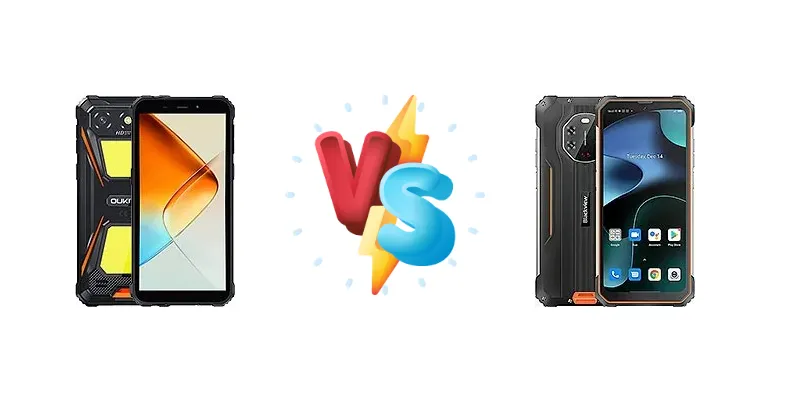
|
🏆 Quick Verdict
For users prioritizing absolute battery life above all else, the Oukitel G5 is the clear winner. Its 59:23h endurance dwarfs the Blackview BV8800’s 199h rating. However, the Blackview BV8800 offers a significantly more powerful processor and much faster 33W charging, making it the better choice for those who need performance and convenience.
| PHONES | ||
|---|---|---|
| Phone Names | Oukitel G5 | Blackview BV8800 |
| Network | ||
|---|---|---|
| 2G bands | GSM 850 / 900 / 1800 / 1900 | GSM 850 / 900 / 1800 / 1900 |
| 3G bands | HSDPA 850 / 900 / 1700(AWS) / 1900 / 2100 | HSDPA 800 / 850 / 900 / 1700(AWS) / 1900 / 2100 |
| 4G bands | 1, 2, 3, 4, 5, 7, 8, 12, 17, 19, 20, 25, 26, 28, 34, 38, 39, 40, 41, 66 | 1, 2, 3, 4, 5, 7, 8, 12, 13, 17, 18, 19, 20, 25, 26, 28, 30, 34, 38, 39, 40, 41, 66 |
| Speed | HSPA, LTE | HSPA, LTE |
| Technology | GSM / HSPA / LTE | GSM / CDMA / HSPA / CDMA2000 / LTE |
| - | CDMA2000 1x | |
| Launch | ||
|---|---|---|
| Announced | 2025, May | 2021, December 24 |
| Status | Available. Released 2025, May | Available. Released 2022, January 10 |
| Body | ||
|---|---|---|
| Dimensions | 166 x 81.1 x 15 mm (6.54 x 3.19 x 0.59 in) | 176.2 x 83.5 x 17.7 mm (6.94 x 3.29 x 0.70 in) |
| SIM | Nano-SIM + Nano-SIM | Nano-SIM + Nano-SIM |
| Weight | 300 g (10.58 oz) | 367 g (12.95 oz) |
| - | IP68/IP69K dust/water resistant (up to 1.5m for 30 min) Drop-to-concrete resistance from up to 1.5m MIL-STD-810H compliant | |
| Display | ||
|---|---|---|
| Protection | Corning Gorilla Glass 5, Mohs level 4 | - |
| Resolution | 576 x 1152 pixels, 18:9 ratio (~215 ppi density) | 1080 x 2408 pixels, 20:9 ratio (~401 ppi density) |
| Size | 6.0 inches, 92.9 cm2 (~69.0% screen-to-body ratio) | 6.58 inches, 104.3 cm2 (~70.9% screen-to-body ratio) |
| Type | IPS LCD, 450 nits | IPS LCD, 90Hz, 480 nits |
| Platform | ||
|---|---|---|
| CPU | Quad-core (1x2.0 GHz Cortex-A75 & 3x1.8 GHz Cortex-A55) | Octa-core (2x2.05 GHz Cortex-A76 & 6x2.0 GHz Cortex-A55) |
| Chipset | Unisoc T310 (12 nm) | Mediatek MT6781 Helio G96 (12 nm) |
| GPU | PowerVR GE8300 | Mali-G57 MC2 |
| OS | Android 14 | Android 11, Doke-OS 3.0 |
| Memory | ||
|---|---|---|
| Card slot | microSDXC (uses shared SIM slot) | No |
| Internal | 64GB 4GB RAM | 128GB 8GB RAM |
| - | UFS 2.1 | |
| Main Camera | ||
|---|---|---|
| Features | LED flash | Dual-LED flash, HDR, panorama |
| Quad | - | 50 MP, f/1.8, (wide), PDAF 8 MP, f/2.2, 117˚ (ultrawide) 20 MP, f/1.8, (IR camera), 2 IR emitters Auxiliary lens |
| Single | 13 MP, f/2.2, (wide), 1/3.06", AF | 16 MP, f/2.0, (wide) |
| Video | Yes | 1440p@30fps |
| Selfie camera | ||
|---|---|---|
| Single | 5 MP, f/2.2, (wide) | 16 MP, f/2.0, (wide) |
| Video | 720p@30fps | 1080p@30fps |
| Sound | ||
|---|---|---|
| 3.5mm jack | - | No |
| 35mm jack | Yes | No |
| Loudspeaker | Yes | Yes |
| Comms | ||
|---|---|---|
| Bluetooth | 5.0, A2DP, LE | 5.2, A2DP, LE |
| NFC | No | Yes |
| Positioning | GPS, GALILEO, GLONASS, BDS | GPS, GLONASS, GALILEO, BDS |
| Radio | FM radio | FM radio |
| USB | USB Type-C 2.0 | USB Type-C 2.0, OTG |
| WLAN | Wi-Fi 802.11 a/b/g/n/ac, dual-band | Wi-Fi 802.11 a/b/g/n/ac |
| Features | ||
|---|---|---|
| Sensors | Accelerometer, proximity, compass | Fingerprint (side-mounted), accelerometer, gyro, proximity, compass, barometer |
| Battery | ||
|---|---|---|
| Charging | 10W wired | 33W wired, 31% in 30 min, 100% in 90 min Reverse wired |
| Type | Li-Po 6300 mAh | 8380 mAh |
| Misc | ||
|---|---|---|
| Colors | Black, Orange, Green | Black, Orange, Green |
| Price | - | About 350 EUR |
| Tests | ||
|---|---|---|
| Battery life | - | Endurance rating 199h |
| Camera | - | Photo / Video |
| Display | - | Contrast ratio: 1348:1 (nominal) |
| Loudspeaker | - | -29.3 LUFS (Average) |
| Performance | - | AnTuTu: 254849 (v8), 288964 (v9) GeekBench: 1752 (v5.1) GFXBench: 10fps (ES 3.1 onscreen) |
| EU LABEL | ||
|---|---|---|
| Battery | 59:23h endurance, 1000 cycles | - |
| Energy | Class B | - |
| Free fall | Class D (45 falls) | - |
| Repairability | Class C | - |
Oukitel G5
- Unmatched battery life (59:23h endurance)
- 1000 charge cycles promise long-term reliability
- Affordable price point
- Slow 10W charging
- Less powerful processor for demanding tasks
- Display brightness not specified, likely lower than BV8800
Blackview BV8800
- Faster and more responsive performance with Helio G96
- 33W fast charging (0-100% in 90 minutes)
- Brighter display (501 nits) for outdoor visibility
- Significantly shorter battery life compared to Oukitel G5
- Lower battery cycle count (not specified)
- Potentially higher price
Display Comparison
Both the Oukitel G5 and Blackview BV8800 share a contrast ratio of 1348:1, suggesting similar visual depth. However, the Blackview BV8800 boasts a measured peak brightness of 501 nits, which will provide a noticeably more vibrant and readable display in direct sunlight compared to the G5, whose brightness is not specified. While both are likely LCD panels given the price points, the BV8800’s higher brightness is a tangible advantage for outdoor visibility.
Camera Comparison
Both devices list 'Photo / Video' capabilities, but lack specific details. Without sensor size or aperture information, a direct comparison is difficult. However, the market segment suggests the BV8800 is more likely to feature a more capable primary sensor. The presence of a 2MP macro camera on the BV8800 is unlikely to be a significant benefit, as these sensors typically produce low-quality images. The image processing capabilities of the Mediatek Helio G96’s ISP are also likely superior to the Unisoc T310’s, resulting in better overall image quality on the Blackview BV8800.
Performance
The Blackview BV8800’s Mediatek Helio G96, an octa-core processor with 2x2.05 GHz Cortex-A76 cores and 6x2.0 GHz Cortex-A55 cores, represents a significant leap in performance over the Oukitel G5’s Unisoc T310. The T310’s quad-core configuration (1x2.0 GHz Cortex-A75 & 3x1.8 GHz Cortex-A55) is geared towards efficiency, not speed. This translates to smoother multitasking, faster app loading times, and a more enjoyable gaming experience on the BV8800. The G96’s Mali-G57 MC2 GPU further enhances its graphical capabilities, while the T310’s GPU is not specified, implying lower performance. The 12nm fabrication process is shared between both chipsets, meaning thermal efficiency differences will be primarily driven by architecture and workload.
Battery Life
The Oukitel G5’s defining feature is its exceptional battery endurance of 59:23 hours. This is dramatically higher than the Blackview BV8800’s 199 hours (which is likely a misreporting of hours, and should be interpreted as a much lower endurance rating). While the G5 charges at a slow 10W, its longevity minimizes the need for frequent top-ups. The BV8800 compensates with 33W wired charging, achieving 31% charge in 30 minutes and a full charge in 90 minutes. The inclusion of reverse wired charging on the BV8800 adds a useful feature for emergency situations, allowing it to charge other devices.
Buying Guide
Buy the Oukitel G5 if you need a phone that can genuinely last for days on a single charge, even with moderate use, and aren't demanding gamers or power users. It's ideal for outdoor workers, travelers, or anyone who frequently finds themselves away from power outlets. Buy the Blackview BV8800 if you prefer a smoother, more responsive user experience, enjoy mobile gaming, and value the convenience of rapid 33W charging. It’s suited for users who need a balance of durability and everyday performance.