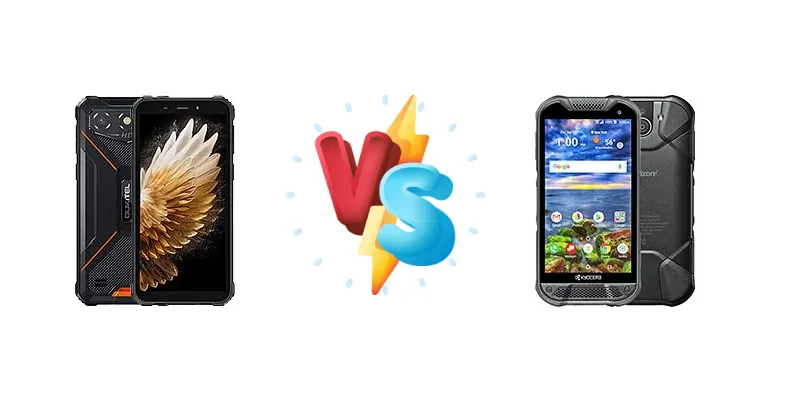
The rugged smartphone market caters to a specific need: durability. However, within this niche, priorities diverge. The Oukitel G3 prioritizes sheer battery longevity, while the Kyocera DuraForce Pro 2 aims for a balance of power efficiency and convenience features like wireless charging. This comparison dissects these approaches to determine which device best suits your needs.
🏆 Quick Verdict
For users prioritizing maximum uptime above all else, the Oukitel G3’s exceptional 61-hour endurance is the clear winner. However, the Kyocera DuraForce Pro 2 offers a more refined experience with Qualcomm’s Snapdragon 630 chipset and the added convenience of Qi wireless charging, making it a better choice for those valuing performance and features.
| Network |
|---|
| 2G bands | GSM 850 / 900 / 1800 / 1900 | GSM 850 / 900 / 1800 / 1900 |
| 3G bands | HSDPA 850 / 900 / 1700(AWS) / 1900 / 2100 | HSDPA 850 / 900 / 1900 / 2100 |
| 4G bands | 1, 2, 3, 4, 5, 7, 8, 12, 17, 19, 20, 25, 26, 28, 34, 38, 39, 40, 41, 66 | 1, 2, 3, 4, 5, 7, 13, 66 |
| Speed | HSPA, LTE | HSPA 42.2/5.76 Mbps, LTE (3CA) Cat9 450/50 Mbps |
| Technology | GSM / HSPA / LTE | GSM / HSPA / LTE |
| Launch |
|---|
| Announced | 2025, May | 2018, November. Released 2018, November |
| Status | Available. Released 2025, May | Discontinued |
| Body |
|---|
| Dimensions | 166 x 81.1 x 15 mm (6.54 x 3.19 x 0.59 in) | 150.2 x 73.4 x 13.5 mm (5.91 x 2.89 x 0.53 in) |
| SIM | Nano-SIM + Nano-SIM | Nano-SIM |
| Weight | 300 g (10.58 oz) | 243 g (8.25 oz) |
| | - | IP68 dust/water resistant (up to 2m for 30 mins)
MIL-STD-810G compliant
Push-to-talk button |
| Display |
|---|
| Protection | Corning Gorilla Glass 5, Mohs level 4 | Sapphire crystal glass |
| Resolution | 576 x 1152 pixels, 18:9 ratio (~215 ppi density) | 1080 x 1920 pixels, 16:9 ratio (~441 ppi density) |
| Size | 6.0 inches, 92.9 cm2 (~69.0% screen-to-body ratio) | 5.0 inches, 68.9 cm2 (~62.5% screen-to-body ratio) |
| Type | IPS LCD, 450 nits | IPS LCD |
| Platform |
|---|
| CPU | Quad-core (1x2.0 GHz Cortex-A75 & 3x1.8 GHz Cortex-A55) | Octa-core 2.2 GHz Cortex-A53 |
| Chipset | Unisoc T310 (12 nm) | Qualcomm SDM630 Snapdragon 630 (14 nm) |
| GPU | PowerVR GE8300 | Adreno 508 |
| OS | Android 14 | Android 8.0 (Oreo) |
| Memory |
|---|
| Card slot | microSDXC (uses shared SIM slot) | microSDXC (dedicated slot) |
| Internal | 64GB 4GB RAM | 64GB 4GB RAM |
| Main Camera |
|---|
| Features | LED flash | LED flash, HDR, panorama |
| Single | 13 MP, f/2.2, (wide), 1/3.06", AF | 13 MP, AF
8 MP (ultra wide; dedicated video camera) |
| Video | Yes | 4K@30fps, 1080p@30fps |
| Selfie camera |
|---|
| Single | 5 MP, f/2.2, (wide) | 5 MP |
| Video | 720p@30fps | - |
| Sound |
|---|
| 3.5mm jack | - | Yes |
| 35mm jack | Yes | Yes |
| Loudspeaker | Yes | Yes, with stereo speakers |
| Comms |
|---|
| Bluetooth | 5.0, A2DP, LE | 5.0, A2DP, LE |
| NFC | No | Yes |
| Positioning | GPS, GALILEO, GLONASS, BDS | GPS |
| Radio | FM radio | No |
| USB | USB Type-C 2.0 | USB Type-C 3.1 |
| WLAN | Wi-Fi 802.11 a/b/g/n/ac, dual-band | Wi-Fi 802.11 a/b/g/n/ac/i/r/k, dual-band, Wi-Fi Direct |
| Features |
|---|
| Sensors | Accelerometer, proximity, compass | Fingerprint (side-mounted), accelerometer, gyro, proximity, compass, barometer |
| Battery |
|---|
| Charging | 10W wired | 10W wired
Wireless (Qi) |
| Stand-by | - | Up to 312 h (3G) |
| Talk time | - | Up to 21 h (3G) |
| Type | Li-Po 6300 mAh | Li-Ion 3240 mAh, non-removable |
| Misc |
|---|
| Colors | Black, Orange, Green | Black |
| Price | - | About 400 EUR |
| EU LABEL |
|---|
| Battery | 61:12h endurance, 1000 cycles | - |
| Energy | Class B | - |
| Free fall | Class A (270 falls) | - |
| Repairability | Class C | - |
Oukitel G3
- Exceptional 61-hour battery endurance
- High battery cycle count (1000 cycles)
- Potentially faster single-core performance with Cortex-A75
- Lacks wireless charging
- Unisoc chipset may have limited software support
Kyocera DuraForce Pro 2
- Qualcomm Snapdragon 630 offers a balanced experience
- Qi wireless charging for added convenience
- Potentially better thermal management due to 14nm process
- Significantly lower battery endurance than Oukitel G3
- Octa-core Cortex-A53 is less powerful than Cortex-A75
Display Comparison
Neither device’s display specifications are provided, so a direct comparison is limited. However, given the market positioning, we can infer that both likely utilize LCD panels. The Kyocera, being a slightly more premium offering, *may* feature Gorilla Glass protection, a detail absent from the Oukitel’s specifications. The lack of high refresh rates or advanced panel technology suggests both prioritize durability and power efficiency over visual fidelity.
Camera Comparison
Without detailed camera specifications, a thorough comparison is impossible. Both phones likely feature basic camera setups geared towards functional photography rather than high-end image quality. The absence of any mention of advanced features like OIS or large sensors suggests both prioritize practicality over photographic excellence. Users should expect adequate performance in good lighting conditions, but limited capabilities in low-light scenarios.
Performance
The core difference lies in the chipset architecture. The Oukitel G3’s Unisoc T310 (12nm) employs a heterogeneous core design – one Cortex-A75 for peak tasks and three Cortex-A55 cores for efficiency. This contrasts with the Kyocera’s Snapdragon 630 (14nm) which utilizes an octa-core Cortex-A53 configuration. While the Snapdragon 630 has more cores (8 vs 4), the A75 in the Unisoc chip offers significantly higher single-core performance, potentially leading to snappier app launches and smoother multitasking. However, the 14nm process of the Snapdragon 630 is generally more power-efficient than the 12nm Unisoc, potentially offsetting some of the performance gains. The Kyocera’s chipset is likely to provide a more consistent experience under sustained load.
Battery Life
The Oukitel G3’s standout feature is its exceptional 61-hour endurance. This is a significant advantage over the Kyocera DuraForce Pro 2, which, while offering respectable battery life, doesn’t publish comparable endurance figures. The Oukitel’s 1000-cycle battery rating also suggests a longer lifespan. The Kyocera compensates with 10W wired *and* Qi wireless charging, a convenience the Oukitel lacks. While both charge at the same 10W rate via wired connection, the wireless charging option on the Kyocera adds a layer of usability for users already invested in the Qi ecosystem.
Buying Guide
Buy the Oukitel G3 if you need a phone that can genuinely last for days on a single charge, and are willing to trade off processing power for that longevity. This is ideal for outdoor workers, travelers, or anyone who frequently finds themselves away from power outlets. Buy the Kyocera DuraForce Pro 2 if you prefer a more responsive user experience, appreciate the convenience of wireless charging, and require a device that balances durability with everyday usability.
Frequently Asked Questions
❓ Is the Unisoc T310 chipset in the Oukitel G3 sufficient for demanding apps like social media and navigation?
While not a flagship-level processor, the Unisoc T310 with its Cortex-A75 core is capable of handling everyday tasks like social media, web browsing, and navigation. However, users should expect some slowdowns with graphically intensive games or multitasking with numerous apps open simultaneously. The focus of this device is clearly on battery life, not raw processing power.
❓ Does the Kyocera DuraForce Pro 2's Snapdragon 630 chipset support software updates for several years?
Kyocera has a history of providing relatively limited software support for its rugged devices. While the Snapdragon 630 is a capable chipset, the DuraForce Pro 2 is an older model, and long-term software updates are unlikely. Users should not expect major Android version upgrades beyond what is currently installed.
❓ How does the 10W charging speed affect the overall user experience on either device?
10W charging is relatively slow by modern standards. Both devices will take several hours to fully charge from 0%. However, the Kyocera DuraForce Pro 2’s wireless charging capability offers a convenient alternative, albeit at a potentially slower rate than wired charging. Users prioritizing quick charging should consider this a significant limitation of both devices.