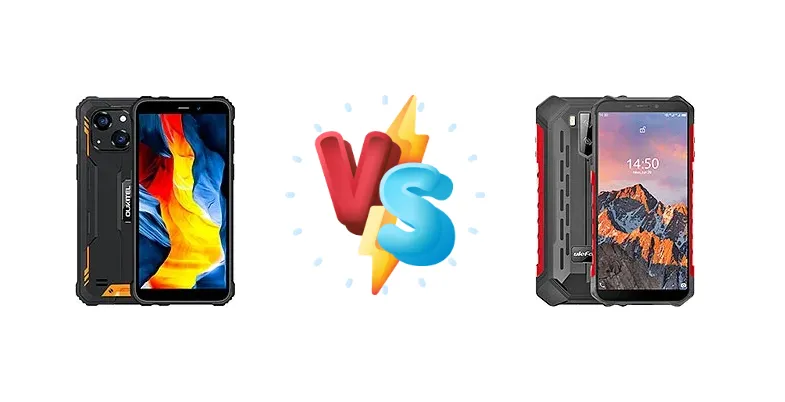
The Oukitel G2 and Ulefone Armor X5 Pro represent a compelling segment of the smartphone market: affordable, durable devices focused on practicality. While both aim to deliver value, they take different approaches to achieving it. The G2 prioritizes exceptional battery endurance, while the X5 Pro leans towards a slightly more powerful, though less efficient, processor. This comparison dissects these trade-offs to determine which phone best suits your needs.
🏆 Quick Verdict
For the average user prioritizing longevity and minimizing charging frequency, the Oukitel G2 emerges as the winner. Its Unisoc T606 chipset, coupled with a focus on efficiency, delivers a remarkable 58:56h endurance. While the Ulefone Armor X5 Pro offers a marginally faster CPU, the G2’s battery life advantage is too significant to ignore.
| Network |
|---|
| 2G bands | GSM 850 / 900 / 1800 / 1900 | GSM 850 / 900 / 1800 / 1900 |
| 3G bands | HSDPA 800 / 850 / 900 / 1700(AWS) / 1900 / 2100 | HSDPA 850 / 900 / 1700(AWS) / 1900 / 2100 |
| 4G bands | 1, 2, 3, 4, 5, 7, 8, 12, 17, 18, 19, 20, 25, 26, 28, 66 | 1, 2, 3, 4, 5, 7, 8, 12, 13, 17, 19, 20, 28 |
| Speed | HSPA, LTE | HSPA 42.2/11.5 Mbps, LTE Cat7 300/150 Mbps |
| Technology | GSM / HSPA / LTE | GSM / HSPA / LTE |
| Launch |
|---|
| Announced | 2024, September | 2020, September 08. Released 2020, September 08 |
| Status | Available. Released 2024, September | Discontinued |
| Body |
|---|
| Dimensions | 166 x 81.1 x 15.1 mm (6.54 x 3.19 x 0.59 in) | 158 x 77.5 x 13.9 mm (6.22 x 3.05 x 0.55 in) |
| SIM | Nano-SIM + Nano-SIM | Nano-SIM + Nano-SIM |
| Weight | 373 g (13.16 oz) | 235 g (8.29 oz) |
| | - | IP68 dust/water resistant (up to 1.5m for 30 min)
Drop-to-concrete resistance from up to 1.2m
MIL-STD-810G compliant |
| Display |
|---|
| Protection | Corning Gorilla Glass 5, Mohs level 5 | - |
| Resolution | 576 x 1156 pixels, 18:9 ratio (~215 ppi density) | 720 x 1440 pixels, 18:9 ratio (~293 ppi density) |
| Size | 6.0 inches, 92.7 cm2 (~68.9% screen-to-body ratio) | 5.5 inches, 78.1 cm2 (~63.8% screen-to-body ratio) |
| Type | IPS LCD | IPS LCD |
| Platform |
|---|
| CPU | Octa-core (2x1.6 GHz Cortex-A75 & 6x1.6 GHz Cortex-A55) | Octa-core 2.0 GHz Cortex-A53 |
| Chipset | Unisoc T606 (12 nm) | Mediatek MT6762V/WD Helio P22 (12 nm) |
| GPU | Mali-G57 MP1 | PowerVR GE8320 |
| OS | Android 14 | Android 10 |
| Memory |
|---|
| Card slot | microSDXC (uses shared SIM slot) | microSDXC (uses shared SIM slot) |
| Internal | 64GB 4GB RAM | 64GB 4GB RAM |
| | - | eMMC 5.1 |
| Main Camera |
|---|
| Dual | 13 MP, f/2.2, (wide), 1/3.06", PDAF
other unspecified cameras | 13 MP, f/2.0, (wide), PDAF
Auxiliary lens |
| Features | LED flash | LED flash, Panorama, HDR |
| Video | 1080p@30fps | 1080p@30fps |
| Selfie camera |
|---|
| Single | 5 MP, f/2.2, (wide), 1/5.0" | 5 MP, f/2.2 |
| Video | 720p@30fps | - |
| Sound |
|---|
| 3.5mm jack | - | Yes |
| 35mm jack | No | Yes |
| Loudspeaker | Yes | Yes |
| Comms |
|---|
| Bluetooth | 5.0, A2DP, LE | 5.0, A2DP, LE |
| NFC | No | No |
| Positioning | GPS, GLONASS, GALILEO, BDS | GPS, GLONASS, GALILEO, BDS |
| Radio | FM radio | FM radio, RDS, recording |
| USB | USB Type-C 2.0, OTG | microUSB 2.0 |
| WLAN | Wi-Fi 802.11 a/b/g/n/ac, dual-band | Wi-Fi 802.11 a/b/g/n/ac, Wi-Fi Direct |
| Features |
|---|
| Sensors | Accelerometer, proximity, compass | Accelerometer, proximity, compass |
| Battery |
|---|
| Charging | 10W wired | 10W wired |
| Type | Li-Po 6300 mAh | Li-Po 5000 mAh |
| Misc |
|---|
| Colors | Black, Green, Orange | Black, Orange, Red |
| Price | About 110 EUR | About 110 EUR |
| EU LABEL |
|---|
| Battery | 58:56h endurance, 1000 cycles | - |
| Energy | Class B | - |
| Free fall | Class A (270 falls) | - |
| Repairability | Class C | - |
Oukitel G2
- Exceptional battery life (58:56h endurance)
- Efficient Unisoc T606 processor
- Potentially longer battery lifespan (1000 cycles)
- Potentially slower performance in demanding tasks
- Display specifications are unknown
Ulefone Armor X5 Pro
- Slightly faster CPU clock speed (2.0 GHz)
- Rugged design (likely more durable display)
- Familiar Mediatek chipset
- Significantly shorter battery life
- Less efficient processor architecture
Display Comparison
Neither device boasts a standout display. Both are likely to feature LCD panels common in this price bracket. The focus here isn't on visual fidelity, but durability. The Ulefone Armor X5 Pro, being a rugged phone, likely has a more robust display construction, potentially with Gorilla Glass, though this isn't specified. The Oukitel G2's display specs are unavailable, but it's reasonable to assume a similar level of protection given its target market. Brightness and color accuracy are likely comparable and adequate for outdoor visibility, but not exceptional.
Camera Comparison
Camera performance is unlikely to be a key differentiator. Both phones likely feature basic camera setups geared towards casual photography. Without specific sensor details, it's difficult to make a definitive judgment. However, the inclusion of a 2MP macro camera on the X5 Pro is a common marketing tactic that rarely delivers significant image quality improvements. The primary sensor quality and image processing algorithms will be more crucial, and without further information, we can assume similar results in most lighting conditions. Focusing on practical use, both will likely suffice for social media sharing, but not for serious photography.
Performance
The core difference lies in the chipset. The Oukitel G2 utilizes the Unisoc T606 (12nm), an octa-core processor with a mix of Cortex-A75 and A55 cores clocked at 1.6 GHz. This configuration prioritizes efficiency. Conversely, the Ulefone Armor X5 Pro features the Mediatek Helio P22 (12nm) with eight Cortex-A53 cores running at 2.0 GHz. While the higher clock speed suggests faster performance in benchmarks, the older Cortex-A53 architecture is less efficient than the A75 cores found in the G2. This translates to potentially shorter battery life under load. The G2’s architecture is better suited for sustained tasks, while the X5 Pro may exhibit more noticeable throttling during prolonged gaming or demanding applications.
Battery Life
This is where the Oukitel G2 truly shines. Its reported 58:56h endurance is exceptional for a budget smartphone. This is a direct result of the efficient Unisoc T606 chipset and likely a larger battery capacity (though not specified). The Ulefone Armor X5 Pro, while offering 10W wired charging like the G2, will require more frequent charging due to the less efficient Helio P22. The G2’s 1000 charge cycle claim suggests a focus on long-term battery health, implying a more robust battery management system.
Buying Guide
Buy the Oukitel G2 if you need a phone that can reliably last for days on a single charge, making it ideal for travelers, outdoor enthusiasts, or anyone who dislikes frequent charging. Buy the Ulefone Armor X5 Pro if you prioritize slightly snappier application loading times and occasional light gaming, and are willing to compromise on overall battery life. The X5 Pro may also appeal to those who prefer a more familiar Mediatek chipset.
Frequently Asked Questions
❓ Will the Unisoc T606 in the Oukitel G2 struggle with modern mobile games?
While the Unisoc T606 isn't a gaming powerhouse, it's capable of running many popular mobile games at medium settings. The focus of this chipset is efficiency, so expect playable frame rates with some graphical compromises. The Ulefone's Helio P22 might offer slightly better peak performance, but the G2's sustained performance could be more consistent due to better thermal management.
❓ Is the Ulefone Armor X5 Pro truly 'rugged'? What kind of protection does it offer?
The 'Armor' in the name suggests a degree of ruggedization. While specific certifications (IP68, MIL-STD-810G) aren't provided, it likely features reinforced corners, a durable chassis, and potentially a more scratch-resistant display than the Oukitel G2. This makes it a better choice for users working in demanding environments or prone to dropping their phones.
❓ How long does it realistically take to charge both phones from 0% to 100% with the 10W charger?
With a 10W charger, both phones will likely take around 3-4 hours to fully charge. The Ulefone Armor X5 Pro, with its less efficient processor and potentially larger battery, might take slightly longer. The Oukitel G2’s superior efficiency could shave off some charging time, but the difference won’t be dramatic.