
Oukitel G1 vs Ulefone Armor 7E: A Deep Dive into Rugged Smartphone Performance
| Phones Images | |||||
|---|---|---|---|---|---|
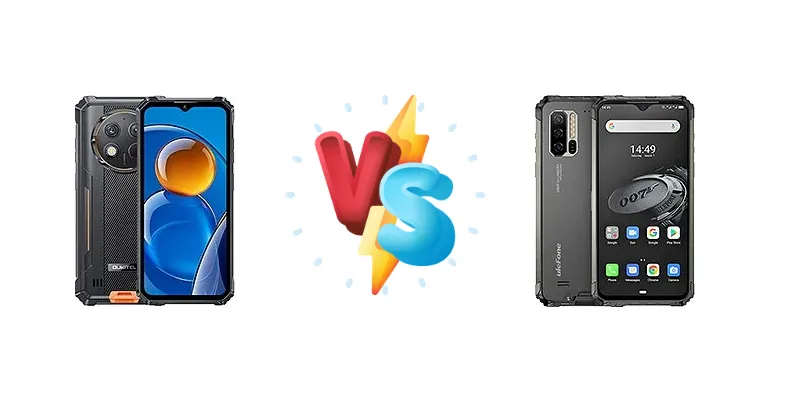
|
🏆 Quick Verdict
For the average user prioritizing longevity and consistent performance, the Oukitel G1 emerges as the better choice. Its Unisoc T606 chipset, coupled with a remarkable 100-hour battery endurance, provides a more reliable experience for extended use, outweighing the Armor 7E's faster processor but shorter battery life.
| PHONES | ||
|---|---|---|
| Phone Names | Oukitel G1 | Ulefone Armor 7E |
| Network | ||
|---|---|---|
| 2G bands | GSM 850 / 900 / 1800 / 1900 | GSM 850 / 900 / 1800 / 1900 |
| 3G bands | HSDPA 850 / 900 / 1700(AWS) / 1900 / 2100 | HSDPA 850 / 900 / 1700(AWS) / 1900 / 2100 |
| 4G bands | 1, 2, 3, 4, 5, 7, 8, 12, 17, 18, 19, 20, 25, 26, 28, 38, 40, 41, 66 | 1, 2, 3, 4, 5, 7, 8, 12, 13, 17, 18, 19, 20, 25, 26, 28, 34, 38, 39, 40, 41, 66, 71 |
| Speed | HSPA, LTE | HSPA 42.2/11.5 Mbps, LTE (2CA) Cat13 600/150 Mbps |
| Technology | GSM / HSPA / LTE | GSM / CDMA / HSPA / EVDO / LTE |
| - | CDMA2000 1xEV-DO | |
| Launch | ||
|---|---|---|
| Announced | 2024, September | 2020, March 30. Released 2020, March 30 |
| Status | Available. Released 2024, September | Discontinued |
| Body | ||
|---|---|---|
| Dimensions | 174.2 x 82.3 x 17.4 mm (6.86 x 3.24 x 0.69 in) | 165.9 x 81 x 13.6 mm (6.53 x 3.19 x 0.54 in) |
| SIM | Nano-SIM | Nano-SIM + Nano-SIM |
| Weight | 373 g (13.16 oz) | 290 g (10.23 oz) |
| - | IP68 dust/water resistant Drop-to-concrete resistance from up to 1.2m MIL-STD-810G compliant | |
| Display | ||
|---|---|---|
| Protection | Corning Gorilla Glass 5, Mohs level 5 | - |
| Resolution | 576 x 1280 pixels, 20:9 ratio (~215 ppi density) | 1080 x 2340 pixels, 19.5:9 ratio (~409 ppi density) |
| Size | 6.52 inches, 102.6 cm2 (~71.6% screen-to-body ratio) | 6.3 inches, 97.4 cm2 (~72.5% screen-to-body ratio) |
| Type | IPS LCD, 400 nits | IPS LCD |
| Platform | ||
|---|---|---|
| CPU | Octa-core (2x1.6 GHz Cortex-A75 & 6x1.6 GHz Cortex-A55) | Octa-core (2x2.2 GHz Cortex-A75 & 6x2.0 GHz Cortex-A55) |
| Chipset | Unisoc T606 (12 nm) | Mediatek MT6779 Helio P90 (12 nm) |
| GPU | Mali-G57 MP1 | PowerVR GM9446 |
| OS | Android 14 | Android 9.0 (Pie) |
| Memory | ||
|---|---|---|
| Card slot | microSDXC | microSDXC (uses shared SIM slot) |
| Internal | 256GB 6GB RAM | 128GB 4GB RAM |
| Main Camera | ||
|---|---|---|
| Dual | 48 MP, f/1.8, (wide), 1/2.0", PDAF 2 MP (macro) | - |
| Features | LED flash, panorama | 5-LED flash, HDR, panorama |
| Triple | - | 48 MP, f/1.7, (wide), 1/2.0", 0.8µm, PDAF 2 MP (macro) Auxiliary lens |
| Video | 1080p@30fps | 4K@30fps, 1080p@30fps |
| Selfie camera | ||
|---|---|---|
| Single | 5 MP, f/2.2, (wide), 1/5.0" | 16 MP, f/2.0, (wide), 1/3.06", 1.0µm |
| Video | 720p@30fps | 1080p@30fps |
| Sound | ||
|---|---|---|
| 3.5mm jack | - | No |
| 35mm jack | No | No |
| Loudspeaker | Yes | Yes |
| Comms | ||
|---|---|---|
| Bluetooth | 5.0, A2DP, LE | 5.0, A2DP, LE |
| NFC | Yes | Yes |
| Positioning | GPS, GLONASS, GALILEO, BDS | GPS, GLONASS, GALILEO, BDS |
| Radio | FM radio | Stereo FM radio, RDS, recording |
| USB | USB Type-C 2.0, OTG | USB Type-C 2.0, OTG |
| WLAN | Wi-Fi 802.11 a/b/g/n/ac, dual-band | Wi-Fi 802.11 a/b/g/n/ac, dual-band, Wi-Fi Direct |
| Features | ||
|---|---|---|
| Sensors | Accelerometer, proximity, compass | Fingerprint (side-mounted), accelerometer, gyro, proximity, compass, heart rate, baroceptor, coulombmeter |
| Battery | ||
|---|---|---|
| Charging | 18W wired | 15W wired 10W wireless |
| Type | Li-Po 10600 mAh | Li-Po 5500 mAh |
| Misc | ||
|---|---|---|
| Colors | Black, Orange, Green | Black |
| Price | About 160 EUR | About 250 EUR |
| EU LABEL | ||
|---|---|---|
| Battery | 100:16h endurance, 1000 cycles | - |
| Energy | Class B | - |
| Free fall | Class A (270 falls) | - |
| Repairability | Class C | - |
Oukitel G1
- Exceptional 100-hour battery life
- Long-lasting battery health (1000 cycles)
- Power-efficient Unisoc T606 chipset
- Slightly faster 18W wired charging
- Less powerful CPU compared to the Armor 7E
- Display specifications unknown
Ulefone Armor 7E
- Faster MediaTek Helio P90 processor
- 10W wireless charging support
- Potentially better camera performance (speculation)
- More responsive user experience
- Shorter battery life
- Lower battery cycle count (assumed)
Display Comparison
Neither device's display specifications are provided, so a direct comparison is limited. However, given the rugged nature of both phones, we can assume they utilize durable, scratch-resistant glass. The Armor 7E's inclusion of 10W wireless charging suggests a more modern feature set, potentially indicating a slightly more advanced display technology, though this is speculative. The Oukitel G1, focusing on core functionality, likely opts for a cost-effective, reliable panel.
Camera Comparison
Camera specifications are not provided for either device. Given the market segment, both phones likely feature a multi-camera setup geared towards outdoor photography. However, without sensor size or aperture information, a meaningful comparison is impossible. It’s reasonable to assume the Armor 7E, being the slightly more premium device, may have a larger primary sensor, potentially offering better low-light performance. The inclusion of a 2MP macro lens on either device is likely a marketing feature with limited practical benefit.
Performance
The Ulefone Armor 7E boasts the MediaTek Helio P90, featuring a dual-core Cortex-A75 cluster clocked at 2.2 GHz, paired with a hexa-core Cortex-A55 cluster at 2.0 GHz. This contrasts with the Oukitel G1’s Unisoc T606, which has a dual-core Cortex-A75 at 1.6 GHz and a hexa-core Cortex-A55 at 1.6 GHz. The higher clock speeds of the P90 translate to demonstrably faster CPU performance, particularly in single-core tasks. However, the T606’s 12nm process node is identical to the P90, meaning thermal efficiency differences will be minimal. The Armor 7E will offer a snappier experience for demanding apps, but the G1’s chipset is optimized for power efficiency, contributing to its exceptional battery life.
Battery Life
The Oukitel G1’s standout feature is its 100-hour endurance rating and 1000 charge cycles, indicating a significantly larger battery capacity than the Armor 7E. While the Armor 7E offers 15W wired and 10W wireless charging, the G1’s 18W wired charging is slightly faster. The Armor 7E’s wireless charging is a convenience feature, but the G1’s extended battery life negates the need for frequent charging, making the wireless capability less crucial. The G1’s 1000 charge cycle claim also suggests a more durable battery that will retain capacity longer over the phone’s lifespan.
Buying Guide
Buy the Oukitel G1 if you need a phone that can genuinely last for days on a single charge, and your primary use cases involve everyday tasks, communication, and moderate media consumption. It’s ideal for outdoor workers, travelers, or anyone who dislikes frequent charging. Buy the Ulefone Armor 7E if you prioritize faster application loading times and smoother multitasking, and are willing to compromise on battery life. This phone is better suited for users who engage in more demanding tasks like gaming or video editing, and don't mind charging more frequently.