
Oukitel G1 vs WP210: A Deep Dive into Rugged Smartphone Performance and Battery Life
| Phones Images | |||||
|---|---|---|---|---|---|
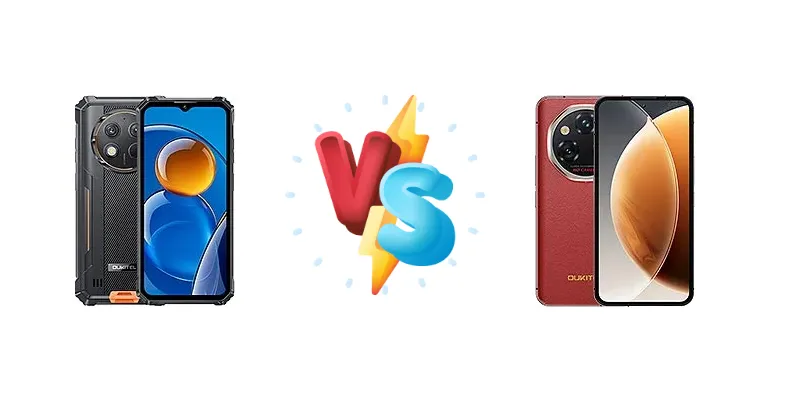
|
🏆 Quick Verdict
For the average user prioritizing raw performance and future-proofing, the Oukitel WP210 is the clear winner. Its Mediatek Dimensity 8200 chipset offers a substantial upgrade over the G1's Unisoc T606. However, the G1 remains a compelling option for those who value exceptional battery endurance and a lower price point.
| PHONES | ||
|---|---|---|
| Phone Names | Oukitel G1 | Oukitel WP210 |
| Network | ||
|---|---|---|
| 2G bands | GSM 850 / 900 / 1800 / 1900 | GSM 850 / 900 / 1800 / 1900 |
| 3G bands | HSDPA 850 / 900 / 1700(AWS) / 1900 / 2100 | HSDPA 800 / 850 / 900 / 1700(AWS) / 1900 / 2100 |
| 4G bands | 1, 2, 3, 4, 5, 7, 8, 12, 17, 18, 19, 20, 25, 26, 28, 38, 40, 41, 66 | 1, 2, 3, 4, 5, 7, 8, 12, 13, 17, 18, 19, 20, 25, 26, 28, 34, 38, 39, 40, 41, 66, 71 |
| 5G bands | - | 1, 2, 3, 5, 7, 8, 12, 20, 25, 28, 34, 38, 39, 40, 41, 48, 66, 71, 77, 78 SA/NSA |
| Speed | HSPA, LTE | HSPA, LTE, 5G |
| Technology | GSM / HSPA / LTE | GSM / HSPA / LTE / 5G |
| Launch | ||
|---|---|---|
| Announced | 2024, September | 2025, July |
| Status | Available. Released 2024, September | Available. Released 2025, July 15 |
| Body | ||
|---|---|---|
| Dimensions | 174.2 x 82.3 x 17.4 mm (6.86 x 3.24 x 0.69 in) | 163.6 x 77.9 x 13.7 mm (6.44 x 3.07 x 0.54 in) |
| SIM | Nano-SIM | Nano-SIM + Nano-SIM |
| Weight | 373 g (13.16 oz) | 311 g (10.97 oz) |
| Display | ||
|---|---|---|
| Protection | Corning Gorilla Glass 5, Mohs level 5 | Corning Gorilla Glass 5, Mohs level 5 |
| Resolution | 576 x 1280 pixels, 20:9 ratio (~215 ppi density) | 1080 x 2408 pixels, 20:9 ratio (~394 ppi density) |
| Size | 6.52 inches, 102.6 cm2 (~71.6% screen-to-body ratio) | 6.7 inches, 108.1 cm2 (~84.9% screen-to-body ratio) |
| Type | IPS LCD, 400 nits | IPS LCD, 120Hz, 500 nits |
| Platform | ||
|---|---|---|
| CPU | Octa-core (2x1.6 GHz Cortex-A75 & 6x1.6 GHz Cortex-A55) | Octa-core (1x3.1 GHz Cortex-A78 & 3x3.0 GHz Cortex-A78 & 4x2.0 GHz Cortex-A55) |
| Chipset | Unisoc T606 (12 nm) | Mediatek Dimensity 8200 (4 nm) |
| GPU | Mali-G57 MP1 | Mali-G610 MC6 |
| OS | Android 14 | Android 15 |
| Memory | ||
|---|---|---|
| Card slot | microSDXC | microSDXC (uses shared SIM slot) |
| Internal | 256GB 6GB RAM | 512GB 12GB RAM |
| Main Camera | ||
|---|---|---|
| Dual | 48 MP, f/1.8, (wide), 1/2.0", PDAF 2 MP (macro) | - |
| Features | LED flash, panorama | LED flash, HDR, panorama |
| Triple | - | 108 MP, f/1.9, (wide), 1/1.8", PDAF 2 MP (macro) Auxiliary lens |
| Video | 1080p@30fps | 4K@30fps |
| Selfie camera | ||
|---|---|---|
| Single | 5 MP, f/2.2, (wide), 1/5.0" | 32 MP, f/2.2, (wide), 1/2.74" |
| Video | 720p@30fps | 1080p@30fps |
| Sound | ||
|---|---|---|
| 35mm jack | No | No |
| Loudspeaker | Yes | Yes |
| Comms | ||
|---|---|---|
| Bluetooth | 5.0, A2DP, LE | 5.3, A2DP, LE |
| NFC | Yes | Yes |
| Positioning | GPS, GLONASS, GALILEO, BDS | GPS (L1+L5), GLONASS, GALILEO, BDS |
| Radio | FM radio | FM radio |
| USB | USB Type-C 2.0, OTG | USB Type-C 2.0 |
| WLAN | Wi-Fi 802.11 a/b/g/n/ac, dual-band | Wi-Fi 802.11 a/b/g/n/ac/6, dual-band |
| Features | ||
|---|---|---|
| Sensors | Accelerometer, proximity, compass | Fingerprint (side-mounted), accelerometer, gyro, proximity, compass |
| Battery | ||
|---|---|---|
| Charging | 18W wired | 45W wired |
| Type | Li-Po 10600 mAh | Li-Po 8800 mAh |
| Misc | ||
|---|---|---|
| Colors | Black, Orange, Green | Gray, Black, Red |
| Price | About 160 EUR | - |
| EU LABEL | ||
|---|---|---|
| Battery | 100:16h endurance, 1000 cycles | 86:17h endurance, 1000 cycles |
| Energy | Class B | Class B |
| Free fall | Class A (270 falls) | Class A (270 falls) |
| Repairability | Class C | Class C |
Oukitel G1
- Exceptional battery endurance (100 hours)
- More affordable price point
- Rugged design for durability
- Significantly slower processor
- Slower charging speed (18W)
Oukitel WP210
- Flagship-level performance (Dimensity 8200)
- Faster charging (45W)
- Likely superior camera system
- Shorter battery endurance (86 hours)
- Higher price tag
Display Comparison
Neither device's display specifications are provided, so a direct comparison is limited. However, given the WP210's higher positioning, it likely features a higher resolution and potentially a higher refresh rate panel. The G1, focusing on cost-effectiveness, likely utilizes a standard 60Hz display. Both are likely to feature ruggedized glass for impact resistance, a key feature of Oukitel's lineup.
Camera Comparison
Without specific camera details, analysis is limited. However, the WP210’s higher price point suggests a more capable camera system. While both likely include multiple lenses, the WP210 likely features a larger primary sensor and more advanced image processing capabilities. The G1 likely prioritizes functionality over image quality, while the WP210 aims to deliver a more competitive photography experience. We can assume both will have a dedicated night mode, but the WP210's image signal processor will likely handle low-light scenarios more effectively.
Performance
The performance gap between these two devices is substantial. The Oukitel WP210’s Mediatek Dimensity 8200, built on a 4nm process, is a flagship-level chipset. Its octa-core configuration – 1x3.1 GHz Cortex-A78, 3x3.0 GHz Cortex-A78, and 4x2.0 GHz Cortex-A55 – delivers significantly higher CPU and GPU performance compared to the G1’s Unisoc T606 (2x1.6 GHz Cortex-A75 & 6x1.6 GHz Cortex-A55). The 4nm node also translates to improved thermal efficiency, reducing throttling during sustained workloads. The G1’s T606 is adequate for everyday tasks, but will struggle with demanding games or heavy multitasking. The WP210 is designed for a much more fluid user experience.
Battery Life
The Oukitel G1 boasts a 100-hour battery endurance rating, while the WP210 achieves 86 hours. While the WP210’s endurance is slightly lower, its 45W wired charging is a significant advantage over the G1’s 18W charging. This means the WP210 can replenish its battery much faster, mitigating the endurance difference. The G1’s longevity is ideal for users who prioritize minimizing charging frequency, while the WP210 offers a balance of endurance and quick top-ups. Both devices claim 1000 charge cycles, indicating a focus on long-term battery health.
Buying Guide
Buy the Oukitel G1 if you need a dependable, long-lasting phone for basic tasks, outdoor work, or situations where access to charging is limited. Its 100-hour battery endurance is ideal for extended trips. Buy the Oukitel WP210 if you prefer a smoother, faster experience for gaming, multitasking, and demanding applications, and are willing to trade some battery life for significantly improved processing power and 5G connectivity.