
Oukitel G1 vs Doogee S96 Pro: A Deep Dive into Rugged Smartphone Performance
| Phones Images | |||||
|---|---|---|---|---|---|
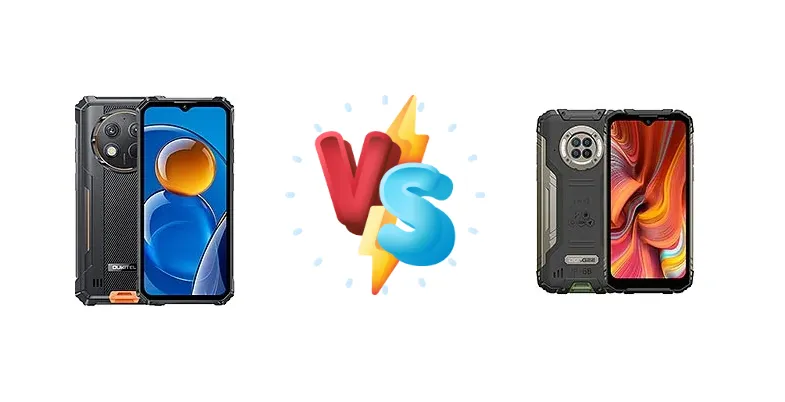
|
🏆 Quick Verdict
For the average user prioritizing sustained operation and value, the Oukitel G1 emerges as the stronger choice. Its impressive 16-hour battery endurance and 1000 charge cycles outweigh the Doogee S96 Pro’s faster processor, especially considering the S96 Pro’s more aggressive power consumption.
| PHONES | ||
|---|---|---|
| Phone Names | Oukitel G1 | Doogee S96 Pro |
| Network | ||
|---|---|---|
| 2G bands | GSM 850 / 900 / 1800 / 1900 | GSM 850 / 900 / 1800 / 1900 |
| 3G bands | HSDPA 850 / 900 / 1700(AWS) / 1900 / 2100 | HSDPA 800 / 850 / 900 / 1700(AWS) / 1900 / 2100 |
| 4G bands | 1, 2, 3, 4, 5, 7, 8, 12, 17, 18, 19, 20, 25, 26, 28, 38, 40, 41, 66 | 1, 2, 3, 4, 5, 7, 8, 12, 13, 17, 18, 19, 20, 25, 26, 28, 38, 40, 66 |
| Speed | HSPA, LTE | HSPA, LTE |
| Technology | GSM / HSPA / LTE | GSM / CDMA / HSPA / LTE |
| Launch | ||
|---|---|---|
| Announced | 2024, September | 2020, October 26. Released 2020, November |
| Status | Available. Released 2024, September | Discontinued |
| Body | ||
|---|---|---|
| Dimensions | 174.2 x 82.3 x 17.4 mm (6.86 x 3.24 x 0.69 in) | 167 x 81.4 x 15.5 mm (6.57 x 3.20 x 0.61 in) |
| SIM | Nano-SIM | Nano-SIM + Nano-SIM |
| Weight | 373 g (13.16 oz) | 310 g (10.93 oz) |
| Display | ||
|---|---|---|
| Protection | Corning Gorilla Glass 5, Mohs level 5 | Corning Gorilla Glass |
| Resolution | 576 x 1280 pixels, 20:9 ratio (~215 ppi density) | 720 x 1520 pixels, 19:9 ratio (~270 ppi density) |
| Size | 6.52 inches, 102.6 cm2 (~71.6% screen-to-body ratio) | 6.22 inches, 96.6 cm2 (~71.0% screen-to-body ratio) |
| Type | IPS LCD, 400 nits | IPS LCD |
| Platform | ||
|---|---|---|
| CPU | Octa-core (2x1.6 GHz Cortex-A75 & 6x1.6 GHz Cortex-A55) | Octa-core (2x2.0 GHz Cortex-A76 & 6x2.0 GHz Cortex-A55) |
| Chipset | Unisoc T606 (12 nm) | Mediatek MT6785 Helio G90 (12 nm) |
| GPU | Mali-G57 MP1 | Mali-G76 MC4 |
| OS | Android 14 | Android 10 |
| Memory | ||
|---|---|---|
| Card slot | microSDXC | microSDXC (dedicated slot) |
| Internal | 256GB 6GB RAM | 128GB 8GB RAM |
| Main Camera | ||
|---|---|---|
| Dual | 48 MP, f/1.8, (wide), 1/2.0", PDAF 2 MP (macro) | - |
| Features | LED flash, panorama | Quad-LED flash, HDR, panorama |
| Quad | - | 48 MP, f/1.8, (wide), PDAF 8 MP, f/2.2, 130˚, (ultrawide) 20 MP, f/2.8, (night vision), 4 infrared night vision lights 2 MP (macro) |
| Video | 1080p@30fps | 1080p |
| Selfie camera | ||
|---|---|---|
| Single | 5 MP, f/2.2, (wide), 1/5.0" | 16 MP, f/2.0, (wide) |
| Video | 720p@30fps | 1080p |
| Sound | ||
|---|---|---|
| 35mm jack | No | Yes |
| Loudspeaker | Yes | Yes |
| Comms | ||
|---|---|---|
| Bluetooth | 5.0, A2DP, LE | 5.0, A2DP, LE |
| NFC | Yes | Yes |
| Positioning | GPS, GLONASS, GALILEO, BDS | GPS, GLONASS, BDS, GALILEO |
| Radio | FM radio | FM radio |
| USB | USB Type-C 2.0, OTG | USB Type-C 2.0, OTG |
| WLAN | Wi-Fi 802.11 a/b/g/n/ac, dual-band | Wi-Fi 802.11 a/b/g/n/ac, dual-band |
| Features | ||
|---|---|---|
| Sensors | Accelerometer, proximity, compass | Fingerprint (side-mounted), accelerometer, gyro, proximity, compass |
| Battery | ||
|---|---|---|
| Charging | 18W wired | 24W wired 10W wireless |
| Type | Li-Po 10600 mAh | 6350 mAh |
| Misc | ||
|---|---|---|
| Colors | Black, Orange, Green | Black, Orange, Green |
| Price | About 160 EUR | About 280 EUR |
| EU LABEL | ||
|---|---|---|
| Battery | 100:16h endurance, 1000 cycles | - |
| Energy | Class B | - |
| Free fall | Class A (270 falls) | - |
| Repairability | Class C | - |
Oukitel G1
- Exceptional 16-hour battery endurance
- Impressive 1000 charge cycle battery lifespan
- More affordable price point (likely)
- Less powerful processor for demanding tasks
- Slower charging speeds (18W)
Doogee S96 Pro
- Faster and more responsive performance with Helio G90
- Faster 24W wired and 10W wireless charging
- Potentially better camera image processing
- Shorter battery life due to power-hungry chipset
- Likely a higher price tag
Display Comparison
Neither device’s display specifications are provided, so a direct comparison is limited. However, given the price points, we can assume both utilize IPS LCD panels. The S96 Pro’s more powerful chipset *could* support a higher refresh rate display, offering smoother scrolling and animations, but this is speculative. The G1’s focus on endurance suggests a potentially more conservatively tuned display to minimize power draw.
Camera Comparison
Without detailed camera specifications, a precise comparison is difficult. However, the chipset difference suggests the S96 Pro will likely have superior image signal processing (ISP) capabilities, resulting in better dynamic range and noise reduction. The G90’s ISP can handle higher resolution sensors and faster frame rates. While both phones likely include multiple cameras, the S96 Pro’s processing power allows for more sophisticated computational photography features. We anticipate the G1’s camera performance to be adequate for casual use, but the S96 Pro will deliver more detailed and vibrant images.
Performance
The Doogee S96 Pro’s Mediatek Helio G90 chipset represents a significant performance leap over the Oukitel G1’s Unisoc T606. The G90 features a Cortex-A76 based CPU core clocked at 2.0 GHz, compared to the G1’s 1.6 GHz Cortex-A75 cores. This translates to noticeably faster application loading times and smoother multitasking. The G90’s Mali-G76 MC4 GPU also provides a substantial advantage in gaming performance. However, this performance comes at a cost; the G90 is more power-hungry, impacting the S96 Pro’s overall battery life. The Unisoc T606 in the G1 is a capable chip for everyday tasks, but will struggle with graphically intensive games.
Battery Life
The Oukitel G1 boasts a remarkable 16-hour endurance rating, coupled with a 1000-cycle battery lifespan. This indicates a focus on long-term battery health and sustained usage. The Doogee S96 Pro, while offering faster 24W wired and 10W wireless charging, doesn’t specify endurance. The G90’s higher power consumption will necessitate more frequent charging. The 24W charging on the S96 Pro will significantly reduce 0-100% charge times compared to the G1’s 18W charging, but the G1’s longevity and endurance are compelling advantages for users prioritizing uptime.
Buying Guide
Buy the Oukitel G1 if you need a phone that will reliably last through multi-day trips, work in remote locations, or simply want peace of mind regarding battery life. It’s ideal for hikers, construction workers, or anyone who frequently finds themselves away from power outlets. Buy the Doogee S96 Pro if you prioritize responsiveness for gaming or demanding applications and value the convenience of 24W wired and 10W wireless charging, even at the cost of reduced battery longevity.