
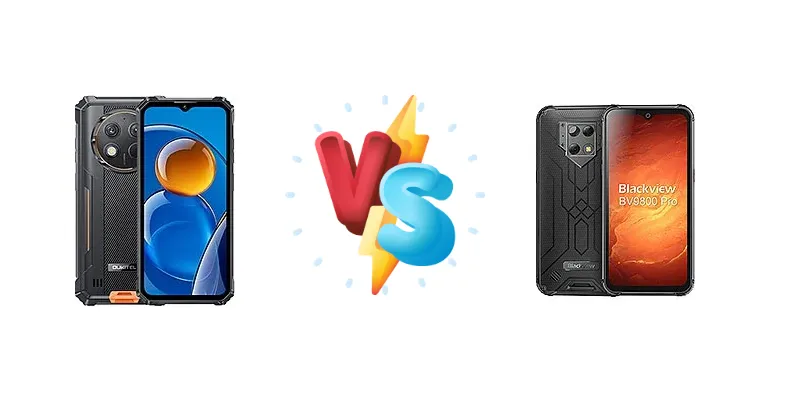
Oukitel G1 vs Blackview BV9800 Pro: A Deep Dive into Rugged Smartphone Choices
| Phones Images | |||||
|---|---|---|---|---|---|
|
🏆 Quick Verdict
For the average user prioritizing all-day (and multi-day) battery life and reliable performance for basic tasks, the Oukitel G1 is the better choice. Its 100-hour endurance rating and 1000 charge cycles offer peace of mind. However, users demanding more processing power for gaming or demanding applications will find the Blackview BV9800 Pro’s Helio P70 a more suitable option.
| PHONES | ||
|---|---|---|
| Phone Names | Oukitel G1 | Blackview BV9800 Pro |
| Network | ||
|---|---|---|
| 2G bands | GSM 850 / 900 / 1800 / 1900 | GSM 850 / 900 / 1800 / 1900 |
| 3G bands | HSDPA 850 / 900 / 1700(AWS) / 1900 / 2100 | HSDPA 800 / 850 / 900 / 1700(AWS) / 1900 / 2100 |
| 4G bands | 1, 2, 3, 4, 5, 7, 8, 12, 17, 18, 19, 20, 25, 26, 28, 38, 40, 41, 66 | 1, 2, 3, 4, 5, 6, 7, 8, 12, 13, 17, 18, 19, 20, 25, 26, 28, 34, 38, 39, 40, 41, 66 |
| Speed | HSPA, LTE | HSPA, LTE |
| Technology | GSM / HSPA / LTE | GSM / CDMA / HSPA / CDMA2000 / LTE |
| Launch | ||
|---|---|---|
| Announced | 2024, September | 2019, October 28. Released 2019, November |
| Status | Available. Released 2024, September | Discontinued |
| Body | ||
|---|---|---|
| Dimensions | 174.2 x 82.3 x 17.4 mm (6.86 x 3.24 x 0.69 in) | 168.5 x 81 x 14.8 mm (6.63 x 3.19 x 0.58 in) |
| SIM | Nano-SIM | Nano-SIM + Nano-SIM |
| Weight | 373 g (13.16 oz) | 322 g (11.36 oz) |
| Display | ||
|---|---|---|
| Protection | Corning Gorilla Glass 5, Mohs level 5 | - |
| Resolution | 576 x 1280 pixels, 20:9 ratio (~215 ppi density) | 1080 x 2340 pixels, 19.5:9 ratio (~409 ppi density) |
| Size | 6.52 inches, 102.6 cm2 (~71.6% screen-to-body ratio) | 6.3 inches, 97.4 cm2 (~71.4% screen-to-body ratio) |
| Type | IPS LCD, 400 nits | IPS LCD |
| Platform | ||
|---|---|---|
| CPU | Octa-core (2x1.6 GHz Cortex-A75 & 6x1.6 GHz Cortex-A55) | Octa-core (4x2.1 GHz Cortex-A73 & 4x2.0 GHz Cortex-A53) |
| Chipset | Unisoc T606 (12 nm) | Mediatek MT6771V/CT Helio P70 (12 nm) |
| GPU | Mali-G57 MP1 | Mali-G72 MP3 |
| OS | Android 14 | Android 9.0 (Pie) |
| Memory | ||
|---|---|---|
| Card slot | microSDXC | microSDXC |
| Internal | 256GB 6GB RAM | 128GB 6GB RAM |
| Main Camera | ||
|---|---|---|
| Dual | 48 MP, f/1.8, (wide), 1/2.0", PDAF 2 MP (macro) | - |
| Features | LED flash, panorama | Thermal imaging, LED flash |
| Triple | - | 48 MP, (wide), PDAF 5 MP, thermal assisted camera FLIR thermal camera (Lepton module) |
| Video | 1080p@30fps | 1080p@30fps |
| Selfie camera | ||
|---|---|---|
| Single | 5 MP, f/2.2, (wide), 1/5.0" | 16 MP, f/2.0, (wide) |
| Video | 720p@30fps | 1080p@30fps |
| Sound | ||
|---|---|---|
| 35mm jack | No | Yes |
| Loudspeaker | Yes | Yes |
| Comms | ||
|---|---|---|
| Bluetooth | 5.0, A2DP, LE | 4.1, A2DP |
| NFC | Yes | Yes |
| Positioning | GPS, GLONASS, GALILEO, BDS | GPS, GLONASS, GALILEO |
| Radio | FM radio | FM radio |
| USB | USB Type-C 2.0, OTG | USB Type-C 2.0, OTG |
| WLAN | Wi-Fi 802.11 a/b/g/n/ac, dual-band | Wi-Fi 802.11 a/b/g/n/ac |
| Features | ||
|---|---|---|
| Sensors | Accelerometer, proximity, compass | Fingerprint (side-mounted), accelerometer, gyro, proximity, compass, barometer |
| Battery | ||
|---|---|---|
| Charging | 18W wired | 18W wired |
| Type | Li-Po 10600 mAh | 6580 mAh |
| Misc | ||
|---|---|---|
| Colors | Black, Orange, Green | Black, Orange |
| Price | About 160 EUR | About 340 EUR |
| EU LABEL | ||
|---|---|---|
| Battery | 100:16h endurance, 1000 cycles | - |
| Energy | Class B | - |
| Free fall | Class A (270 falls) | - |
| Repairability | Class C | - |
Oukitel G1
- Exceptional 100-hour battery endurance
- Long battery lifespan with 1000 charge cycles
- Power-efficient Unisoc T606 chipset
- Less powerful processor compared to the BV9800 Pro
- Limited performance for demanding games and apps
Blackview BV9800 Pro
- More powerful MediaTek Helio P70 processor
- Faster application loading and multitasking
- Potentially better camera image processing
- Shorter battery life compared to the Oukitel G1
- Likely faster battery degradation over time
Display Comparison
Neither device’s display specifications are provided, so a direct comparison is limited. However, given their price points, both likely utilize IPS LCD panels. The BV9800 Pro, being positioned as a slightly more premium device, *may* offer a higher resolution or slightly better color accuracy. The absence of details like refresh rate or peak brightness suggests neither is targeting display-centric users.
Camera Comparison
Without detailed camera specifications, a comprehensive comparison is impossible. However, it’s reasonable to assume both devices feature multi-camera setups geared towards general-purpose photography. The absence of information regarding sensor sizes or optical image stabilization (OIS) suggests neither is a standout performer in low-light conditions. The inclusion of a 2MP macro camera on either device is likely a marketing tactic, as such sensors typically produce images of limited quality. Image processing will likely be the differentiating factor, with the BV9800 Pro potentially offering more sophisticated algorithms due to its more powerful processor.
Performance
The core difference lies in the chipsets. The Blackview BV9800 Pro’s MediaTek Helio P70, with its 4x2.1 GHz Cortex-A73 cores, offers a significant performance advantage over the Oukitel G1’s Unisoc T606. The A73 cores are architecturally superior to the T606’s 2x1.6 GHz Cortex-A75 cores, resulting in faster application loading and smoother multitasking. While both are 12nm chips, the Helio P70’s core configuration translates to a noticeable boost in CPU-intensive tasks. The G1’s Cortex-A55 cores are more power-efficient, contributing to its exceptional battery life, but at the cost of raw processing speed.
Battery Life
The Oukitel G1’s standout feature is its 100-hour endurance rating, a testament to the efficiency of the Unisoc T606 chipset and likely a larger battery capacity (though not specified). This is a significant advantage over the BV9800 Pro, which, while equipped with 18W wired charging like the G1, doesn’t boast the same level of longevity. The G1’s advertised 1000 charge cycles also suggest a longer lifespan, mitigating battery degradation over time. While both offer 18W charging, the G1’s lower power draw means it may reach full charge slightly faster in real-world scenarios.
Buying Guide
Buy the Oukitel G1 if you need a phone that can genuinely last for days on a single charge, and your usage primarily involves communication, navigation, and light media consumption. It’s ideal for outdoor workers, travelers, or anyone who dislikes frequent charging. Buy the Blackview BV9800 Pro if you prefer a more responsive experience for gaming, multitasking, or running demanding apps, and are willing to compromise slightly on ultimate battery longevity. It’s geared towards users who need a bit more ‘oomph’ from their rugged device.