
Oukitel C69 vs. Nokia XR20: Which Budget Phone Reigns Supreme?
| Phones Images | |||||
|---|---|---|---|---|---|
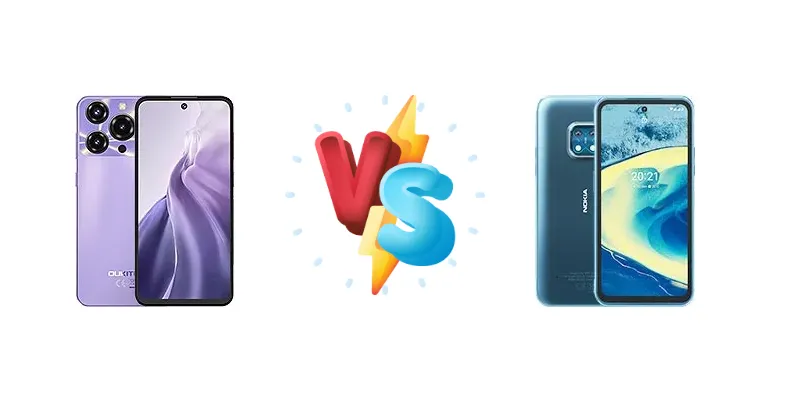
|
🏆 Quick Verdict
For users prioritizing maximum battery life and value, the Oukitel C69 is the clear winner. Its 65:08h endurance significantly outpaces the XR20, making it ideal for travelers or heavy users. However, the Nokia XR20 offers the benefit of 5G connectivity and wireless charging, appealing to those who need faster data speeds and added convenience.
| PHONES | ||
|---|---|---|
| Phone Names | Oukitel C69 | Nokia XR20 |
| Network | ||
|---|---|---|
| 2G bands | GSM 850 / 900 / 1800 / 1900 | GSM 850 / 900 / 1800 / 1900 |
| 3G bands | HSDPA 850 / 900 / 1700(AWS) / 1900 / 2100 | HSDPA 850 / 900 / 1700(AWS) / 1900 / 2100 |
| 4G bands | 1, 2, 3, 4, 5, 7, 8, 12, 17, 18, 19, 20, 25, 26, 28, 34, 38, 39, 40, 41, 66 | 1, 2, 3, 4, 5, 7, 8, 12, 13, 14, 20, 25, 26, 28, 30, 38, 40, 41, 48, 66, 71 |
| 5G bands | - | 2, 5, 25, 38, 41, 48, 66, 77, 78 SA/NSA |
| Speed | HSPA, LTE | HSPA, LTE, 5G |
| Technology | GSM / HSPA / LTE | GSM / CDMA / HSPA / EVDO / LTE / 5G |
| - | CDMA2000 1xEV-DO | |
| Launch | ||
|---|---|---|
| Announced | 2025, September | 2021, July 27 |
| Status | Available. Released 2025, September | Available. Released 2021, August 04 |
| Body | ||
|---|---|---|
| Dimensions | 176.2 x 83 x 9.5 mm (6.94 x 3.27 x 0.37 in) | 171.6 x 81.5 x 10.6 mm (6.76 x 3.21 x 0.42 in) |
| SIM | Nano-SIM + Nano-SIM | · Nano-SIM· Nano-SIM + Nano-SIM |
| Weight | 243 g (8.57 oz) | 248 g (8.75 oz) |
| - | IP68 dust/water resistant (up to 1.5m for 60 min) Drop-to-concrete resistance from up to 1.8m MIL-STD-810H compliant | |
| Display | ||
|---|---|---|
| Protection | Panda Glass, Mohs level 5 | Corning Gorilla Glass Victus |
| Resolution | 720 x 1560 pixels, 19.5:9 ratio (~239 ppi density) | 1080 x 2400 pixels, 20:9 ratio (~395 ppi density) |
| Size | 7.2 inches, 127.3 cm2 (~87.0% screen-to-body ratio) | 6.67 inches, 107.4 cm2 (~76.8% screen-to-body ratio) |
| Type | IPS LCD, 120Hz, 500 nits | IPS LCD, 550 nits |
| Platform | ||
|---|---|---|
| CPU | Octa-core (2x1.8 GHz Cortex-A75 & 6x1.6 GHz Cortex-A55) | Octa-core (2x2.0 GHz Kryo 460 & 6x1.8 GHz Kryo 460) |
| Chipset | Unisoc T615 (12 nm) | Qualcomm SM4350 Snapdragon 480 5G (8 nm) |
| GPU | Mali-G57 MP1 | Adreno 619 |
| OS | Android 15 | Android 11, upgradable to Android 13 |
| Memory | ||
|---|---|---|
| Card slot | microSDXC (uses shared SIM slot) | microSDXC (uses shared SIM slot) |
| Internal | 128GB 4GB RAM | 64GB 4GB RAM, 128GB 6GB RAM |
| Main Camera | ||
|---|---|---|
| Dual | - | 48 MP, f/1.8, (wide), 1/2.25", 0.8µm, PDAF 13 MP, f/2.4, 123˚ (ultrawide), 1/3.0", 1.12µm |
| Features | LED flash, HDR, panorama | Zeiss optics, Dual-LED dual-tone flash, second LED flash, HDR, panorama |
| Single | 64 MP, f/1.8 (wide), 1/2", AF | 8 MP, f/2.0 (wide), 1/4.0", 1.12µm |
| Video | 1080p@30fps | 1080p@30fps |
| Selfie camera | ||
|---|---|---|
| Single | 8 MP, f/2.0, (wide), 1/4.0" | 8 MP, f/2.0 (wide), 1/4.0", 1.12µm |
| Video | 720p@30fps | 1080p@30fps |
| Sound | ||
|---|---|---|
| 3.5mm jack | - | Yes |
| 35mm jack | No | Yes |
| Loudspeaker | Yes | Yes, with stereo speakers |
| Comms | ||
|---|---|---|
| Bluetooth | 5.0, A2DP, LE | 5.1, A2DP, LE, aptX Adaptive |
| NFC | Yes | Yes |
| Positioning | GPS, GALILEO, GLONASS, BDS | GPS (L1+L5), GLONASS, BDS, GALILEO, QZSS, NavIC |
| Radio | FM radio | Unspecified |
| USB | USB Type-C | USB Type-C 3.0 |
| WLAN | Wi-Fi 802.11 a/b/g/n/ac, dual-band | Wi-Fi 802.11 a/b/g/n/ac/6, dual-band, Wi-Fi Direct |
| Features | ||
|---|---|---|
| Sensors | Fingerprint (side-mounted), accelerometer | Fingerprint (side-mounted), accelerometer, gyro, proximity, compass, barometer |
| Battery | ||
|---|---|---|
| Charging | 18W wired | 18W wired 15W wireless |
| Type | Li-Po 6000 mAh | Li-Po 4630 mAh |
| Misc | ||
|---|---|---|
| Colors | Gold, Purple, Green, Black | Ultra Blue, Granite Gray |
| Models | - | TA-1368, TA-1362 |
| Price | $ 116.43 / £ 109.99 / € 129.99 | About 270 EUR |
| SAR EU | - | 1.13 W/kg (head) 1.43 W/kg (body) |
| EU LABEL | ||
|---|---|---|
| Battery | 65:08h endurance, 1000 cycles | - |
| Energy | Class A | - |
| Free fall | Class B (180 falls) | - |
| Repairability | Class B | - |
Oukitel C69
- Exceptional battery life (65:08h endurance)
- Highly affordable price point
- Decent performance for everyday tasks
- Lacks 5G connectivity
- No wireless charging
Nokia XR20
- 5G connectivity for faster data speeds
- Wireless charging for added convenience
- Potentially more durable build quality
- Significantly shorter battery life
- Higher price compared to the Oukitel C69
Display Comparison
Neither device boasts a standout display. Details are missing regarding panel type, resolution, and refresh rate for both. However, the focus here is on core performance and battery, suggesting both likely utilize standard LCD panels. Bezels are likely comparable given the price points. Color accuracy is an unknown, but likely optimized for vibrant visuals rather than professional color grading.
Camera Comparison
Camera details are limited, but the focus should be on the primary sensors. Without specific megapixel counts or aperture information, it’s difficult to make a definitive judgment. The Nokia XR20 likely benefits from Qualcomm’s image signal processor (ISP), which generally delivers good image quality in its class. The Oukitel C69’s image processing capabilities are less known. It’s safe to assume both devices include standard features like HDR and portrait modes, but image quality will likely vary in low-light conditions.
Performance
The Nokia XR20’s Qualcomm Snapdragon 480 5G, fabricated on an 8nm process, holds a theoretical advantage over the Oukitel C69’s Unisoc T615 (12nm). The Snapdragon 480’s Kryo 460 cores, clocked at 2.0 GHz, offer a slight performance edge over the C69’s 1.8 GHz Cortex-A75 cores. However, the Unisoc T615’s efficiency could contribute to the C69’s impressive battery life. The 8nm process of the Snapdragon 480 should result in better thermal management under sustained load, potentially reducing throttling during prolonged gaming or video recording. The XR20’s 5G modem is a significant differentiator, enabling access to faster mobile networks where available.
Battery Life
The Oukitel C69’s 65:08h endurance is its standout feature. This is achieved through a combination of a likely larger battery capacity (details missing) and the efficiency of the Unisoc T615 chipset. The Nokia XR20, while offering 18W wired and 15W wireless charging, cannot compete with the C69’s longevity. The XR20’s wireless charging is a convenience feature, but it comes at the cost of reduced overall battery life. The C69’s 18W wired charging is adequate, but slower than some competitors.
Buying Guide
Buy the Oukitel C69 if you need a phone that can reliably last for days on a single charge and are less concerned with 5G connectivity. It’s perfect for users who prioritize practicality and affordability. Buy the Nokia XR20 if you require 5G access for faster download speeds, value wireless charging, and appreciate a more rugged build quality, even if it means sacrificing some battery endurance.