
Ulefone Power Armor 13 vs. Oukitel C65: A Deep Dive into Ruggedness and Endurance
| Phones Images | |||||
|---|---|---|---|---|---|
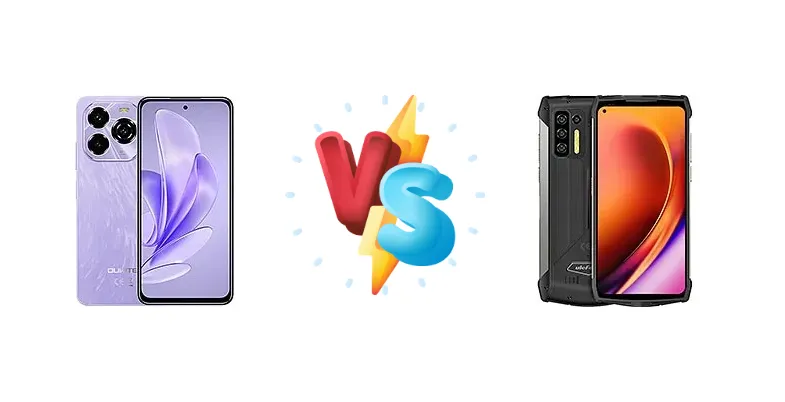
|
🏆 Quick Verdict
For the average user prioritizing longevity and minimizing charging frequency, the Oukitel C65 emerges as the winner. Its remarkable 55:29h endurance rating significantly surpasses the Ulefone Power Armor 13’s 296h, making it ideal for extended trips or heavy usage. However, the Power Armor 13’s faster charging and more powerful processor appeal to a different user profile.
| PHONES | ||
|---|---|---|
| Phone Names | Oukitel C65 | Ulefone Power Armor 13 |
| Network | ||
|---|---|---|
| 2G bands | GSM 850 / 900 / 1800 / 1900 | GSM 850 / 900 / 1800 / 1900 |
| 3G bands | HSDPA 850 / 900 / 1700(AWS) / 1900 / 2100 | HSDPA 850 / 900 / 1700(AWS) / 1900 / 2100 |
| 4G bands | 1, 2, 3, 4, 5, 7, 8, 12, 17, 18, 19, 20, 25, 26, 28, 38, 40, 41, 66 | 1, 2, 3, 4, 5, 7, 8, 12, 13, 17, 18, 19, 20, 25, 26, 28, 38, 40, 66 |
| Speed | HSPA, LTE | HSPA 42.2/11.5 Mbps, LTE Cat12 600/150 Mbps |
| Technology | GSM / HSPA / LTE | GSM / HSPA / LTE |
| Launch | ||
|---|---|---|
| Announced | 2025, May | 2021, July 22 |
| Status | Available. Released 2025, July | Available. Released 2021, July 26 |
| Body | ||
|---|---|---|
| Dimensions | 166.8 x 77.5 x 8.7 mm (6.57 x 3.05 x 0.34 in) | 183.7 x 85.4 x 20.8 mm (7.23 x 3.36 x 0.82 in) |
| SIM | Nano-SIM + Nano-SIM | Nano-SIM + Nano-SIM |
| Weight | 201 g (7.09 oz) | 492 g (1.08 lb) |
| - | IP68 dust/water resistant (up to 1.5m for 30 min) Drop-to-concrete resistance from up to 1.2m MIL-STD-810G compliant | |
| Display | ||
|---|---|---|
| Protection | CTC Glass, Mohs level 4 | Corning Gorilla Glass 3 |
| Resolution | 720 x 1600 pixels, 20:9 ratio (~262 ppi density) | 1080 x 2400 pixels, 20:9 ratio (~386 ppi density) |
| Size | 6.7 inches, 108.4 cm2 (~83.8% screen-to-body ratio) | 6.81 inches, 112.0 cm2 (~71.4% screen-to-body ratio) |
| Type | IPS LCD, 90Hz, 430 nits | IPS LCD |
| Platform | ||
|---|---|---|
| CPU | Octa-core (2x1.6 GHz Cortex-A75 & 6x1.6 GHz Cortex-A55) | Octa-core (2x2.05 GHz Cortex-A76 & 6x2.0 GHz Cortex-A55) |
| Chipset | Unisoc T606 (12 nm) | Mediatek MT6785V/CD Helio G95 (12 nm) |
| GPU | Mali-G57 MP1 | Mali-G76 MC4 |
| OS | Android 15 | Android 11 |
| Memory | ||
|---|---|---|
| Card slot | microSDXC (uses shared SIM slot) | microSDXC (uses shared SIM slot) |
| Internal | 128GB 4GB RAM | 256GB 8GB RAM |
| Main Camera | ||
|---|---|---|
| Features | LED flash, panorama | Quad-LED flash, HDR, panorama |
| Penta | - | 48 MP, f/1.8, 26mm (wide), 1/2.0", 0.8µm, PDAF 8 MP, f/2.2, (ultrawide) 2 MP (macro) Auxiliary lens |
| Single | 50 MP, f/1.8 (wide), 1/2.5", AF | - |
| Video | 1080p@30fps | 4K@30fps, 1080p@30fps |
| Selfie camera | ||
|---|---|---|
| Features | - | HDR, panorama |
| Single | 8 MP, f/2.0, (wide), 1/4.0" | 16 MP, f/2.2 |
| Video | 720p@30fps | 1080p@30fps |
| Sound | ||
|---|---|---|
| 3.5mm jack | - | Yes |
| 35mm jack | Yes | Yes |
| Loudspeaker | Yes | Yes |
| Comms | ||
|---|---|---|
| Bluetooth | 5.0, A2DP, LE | 5.0, A2DP, LE |
| NFC | Yes | Yes |
| Positioning | GPS, GALILEO, GLONASS, BDS | GPS, GLONASS, GALILEO, BDS |
| Radio | FM radio | FM radio, RDS, recording |
| USB | USB Type-C | - |
| WLAN | Wi-Fi 802.11 a/b/g/n/ac, dual-band | Wi-Fi 802.11 a/b/g/n/ac, dual-band |
| Features | ||
|---|---|---|
| Sensors | Fingerprint (side-mounted), accelerometer | Fingerprint (side-mounted), accelerometer, gyro, proximity, compass, baroceptor, coulombmeter |
| - | Infrared distance measure (error range: 1~20m, ±10mm; 20~40m, ±25mm) | |
| Battery | ||
|---|---|---|
| Charging | 10W wired | 33W wired 15W wireless 5W reverse wireless |
| Type | Li-Po 5150 mAh | Li-Po 13200 mAh |
| Misc | ||
|---|---|---|
| Colors | Blue, Gold, Green, Purple, White | Black |
| Price | - | About 300 EUR |
| Tests | ||
|---|---|---|
| Battery life | - | Endurance rating 296h |
| Camera | - | Photo / Video |
| Display | - | Contrast ratio: 1306:1 (nominal) |
| Loudspeaker | - | -28.3 LUFS (Average) |
| Performance | - | AnTuTu: 294194 (v8), 351678 (v9) GeekBench: 1610 (v5.1) GFXBench: 18fps (ES 3.1 onscreen) |
| EU LABEL | ||
|---|---|---|
| Battery | 55:29h endurance, 1000 cycles | - |
| Energy | Class A | - |
| Free fall | Class A (270 falls) | - |
| Repairability | Class B | - |
Oukitel C65
- Unmatched battery endurance (55:29h)
- Long battery lifespan (1000 cycles)
- Excellent value for money
- Slow 10W charging
- Less powerful processor
- Limited camera details
Ulefone Power Armor 13
- Faster 33W wired and 15W wireless charging
- More powerful Helio G95 processor
- Ruggedized build for enhanced durability
- Significantly lower battery endurance (296h)
- Higher price point
- Limited camera details
Display Comparison
The Ulefone Power Armor 13 boasts a measured peak brightness of 401 nits and a 1306:1 contrast ratio, offering a reasonably viewable experience. While the Oukitel C65’s display specifications are not provided, the Power Armor 13’s contrast ratio suggests a decent level of image quality. The 401 nits brightness is adequate for outdoor visibility, but may struggle in direct sunlight. Neither device is expected to offer high refresh rates or advanced panel technologies like LTPO, focusing instead on durability and power efficiency.
Camera Comparison
Both devices list 'Photo / Video' capabilities, but lack specific details regarding sensor size, aperture, or image stabilization. Given the market positioning, it’s unlikely either phone features a flagship-level camera system. The Ulefone Power Armor 13 likely benefits from MediaTek’s image signal processor (ISP), potentially offering better image processing than the Oukitel C65. However, without detailed specifications, a definitive comparison is impossible. Expect both to perform adequately in good lighting conditions, but struggle in low-light scenarios.
Performance
The Ulefone Power Armor 13’s MediaTek Helio G95 chipset, featuring a 2x2.05 GHz Cortex-A76 and 6x2.0 GHz Cortex-A55 configuration, provides a significant performance advantage over the Oukitel C65’s Unisoc T606 (2x1.6 GHz Cortex-A75 & 6x1.6 GHz Cortex-A55). The G95’s more modern CPU architecture and higher clock speeds translate to smoother multitasking and better gaming performance. However, the T606’s 12nm process node is comparable to the G95’s, suggesting similar thermal efficiency. The Power Armor 13 is the clear choice for users who prioritize responsiveness and gaming capabilities.
Battery Life
The Oukitel C65’s standout feature is its exceptional battery endurance, rated at 55:29h. This is dramatically higher than the Ulefone Power Armor 13’s 296h (equivalent to approximately 12.3 days). While the Power Armor 13 compensates with significantly faster charging – 33W wired, 15W wireless, and 5W reverse wireless – the Oukitel C65’s longevity minimizes the need for frequent charging. The C65’s 10W charging is slow by comparison, but the massive battery capacity mitigates this drawback. The Oukitel C65 also boasts 1000 charge cycles, suggesting a longer lifespan before significant battery degradation.
Buying Guide
Buy the Oukitel C65 if you need a phone that can genuinely last for days on a single charge, and aren't heavily reliant on demanding applications or gaming. It’s perfect for field workers, travelers, or anyone who simply wants to avoid the daily charging routine. Buy the Ulefone Power Armor 13 if you prioritize a rugged build, faster charging speeds (including wireless options), and a more capable processor for gaming and multitasking, even if it means more frequent charging.