
Oukitel C65 vs Blackview BV9900E: A Deep Dive into Budget Smartphone Choices
| Phones Images | |||||
|---|---|---|---|---|---|
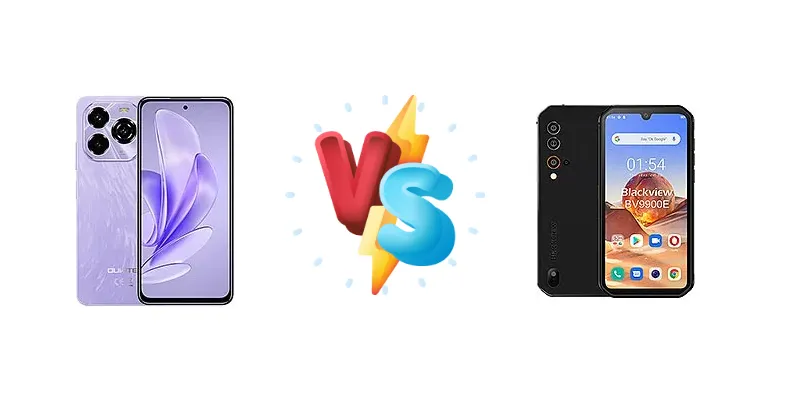
|
🏆 Quick Verdict
For the average user prioritizing responsiveness and occasional gaming, the Blackview BV9900E is the better choice. Its Helio P90 chipset delivers significantly more processing power. However, if maximizing battery life above all else is your goal, the Oukitel C65’s impressive endurance is hard to ignore.
| PHONES | ||
|---|---|---|
| Phone Names | Oukitel C65 | Blackview BV9900E |
| Network | ||
|---|---|---|
| 2G bands | GSM 850 / 900 / 1800 / 1900 | GSM 850 / 900 / 1800 / 1900 |
| 3G bands | HSDPA 850 / 900 / 1700(AWS) / 1900 / 2100 | HSDPA 800 / 850 / 900 / 1700(AWS) / 1900 / 2100 |
| 4G bands | 1, 2, 3, 4, 5, 7, 8, 12, 17, 18, 19, 20, 25, 26, 28, 38, 40, 41, 66 | 1, 2, 3, 4, 5, 7, 8, 12, 13, 17, 18, 19, 20, 25, 26, 28, 34, 38, 39, 40, 41, 66 |
| Speed | HSPA, LTE | HSPA, LTE |
| Technology | GSM / HSPA / LTE | GSM / CDMA / HSPA / CDMA2000 / LTE |
| Launch | ||
|---|---|---|
| Announced | 2025, May | 2020, September 10. Released 2020, September |
| Status | Available. Released 2025, July | Discontinued |
| Body | ||
|---|---|---|
| Dimensions | 166.8 x 77.5 x 8.7 mm (6.57 x 3.05 x 0.34 in) | 156.5 x 78.3 x 14.2 mm (6.16 x 3.08 x 0.56 in) |
| SIM | Nano-SIM + Nano-SIM | Nano-SIM + Nano-SIM |
| Weight | 201 g (7.09 oz) | 273 g (9.63 oz) |
| Display | ||
|---|---|---|
| Protection | CTC Glass, Mohs level 4 | Corning Gorilla Glass 5 |
| Resolution | 720 x 1600 pixels, 20:9 ratio (~262 ppi density) | 1080 x 2280 pixels, 19:9 ratio (~432 ppi density) |
| Size | 6.7 inches, 108.4 cm2 (~83.8% screen-to-body ratio) | 5.84 inches, 85.1 cm2 (~69.5% screen-to-body ratio) |
| Type | IPS LCD, 90Hz, 430 nits | IPS LCD |
| Platform | ||
|---|---|---|
| CPU | Octa-core (2x1.6 GHz Cortex-A75 & 6x1.6 GHz Cortex-A55) | Octa-core (2x2.2 GHz Cortex-A75 & 6x2.0 GHz Cortex-A55) |
| Chipset | Unisoc T606 (12 nm) | Mediatek MT6779V/CE Helio P90 (12 nm) |
| GPU | Mali-G57 MP1 | PowerVR GM9446 |
| OS | Android 15 | Android 10 |
| Memory | ||
|---|---|---|
| Card slot | microSDXC (uses shared SIM slot) | microSDXC |
| Internal | 128GB 4GB RAM | 128GB 6GB RAM |
| Main Camera | ||
|---|---|---|
| Features | LED flash, panorama | LED flash, HDR, panorama |
| Quad | - | 48 MP, f/1.8, (wide), PDAF 16 MP, 120˚ (ultrawide) 2 MP (macro) Auxiliary lens |
| Single | 50 MP, f/1.8 (wide), 1/2.5", AF | - |
| Video | 1080p@30fps | 4K@30fps, 1080p@60fps |
| Selfie camera | ||
|---|---|---|
| Single | 8 MP, f/2.0, (wide), 1/4.0" | 16 MP, f/2.0, (wide) |
| Video | 720p@30fps | 1080p@30fps |
| Sound | ||
|---|---|---|
| 35mm jack | Yes | No |
| Loudspeaker | Yes | Yes |
| Comms | ||
|---|---|---|
| Bluetooth | 5.0, A2DP, LE | 5.0, A2DP, LE |
| NFC | Yes | Yes |
| Positioning | GPS, GALILEO, GLONASS, BDS | GPS, GLONASS, GALILEO, BDS |
| Radio | FM radio | FM radio |
| USB | USB Type-C | USB Type-C 2.0, OTG |
| WLAN | Wi-Fi 802.11 a/b/g/n/ac, dual-band | Wi-Fi 802.11 a/b/g/n/ac |
| Features | ||
|---|---|---|
| Sensors | Fingerprint (side-mounted), accelerometer | Fingerprint (side-mounted), accelerometer, gyro, proximity, compass, barometer |
| Battery | ||
|---|---|---|
| Charging | 10W wired | 15W wired 18W wireless |
| Type | Li-Po 5150 mAh | 4380 mAh |
| Misc | ||
|---|---|---|
| Colors | Blue, Gold, Green, Purple, White | Black, Silver |
| Price | - | About 260 EUR |
| EU LABEL | ||
|---|---|---|
| Battery | 55:29h endurance, 1000 cycles | - |
| Energy | Class A | - |
| Free fall | Class A (270 falls) | - |
| Repairability | Class B | - |
Oukitel C65
- Exceptional battery endurance (55:29h)
- Long battery lifespan (1000 cycles)
- Lower price point (likely)
- Slower processor performance
- Slow 10W charging
- Likely basic camera system
Blackview BV9900E
- More powerful Helio P90 chipset
- Faster 15W wired and 18W wireless charging
- Smoother multitasking and gaming
- Potentially shorter battery life
- Higher price point (likely)
- May run warmer under heavy load
Display Comparison
Neither device boasts a standout display. Given the context data focuses on internal components, we can infer both likely utilize IPS LCD panels common in this price bracket. The absence of details like resolution or refresh rate suggests a focus on cost optimization. The BV9900E’s chipset *could* support a higher resolution panel, but this isn’t confirmed. Bezels are likely substantial on both, typical for budget devices.
Camera Comparison
Without detailed camera specifications, a direct comparison is difficult. However, the market segment suggests both phones will feature basic camera setups. The absence of mention of high-resolution sensors or advanced features indicates a focus on functionality over photographic excellence. We can assume both will have a primary camera, potentially an ultrawide, and a depth sensor. The BV9900E’s more powerful ISP (Image Signal Processor) within the Helio P90 chipset *could* result in slightly better image processing, particularly in low-light conditions, but this is speculative.
Performance
The Blackview BV9900E’s MediaTek Helio P90 (12nm) represents a substantial performance leap over the Oukitel C65’s Unisoc T606 (12nm). The P90’s CPU configuration – 2x2.2 GHz Cortex-A75 & 6x2.0 GHz Cortex-A55 – is clocked higher than the C65’s 2x1.6 GHz Cortex-A75 & 6x1.6 GHz Cortex-A55. This translates to faster app loading times, smoother multitasking, and a more enjoyable gaming experience. While both use a 12nm process, the architectural improvements in the P90 provide a clear advantage. Users who play graphically intensive games or frequently switch between apps will significantly benefit from the BV9900E.
Battery Life
The Oukitel C65 claims 55:29h of endurance and 1000 charge cycles, highlighting its focus on longevity. While the BV9900E’s battery capacity isn’t specified, its 15W wired and 18W wireless charging capabilities offer significantly faster replenishment compared to the C65’s 10W wired charging. The C65’s endurance is ideal for users who prioritize minimizing charging frequency, while the BV9900E offers convenience with its faster charging options. The 1000 cycle claim on the C65 suggests a focus on long-term battery health.
Buying Guide
Buy the Oukitel C65 if you need a phone that can reliably last through two full days of moderate use, and your primary tasks are communication, social media, and light web browsing. Buy the Blackview BV9900E if you prefer a smoother experience with more demanding apps, enjoy mobile gaming, and appreciate the convenience of faster charging, including wireless charging.