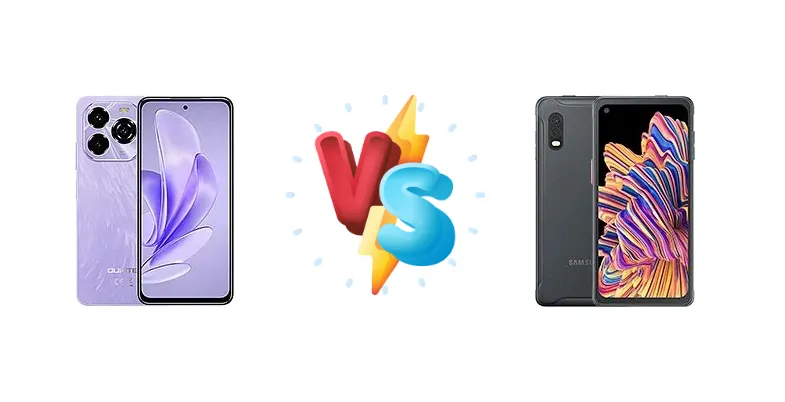
The Oukitel C65 Pro and Samsung Galaxy XCover Pro both target users needing a durable, reliable smartphone, but they approach this goal with different philosophies. The Oukitel prioritizes extreme battery life and affordability, while the Samsung offers a more refined experience with a more powerful chipset and established brand reputation. This comparison dissects their key differences to determine which device best suits your needs.
🏆 Quick Verdict
For the average user prioritizing longevity and value, the Oukitel C65 Pro emerges as the winner. Its exceptional 55:29h battery endurance and lower price point outweigh the Samsung Galaxy XCover Pro’s more powerful processor, especially for tasks beyond demanding gaming or intensive multitasking.
| Network |
|---|
| 2G bands | GSM 850 / 900 / 1800 / 1900 | GSM 850 / 900 / 1800 / 1900 |
| 3G bands | HSDPA 850 / 900 / 1700(AWS) / 1900 / 2100 | HSDPA 850 / 900 / 1900 / 2100 - International |
| 4G bands | 1, 2, 3, 4, 5, 7, 8, 12, 17, 18, 19, 20, 25, 26, 28, 38, 40, 41, 66 | 1, 2, 3, 5, 7, 8, 20, 28, 38, 40, 41 - International |
| Speed | HSPA, LTE | HSPA 42.2/5.76 Mbps, LTE (3CA) Cat11 600/50 Mbps |
| Technology | GSM / HSPA / LTE | GSM / HSPA / LTE |
| | - | 1, 2, 3, 4, 5, 7, 12, 13, 14, 20, 29, 38, 40, 41, 66 - Canada |
| Launch |
|---|
| Announced | 2025, May | 2020, January |
| Status | Available. Released 2025, July | Available. Released 2020, January |
| Body |
|---|
| Dimensions | 166.8 x 77.5 x 8.7 mm (6.57 x 3.05 x 0.34 in) | 159.9 x 76.7 x 10 mm (6.30 x 3.02 x 0.39 in) |
| SIM | Nano-SIM + Nano-SIM | · Nano-SIM· Nano-SIM + Nano-SIM |
| Weight | 201 g (7.09 oz) | 218 g (7.69 oz) |
| | - | IP68 dust/water resistant (up to 1.5m for 35 min)
Drop-to-concrete resistance from up to 1.5m
MIL-STD-810G compliant*
*does not guarantee ruggedness or use in extreme conditions |
| Display |
|---|
| Protection | CTC Glass, Mohs level 4 | Corning Gorilla Glass 5 |
| Resolution | 720 x 1600 pixels, 20:9 ratio (~262 ppi density) | 1080 x 2340 pixels, 19.5:9 ratio (~409 ppi density) |
| Size | 6.7 inches, 108.4 cm2 (~83.8% screen-to-body ratio) | 6.3 inches, 97.4 cm2 (~79.4% screen-to-body ratio) |
| Type | IPS LCD, 90Hz, 430 nits | IPS LCD |
| Platform |
|---|
| CPU | Octa-core (2x1.6 GHz Cortex-A75 & 6x1.6 GHz Cortex-A55) | Octa-core (4x2.3 GHz Cortex-A73 & 4x1.7 GHz Cortex-A53) |
| Chipset | Unisoc T606 (12 nm) | Exynos 9611 (10 nm) |
| GPU | Mali-G57 MP1 | Mali-G72 MP3 |
| OS | Android 15 | Android 10, upgradable to Android 13, One UI 5 |
| Memory |
|---|
| Card slot | microSDXC (uses shared SIM slot) | microSDXC (dedicated slot) |
| Internal | 256GB 8GB RAM | 64GB 4GB RAM |
| Main Camera |
|---|
| Dual | - | 25 MP, f/1.7, 26mm (wide), PDAF
8 MP, f/2.2, 123˚ (ultrawide), 1/4.0", 1.12µm |
| Features | LED flash, panorama | Dual-LED flash, HDR, panorama |
| Single | 50 MP, f/1.8 (wide), 1/2.5", AF | - |
| Video | 1080p@30fps | 1080p@30fps |
| Selfie camera |
|---|
| Features | - | HDR |
| Single | 8 MP, f/2.0, (wide), 1/4.0" | 13 MP, f/2.0, (wide), 1/3.1", 1.12µm |
| Video | 720p@30fps | 1080p@30fps |
| Sound |
|---|
| 3.5mm jack | - | Yes |
| 35mm jack | Yes | Yes |
| Loudspeaker | Yes | Yes |
| Comms |
|---|
| Bluetooth | 5.0, A2DP, LE | 5.0, A2DP, LE |
| NFC | Yes | Yes |
| Positioning | GPS, GALILEO, GLONASS, BDS | GPS, GLONASS, GALILEO, BDS |
| Radio | FM radio | FM radio (market/region dependent) |
| USB | USB Type-C | USB Type-C 2.0 |
| WLAN | Wi-Fi 802.11 a/b/g/n/ac, dual-band | Wi-Fi 802.11 a/b/g/n/ac/k/v/r, dual-band, Wi-Fi Direct |
| Features |
|---|
| Sensors | Fingerprint (side-mounted), accelerometer | Fingerprint (side-mounted), accelerometer, gyro, proximity, compass |
| | - | ANT+ |
| Battery |
|---|
| Charging | 10W wired | 15W wired |
| Type | Li-Po 5150 mAh | Li-Po 4050 mAh, removable |
| Misc |
|---|
| Colors | Blue, Gold, Green, Purple, White | Black |
| Models | - | SM-G715FN/DS, SM-G715FN, SM-G715F, SM-G715W, SM-G715U, SM-G715U1 |
| Price | - | About 120 EUR |
| SAR EU | - | 0.47 W/kg (head) 1.23 W/kg (body) |
| EU LABEL |
|---|
| Battery | 55:29h endurance, 1000 cycles | - |
| Energy | Class A | - |
| Free fall | Class A (270 falls) | - |
| Repairability | Class B | - |
Oukitel C65 Pro
- Exceptional battery life (55:29h endurance)
- High charge cycle count (1000 cycles)
- More affordable price point
- Less powerful processor (Unisoc T606)
- Slower charging speed (10W)
- Display details are unknown
Samsung Galaxy XCover Pro
- More powerful processor (Exynos 9611)
- Faster charging (15W)
- Established brand reputation (Samsung)
- Likely shorter battery life
- Higher price
- Potential for thermal throttling
Display Comparison
Neither device boasts a cutting-edge display. Details on panel type, resolution, and refresh rate are missing for the Oukitel C65 Pro, suggesting a basic LCD. The Samsung XCover Pro also utilizes an LCD, prioritizing durability over visual fidelity. The focus here isn't on vibrant colors or high refresh rates, but on visibility in direct sunlight and resistance to damage. Bezels are likely substantial on both, reflecting their rugged design.
Camera Comparison
Camera details are sparse for both devices. The Oukitel C65 Pro’s camera specs are not provided, making a direct comparison difficult. The Samsung Galaxy XCover Pro’s camera configuration is also not detailed in the provided data. Given the rugged focus, expect both to prioritize functional image capture over high-end photography. The inclusion of a 2MP macro camera on either device is likely a marketing tactic, offering minimal real-world benefit. Image processing will likely lean towards natural colors and good dynamic range, rather than overly saturated or artificial results.
Performance
The Samsung Galaxy XCover Pro’s Exynos 9611 (10nm) significantly outperforms the Oukitel C65 Pro’s Unisoc T606 (12nm) on paper. The Exynos utilizes a Cortex-A73 cluster clocked at 2.3 GHz, compared to the Oukitel’s 1.6 GHz Cortex-A75. This translates to faster app loading, smoother multitasking, and better performance in graphically intensive applications. However, the 12nm process of the Unisoc T606 may offer slightly better efficiency, though the difference is likely offset by the Exynos’s superior architecture. The Exynos 9611 is more likely to exhibit thermal throttling under sustained load, while the Unisoc T606 will likely feel sluggish with demanding tasks.
Battery Life
Battery life is where the Oukitel C65 Pro truly shines. Its 55:29h endurance is exceptional, indicating it can last for multiple days on a single charge with moderate use. The Samsung Galaxy XCover Pro’s battery life is not specified, but its 15W charging is faster than the Oukitel’s 10W, meaning quicker top-ups when needed. However, the Oukitel’s longevity is a significant advantage for users who prioritize minimizing charging frequency. The Oukitel also boasts a claimed 1000 charge cycles, suggesting a longer lifespan before significant battery degradation.
Buying Guide
Buy the Oukitel C65 Pro if you need a phone that can genuinely last for days on a single charge, and if budget is a primary concern. It’s ideal for outdoor workers, travelers, or anyone who frequently finds themselves away from power outlets. Buy the Samsung Galaxy XCover Pro if you prefer a more polished software experience, require faster processing for applications like CAD or complex spreadsheets, and value the Samsung ecosystem and brand reliability.
Frequently Asked Questions
❓ Is the Exynos 9611 in the Samsung Galaxy XCover Pro prone to overheating during prolonged use?
The Exynos 9611, built on a 10nm process, is known to exhibit thermal throttling under sustained heavy loads, such as extended gaming sessions or video recording. While it offers more raw power than the Unisoc T606, it may reduce performance to manage heat, potentially impacting user experience.
❓ How does the 1000 charge cycle claim of the Oukitel C65 Pro translate to real-world battery lifespan?
The 1000 charge cycle claim suggests the Oukitel C65 Pro’s battery is designed to retain a significant portion of its original capacity even after being fully charged and discharged 1000 times. This indicates a longer overall battery lifespan compared to phones with lower cycle counts, potentially delaying the need for a battery replacement.
❓ Will the Unisoc T606 in the Oukitel C65 Pro be sufficient for running popular social media apps and basic productivity tasks?
Yes, the Unisoc T606 is perfectly capable of handling everyday tasks like browsing the web, using social media apps, and running basic productivity software. While it won’t deliver flagship-level performance, it provides a smooth and responsive experience for typical smartphone usage.