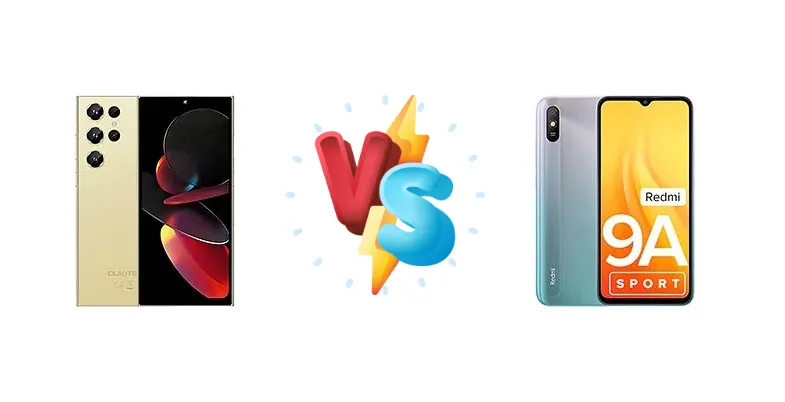
The sub-$150 smartphone market is fiercely competitive. The Oukitel C61 and Xiaomi Redmi 9A Sport represent compelling options for users prioritizing affordability and essential features. However, they take different approaches to achieving this, with the Oukitel emphasizing battery endurance and the Redmi focusing on a slightly more powerful, though less efficient, processor. This comparison dissects their key differences to help you choose the right device.
🏆 Quick Verdict
For the average user prioritizing all-day battery life and consistent performance, the Oukitel C61 emerges as the winner. Its Unisoc T615 chipset, coupled with exceptional 64:19h endurance, provides a more reliable experience than the Redmi 9A Sport’s Helio G25, which trades efficiency for a modest CPU clock speed boost.
| Network |
|---|
| 2G bands | GSM 850 / 900 / 1800 / 1900 | GSM 850 / 900 / 1800 / 1900 |
| 3G bands | HSDPA 850 / 900 / 1700(AWS) / 1900 / 2100 | HSDPA 850 / 900 / 2100 |
| 4G bands | 1, 2, 3, 4, 5, 7, 8, 12, 17, 18, 19, 20, 25, 26, 28, 34, 38, 39, 40, 41, 66 | 1, 3, 5, 8, 40, 41 |
| Speed | HSPA, LTE | HSPA, LTE |
| Technology | GSM / HSPA / LTE | GSM / HSPA / LTE |
| Launch |
|---|
| Announced | 2025, March | 2021, September 28 |
| Status | Available. Released 2025, May | Available. Released 2021, September 28 |
| Body |
|---|
| Dimensions | 170.7 x 79.6 x 9.5 mm (6.72 x 3.13 x 0.37 in) | 164.9 x 77.1 x 9 mm (6.49 x 3.04 x 0.35 in) |
| SIM | Nano-SIM + Nano-SIM | Nano-SIM + Nano-SIM |
| Weight | 216 g (7.62 oz) | 194 g (6.84 oz) |
| | - | Water-repellent coating |
| Display |
|---|
| Protection | Corning Gorilla Glass, Mohs level 5 | - |
| Resolution | 720 x 1640 pixels (~260 ppi density) | 720 x 1600 pixels, 20:9 ratio (~269 ppi density) |
| Size | 6.88 inches, 112.4 cm2 (~82.7% screen-to-body ratio) | 6.53 inches, 102.9 cm2 (~81.0% screen-to-body ratio) |
| Type | IPS LCD, 90Hz, 450 nits | IPS LCD, 400 nits (typ) |
| Platform |
|---|
| CPU | Octa-core (2x1.8 GHz Cortex-A75 & 6x1.6 GHz Cortex-A55) | Octa-core (4x2.0 GHz Cortex-A53 & 4x1.5 GHz Cortex-A53) |
| Chipset | Unisoc T615 (12 nm) | Mediatek MT6762G Helio G25 (12 nm) |
| GPU | Mali-G57 MP1 | PowerVR GE8320 |
| OS | Android 15 | Android 10, MIUI 12 |
| Memory |
|---|
| Card slot | microSDXC (uses shared SIM slot) | microSDXC (dedicated slot) |
| Internal | 128GB 4GB RAM | 32GB 2GB RAM, 32GB 3GB RAM |
| | - | eMMC 5.1 |
| Main Camera |
|---|
| Features | LED flash, HDR, panorama | LED flash, HDR |
| Single | 13 MP, f/2.2, (wide), 1/3.06", AF | 13 MP, f/2.2, 28mm (wide), 1.0µm, PDAF |
| Video | 1080p@30fps | 1080p@30/60fps |
| Selfie camera |
|---|
| Features | - | HDR |
| Single | 5 MP, f/2.2, (wide), 1/5.0" | 5 MP, f/2.2, (wide), 1.12µm |
| Video | 720p@30fps | 1080p@30fps |
| Sound |
|---|
| 3.5mm jack | - | Yes |
| 35mm jack | No | Yes |
| Loudspeaker | Yes | Yes |
| Comms |
|---|
| Bluetooth | 5.0, A2DP, LE | 5.0, A2DP, LE |
| NFC | Yes | No |
| Positioning | GPS, GALILEO, GLONASS, BDS | GPS, GLONASS, BDS |
| Radio | FM radio | FM radio |
| USB | USB Type-C | microUSB 2.0, OTG |
| WLAN | Wi-Fi 802.11 a/b/g/n/ac, dual-band | Wi-Fi 802.11 a/b/g/n, Wi-Fi Direct |
| Features |
|---|
| Sensors | Fingerprint (side-mounted), accelerometer, compass | Accelerometer, proximity |
| Battery |
|---|
| Charging | 10W wired | 10W wired |
| Type | Li-Po 5150 mAh | Li-Po 5000 mAh |
| Misc |
|---|
| Colors | Gold, Purple, Blue, Black | Carbon Black, Coral Green, Metallic Blue |
| Price | € 89.99 / $ 129.99 / £ 82.99 | About 100 EUR |
| EU LABEL |
|---|
| Battery | 64:19h endurance, 1000 cycles | - |
| Energy | Class A | - |
| Free fall | Class B (180 falls) | - |
| Repairability | Class B | - |
Oukitel C61
- Exceptional battery life (64:19h endurance)
- More efficient processor (Unisoc T615)
- Modern CPU core architecture (Cortex-A75)
- Potentially better multitasking performance
- Slower CPU clock speeds compared to Redmi 9A Sport
- 10W charging is slow
Xiaomi Redmi 9A Sport
- Slightly faster CPU clock speeds (2.0 GHz)
- Potentially snappier responsiveness for single-threaded tasks
- Affordable price point
- MediaTek chipset is widely supported
- Significantly shorter battery life
- Less efficient processor (Helio G25)
- Older CPU core architecture (Cortex-A53)
- May exhibit throttling under sustained load
Display Comparison
Neither device boasts a standout display. Both likely utilize LCD panels, common in this price bracket. Detailed specs like resolution and brightness are missing, but the focus here is on internal components. The display quality will likely be similar, serving adequately for basic tasks and media consumption. Bezels are expected to be noticeable on both, reflecting their budget positioning.
Camera Comparison
Camera details are sparse, but it’s safe to assume both phones feature basic camera systems. Focusing on the chipsets, the Unisoc T615 and Helio G25 both have capable ISPs, but image processing algorithms will heavily influence the final results. Without detailed sensor information, it’s difficult to declare a clear winner. The presence of a 2MP macro lens on either device is largely a marketing tactic, offering minimal practical benefit. Expect acceptable image quality in good lighting conditions, but struggles in low light.
Performance
The core difference lies in the chipsets. The Oukitel C61’s Unisoc T615 (12nm) employs a big.LITTLE architecture with 2x 1.8 GHz Cortex-A75 cores and 6x 1.6 GHz Cortex-A55 cores. This configuration prioritizes efficiency alongside performance. The Redmi 9A Sport’s MediaTek Helio G25 (12nm) uses a less sophisticated setup: 4x 2.0 GHz Cortex-A53 cores and 4x 1.5 GHz Cortex-A53 cores. While the G25’s cores clock slightly higher, the older Cortex-A53 architecture is less efficient and offers lower IPC (Instructions Per Clock) than the A75 cores in the T615. This translates to potentially snappier responsiveness for single-threaded tasks on the Redmi, but the Oukitel will likely maintain smoother multitasking and sustained performance due to its more modern core design.
Battery Life
This is where the Oukitel C61 truly shines. Its 64:19h endurance rating is exceptional for a budget smartphone, indicating significantly longer usage times between charges. The Redmi 9A Sport’s battery life is not specified, but the Helio G25’s less efficient architecture suggests considerably shorter endurance. Both phones support 10W wired charging, meaning slow charging speeds – expect several hours to reach a full charge. The Oukitel’s superior battery capacity and chipset efficiency will offset the slow charging, providing a more practical user experience.
Buying Guide
Buy the Oukitel C61 if you need a phone that will reliably last through a full day – and beyond – of moderate use, and you value consistent performance over peak bursts. Buy the Xiaomi Redmi 9A Sport if you occasionally engage in light gaming and prefer a slightly faster CPU clock speed, understanding that this comes at the cost of significantly reduced battery life and overall efficiency.
Frequently Asked Questions
❓ Will the Unisoc T615 in the Oukitel C61 struggle with demanding games?
The Unisoc T615 is not a gaming powerhouse. While it can handle less demanding titles at lower settings, graphically intensive games will likely require significant compromises in visual quality and frame rates. The Helio G25 in the Redmi 9A Sport is similarly limited, so neither phone is ideal for serious mobile gaming.
❓ How much faster is the Redmi 9A Sport's CPU clock speed in real-world use?
The 2.0 GHz clock speed of the Redmi 9A Sport’s CPU is slightly higher than the Oukitel C61’s, but the older Cortex-A53 architecture means this doesn’t translate to a proportional performance increase. The Oukitel’s A75 cores offer better IPC, resulting in smoother multitasking and sustained performance despite the lower clock speed.
❓ Is the 10W charging on either phone a significant drawback?
Yes, 10W charging is quite slow by modern standards. Expect several hours to fully charge either device. However, the Oukitel C61’s exceptional battery life mitigates this issue, as you won’t need to charge it as frequently.
❓ What type of user would benefit most from the Oukitel C61's long battery life?
The Oukitel C61 is ideal for users who are frequently away from power outlets, such as travelers, delivery drivers, or anyone who relies heavily on their phone throughout the day without easy access to charging. It's also a great choice for those who simply dislike the inconvenience of frequent charging.