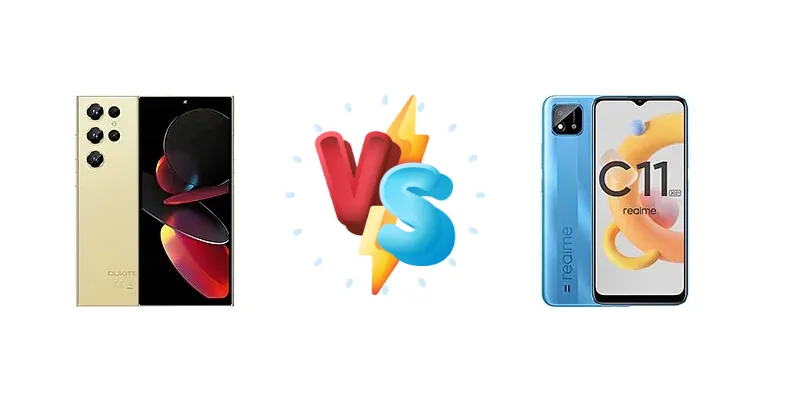
The sub-$150 smartphone market is fiercely competitive. Both the Oukitel C61 and the Realme C11 (2021) aim to deliver essential smartphone functionality at an incredibly accessible price point. However, significant differences in their underlying hardware suggest one offers a more compelling experience for performance-conscious users, while the other prioritizes longevity.
🏆 Quick Verdict
For the average user prioritizing responsiveness and future-proofing, the Oukitel C61 emerges as the clear winner. Its Unisoc T615 chipset, built on a more modern 12nm process, delivers substantially better CPU performance than the Realme C11’s older 28nm Unisoc SC9863A, making everyday tasks smoother and more enjoyable.
| Network |
|---|
| 2G bands | GSM 850 / 900 / 1800 / 1900 | GSM 850 / 900 / 1800 / 1900 |
| 3G bands | HSDPA 850 / 900 / 1700(AWS) / 1900 / 2100 | HSDPA 850 / 900 / 1900 / 2100 |
| 4G bands | 1, 2, 3, 4, 5, 7, 8, 12, 17, 18, 19, 20, 25, 26, 28, 34, 38, 39, 40, 41, 66 | 1, 3, 5, 8, 38, 40, 41 |
| Speed | HSPA, LTE | HSPA, LTE |
| Technology | GSM / HSPA / LTE | GSM / HSPA / LTE |
| Launch |
|---|
| Announced | 2025, March | 2021, June 28 |
| Status | Available. Released 2025, May | Available. Released 2021, June 28 |
| Body |
|---|
| Build | - | Glass front, plastic frame, plastic back |
| Dimensions | 170.7 x 79.6 x 9.5 mm (6.72 x 3.13 x 0.37 in) | 165.2 x 76.4 x 8.9 mm (6.50 x 3.01 x 0.35 in) |
| SIM | Nano-SIM + Nano-SIM | Nano-SIM + Nano-SIM |
| Weight | 216 g (7.62 oz) | 190 g (6.70 oz) |
| | - | Splash resistant design |
| Display |
|---|
| Protection | Corning Gorilla Glass, Mohs level 5 | - |
| Resolution | 720 x 1640 pixels (~260 ppi density) | 720 x 1600 pixels, 20:9 ratio (~269 ppi density) |
| Size | 6.88 inches, 112.4 cm2 (~82.7% screen-to-body ratio) | 6.52 inches, 102.6 cm2 (~81.3% screen-to-body ratio) |
| Type | IPS LCD, 90Hz, 450 nits | IPS LCD, 400 nits (typ) |
| Platform |
|---|
| CPU | Octa-core (2x1.8 GHz Cortex-A75 & 6x1.6 GHz Cortex-A55) | Octa-core (4x1.6 GHz Cortex-A55 & 4x1.2 GHz Cortex-A55) |
| Chipset | Unisoc T615 (12 nm) | Unisoc SC9863A (28 nm) |
| GPU | Mali-G57 MP1 | IMG8322 |
| OS | Android 15 | Android 11, Realme Go UI |
| Memory |
|---|
| Card slot | microSDXC (uses shared SIM slot) | microSDXC (dedicated slot) |
| Internal | 128GB 4GB RAM | 32GB 2GB RAM, 64GB 4GB RAM |
| | - | eMMC 5.1 |
| Main Camera |
|---|
| Features | LED flash, HDR, panorama | LED flash, HDR, panorama |
| Single | 13 MP, f/2.2, (wide), 1/3.06", AF | 8 MP, f/2.0, (wide), AF |
| Video | 1080p@30fps | 1080p@30fps |
| Selfie camera |
|---|
| Features | - | HDR, panorama |
| Single | 5 MP, f/2.2, (wide), 1/5.0" | 5 MP, f/2.2, (wide) |
| Video | 720p@30fps | 1080p@30fps |
| Sound |
|---|
| 3.5mm jack | - | Yes |
| 35mm jack | No | Yes |
| Loudspeaker | Yes | Yes |
| Comms |
|---|
| Bluetooth | 5.0, A2DP, LE | 4.2, A2DP |
| NFC | Yes | No |
| Positioning | GPS, GALILEO, GLONASS, BDS | GPS, GLONASS, GALILEO, BDS |
| Radio | FM radio | Unspecified |
| USB | USB Type-C | microUSB 2.0, OTG |
| WLAN | Wi-Fi 802.11 a/b/g/n/ac, dual-band | Wi-Fi 802.11 b/g/n |
| Features |
|---|
| Sensors | Fingerprint (side-mounted), accelerometer, compass | Accelerometer, gyro, proximity, compass |
| Battery |
|---|
| Charging | 10W wired | 10W wired
Reverse wired |
| Type | Li-Po 5150 mAh | 5000 mAh |
| Misc |
|---|
| Colors | Gold, Purple, Blue, Black | Cool Blue, Cool Grey |
| Models | - | RMX3231 |
| Price | € 89.99 / $ 129.99 / £ 82.99 | About 80 EUR |
| EU LABEL |
|---|
| Battery | 64:19h endurance, 1000 cycles | - |
| Energy | Class A | - |
| Free fall | Class B (180 falls) | - |
| Repairability | Class B | - |
Oukitel C61
- Significantly faster processor (Unisoc T615)
- More efficient chipset (12nm process)
- Potentially longer battery lifespan (1000 cycles)
- Lacks reverse wired charging
- Detailed display specs unavailable
Realme C11 (2021)
- Reverse wired charging capability
- Potentially lower price point
- Simple and straightforward operation
- Significantly slower processor (Unisoc SC9863A)
- Less efficient chipset (28nm process)
- Likely to struggle with demanding apps
Display Comparison
Neither device boasts a standout display. Both are likely to feature LCD panels, typical for this price bracket. However, detailed display specs (resolution, brightness, color gamut) are unavailable. The focus here is on internal components, as display quality is unlikely to be a major differentiator. Bezels are expected to be substantial on both models, reflecting their budget positioning.
Camera Comparison
Camera details are sparse for both devices. It’s safe to assume both will feature basic camera setups geared towards casual photography. Without sensor size or aperture information, a direct comparison is difficult. However, given the overall focus on cost reduction, image quality is unlikely to be a key strength for either phone. The presence of a 2MP macro lens on either device is largely a marketing tactic, offering minimal practical benefit.
Performance
The core difference lies in the chipsets. The Oukitel C61’s Unisoc T615, fabricated on a 12nm process, features an octa-core configuration with 2x 1.8 GHz Cortex-A75 cores and 6x 1.6 GHz Cortex-A55 cores. This architecture provides a significant performance boost over the Realme C11 (2021)’s Unisoc SC9863A, which uses a 28nm process and an octa-core setup of 4x 1.6 GHz Cortex-A55 and 4x 1.2 GHz Cortex-A55 cores. The larger process node of the SC9863A translates to lower efficiency and reduced performance. The A75 cores in the T615 are considerably more powerful than the A55 cores found in both devices, resulting in faster app loading times and smoother multitasking on the Oukitel C61.
Battery Life
The Oukitel C61 claims 64:19h endurance and a 1000 cycle lifespan, suggesting a focus on long-term battery health. While the Realme C11 (2021) doesn’t provide endurance figures, both phones share 10W wired charging. The Realme C11 (2021) adds reverse wired charging, allowing it to act as a power bank for other devices. However, the Oukitel C61’s potentially superior battery longevity, coupled with the more efficient T615 chipset, could translate to longer real-world usage between charges, even with similar battery capacities (which are not specified).
Buying Guide
Buy the Oukitel C61 if you need a phone that feels responsive for daily tasks like browsing, social media, and light gaming. Its more powerful processor and efficient architecture will provide a better user experience. Buy the Realme C11 (2021) if you absolutely prioritize reverse wired charging and are willing to sacrifice performance for that specific feature, or if you find it at a significantly lower price point.
Frequently Asked Questions
❓ Will the Realme C11 (2021) struggle with popular apps like Facebook or WhatsApp?
The Unisoc SC9863A chipset in the Realme C11 (2021) is relatively underpowered. While it can handle basic tasks like Facebook and WhatsApp, expect slower loading times and occasional lag, especially with multiple apps open simultaneously. The Oukitel C61’s T615 chipset will provide a noticeably smoother experience.
❓ Is the reverse wired charging on the Realme C11 (2021) useful for charging a smartphone?
The Realme C11 (2021)'s 10W reverse wired charging is slow. It's best suited for topping up accessories like wireless earbuds or smartwatches, rather than fully charging another smartphone. Expect a very long charging time for any device.
❓ How much of a difference will the 12nm vs 28nm process node make in real-world usage?
The 12nm process node of the Unisoc T615 in the Oukitel C61 is significantly more efficient than the 28nm process of the Realme C11’s SC9863A. This translates to lower power consumption, less heat generation, and ultimately, better battery life and sustained performance under load.