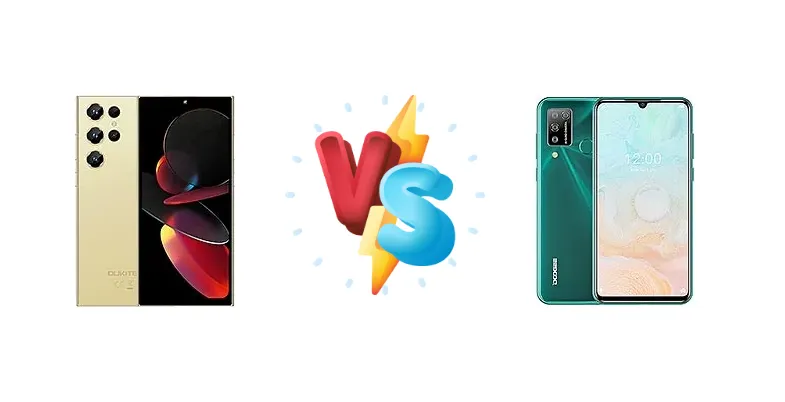
The Oukitel C61 and Doogee N20 Pro represent a competitive segment of the smartphone market – affordable devices aiming to deliver essential functionality without breaking the bank. This comparison focuses on the core performance and endurance differences between these two phones, dissecting their chipsets and battery capabilities to determine which offers the best value.
🏆 Quick Verdict
For the average user prioritizing long-lasting battery life and a slightly more modern CPU architecture, the Oukitel C61 emerges as the winner. Its Unisoc T615, while not a powerhouse, offers a more efficient core configuration and impressive 64:19h endurance, making it ideal for daily tasks and extended use.
| Network |
|---|
| 2G bands | GSM 850 / 900 / 1800 / 1900 | GSM 850 / 900 / 1800 / 1900 |
| 3G bands | HSDPA 850 / 900 / 1700(AWS) / 1900 / 2100 | HSDPA 850 / 900 / 2100 |
| 4G bands | 1, 2, 3, 4, 5, 7, 8, 12, 17, 18, 19, 20, 25, 26, 28, 34, 38, 39, 40, 41, 66 | 1, 3, 5, 7, 8, 19, 20 |
| Speed | HSPA, LTE | HSPA, LTE |
| Technology | GSM / HSPA / LTE | GSM / HSPA / LTE |
| Launch |
|---|
| Announced | 2025, March | 2020, August 04. Released 2020, August |
| Status | Available. Released 2025, May | Discontinued |
| Body |
|---|
| Dimensions | 170.7 x 79.6 x 9.5 mm (6.72 x 3.13 x 0.37 in) | 159 x 77.1 x 8.8 mm (6.26 x 3.04 x 0.35 in) |
| SIM | Nano-SIM + Nano-SIM | Nano-SIM + Nano-SIM |
| Weight | 216 g (7.62 oz) | 175 g (6.17 oz) |
| Display |
|---|
| Protection | Corning Gorilla Glass, Mohs level 5 | - |
| Resolution | 720 x 1640 pixels (~260 ppi density) | 1080 x 2280 pixels, 19:9 ratio (~400 ppi density) |
| Size | 6.88 inches, 112.4 cm2 (~82.7% screen-to-body ratio) | 6.3 inches, 99.1 cm2 (~80.8% screen-to-body ratio) |
| Type | IPS LCD, 90Hz, 450 nits | IPS LCD |
| Platform |
|---|
| CPU | Octa-core (2x1.8 GHz Cortex-A75 & 6x1.6 GHz Cortex-A55) | Octa-core (4x2.0 GHz Cortex-A73 & 4x2.0 GHz Cortex-A53) |
| Chipset | Unisoc T615 (12 nm) | Mediatek MT6771V/CA Helio P60 (12 nm) |
| GPU | Mali-G57 MP1 | Mali-G72 MP3 |
| OS | Android 15 | Android 10 |
| Memory |
|---|
| Card slot | microSDXC (uses shared SIM slot) | microSDXC (uses shared SIM slot) |
| Internal | 128GB 4GB RAM | 128GB 6GB RAM |
| Main Camera |
|---|
| Features | LED flash, HDR, panorama | LED flash |
| Quad | - | 16 MP, f/2.0, (wide), PDAF
8 MP, f/2.4, 130˚ (ultrawide)
2 MP (macro)
Auxiliary lens |
| Single | 13 MP, f/2.2, (wide), 1/3.06", AF | - |
| Video | 1080p@30fps | 1080p |
| Selfie camera |
|---|
| Single | 5 MP, f/2.2, (wide), 1/5.0" | 16 MP, f/2.0, (wide) |
| Video | 720p@30fps | 1080p |
| Sound |
|---|
| 35mm jack | No | Yes |
| Loudspeaker | Yes | Yes |
| Comms |
|---|
| Bluetooth | 5.0, A2DP, LE | 5.0, A2DP, LE |
| NFC | Yes | No |
| Positioning | GPS, GALILEO, GLONASS, BDS | GPS, GLONASS, BDS, GALILEO |
| Radio | FM radio | FM radio |
| USB | USB Type-C | microUSB 2.0 |
| WLAN | Wi-Fi 802.11 a/b/g/n/ac, dual-band | Wi-Fi 802.11 a/b/g/n/ac, dual-band |
| Features |
|---|
| Sensors | Fingerprint (side-mounted), accelerometer, compass | Fingerprint (rear-mounted), accelerometer, proximity |
| Battery |
|---|
| Charging | 10W wired | 10W wired |
| Type | Li-Po 5150 mAh | 4400 mAh |
| Misc |
|---|
| Colors | Gold, Purple, Blue, Black | Gray, Purple, Forest |
| Price | € 89.99 / $ 129.99 / £ 82.99 | About 170 EUR |
| EU LABEL |
|---|
| Battery | 64:19h endurance, 1000 cycles | - |
| Energy | Class A | - |
| Free fall | Class B (180 falls) | - |
| Repairability | Class B | - |
Oukitel C61
- Exceptional battery life (64:19h endurance)
- More modern CPU architecture (Cortex-A75)
- Potentially longer battery lifespan (1000 cycles)
- Lower peak CPU clock speed compared to the N20 Pro
- Limited information on display quality
Doogee N20 Pro
- Higher peak CPU clock speed on prime cores
- Established MediaTek chipset
- Potentially better compatibility with some apps
- Shorter battery life compared to the C61
- Older CPU architecture (Cortex-A73)
Display Comparison
Neither device provides display specifications in the provided data. Given their price point, it's reasonable to assume both utilize IPS LCD panels with 720p+ resolutions. The absence of details like refresh rate or peak brightness suggests a focus on cost reduction, meaning display quality won't be a key differentiator. Bezels are likely to be substantial on both.
Camera Comparison
The provided data doesn't detail camera specifications beyond the presence of cameras. In this price bracket, image quality is typically heavily reliant on software processing rather than sensor size or lens quality. It’s safe to assume both phones feature a multi-camera setup with a primary sensor, likely around 13-20MP, and potentially auxiliary lenses like depth or macro sensors (the usefulness of a 2MP macro lens is minimal). Without further information, a direct comparison is impossible, but software optimization will be the deciding factor.
Performance
The core difference lies in the chipsets: the Oukitel C61 features the Unisoc T615, a 12nm processor with an octa-core configuration of 2x1.8 GHz Cortex-A75 and 6x1.6 GHz Cortex-A55 cores. The Doogee N20 Pro utilizes the MediaTek Helio P60 (MT6771V/CA), also a 12nm chip, but with a different core arrangement – 4x2.0 GHz Cortex-A73 and 4x2.0 GHz Cortex-A53. While the Helio P60’s A73 cores have a higher clock speed, the A75 cores in the T615 generally offer better single-core performance and efficiency. This translates to a smoother experience in everyday tasks for the Oukitel C61. The T615’s architecture is newer, potentially benefiting from software optimizations. Both chipsets are adequate for basic multitasking and light gaming, but neither is designed for demanding titles.
Battery Life
The Oukitel C61 boasts a significant advantage in battery endurance with a reported 64:19h rating and a 1000 cycle lifespan. This suggests a larger battery capacity and optimized power management. The Doogee N20 Pro, with only 10W wired charging, will likely require more frequent charging. While both phones share the same 10W charging speed, the C61’s superior endurance means users will spend less time tethered to a power outlet. The 1000 cycle lifespan of the C61 also indicates a more durable battery over the long term.
Buying Guide
Buy the Oukitel C61 if you need a phone that can reliably last through a full day (and then some) of moderate use, and you prioritize battery life over raw processing power. It’s perfect for users who primarily browse, use social media, and make calls. Buy the Doogee N20 Pro if you prefer a chipset with a slightly higher peak clock speed on its prime cores, potentially offering a marginal performance boost in specific, demanding applications, but are willing to accept potentially shorter battery life.
Frequently Asked Questions
❓ Will the Unisoc T615 in the Oukitel C61 struggle with graphically intensive games like PUBG Mobile?
While the Unisoc T615 can run PUBG Mobile, you'll likely need to lower the graphics settings to medium or low to achieve a playable frame rate. It's not a gaming-focused chipset, so don't expect flagship-level performance. The Helio P60 in the Doogee N20 Pro might offer a slight edge in frame rates, but both will require compromises.
❓ How does the 10W charging affect the user experience on both the Oukitel C61 and Doogee N20 Pro?
10W charging is relatively slow by today's standards. Expect a full charge to take around 3-4 hours. However, the Oukitel C61's exceptional battery life mitigates this issue, as you won't need to charge it as frequently. The Doogee N20 Pro, with its shorter battery life, will require more frequent top-ups, making the slow charging more noticeable.
❓ Is the 1000 charge cycle claim for the Oukitel C61's battery realistic?
While 1000 charge cycles is an ambitious claim, it suggests Oukitel has implemented battery health management features to prolong the battery's lifespan. It's unlikely the battery will retain 100% capacity after 1000 cycles, but it should still offer significantly better performance than a battery without such features.