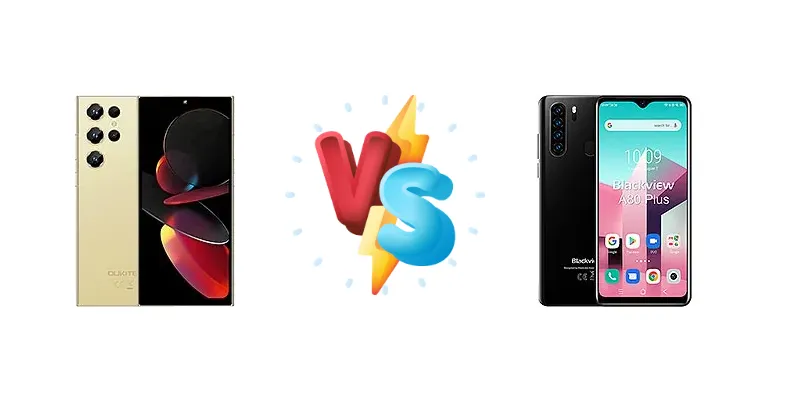
The Oukitel C61 and Blackview A80 Plus represent the fiercely competitive sub-$150 smartphone market. Both aim to deliver essential functionality at an incredibly low price point, but they take different approaches to achieving this. The C61 prioritizes processing power with a newer Unisoc chipset, while the A80 Plus relies on the established, though less potent, MediaTek Helio A25. This comparison will dissect their key differences to determine which device offers the best value.
🏆 Quick Verdict
For the average user prioritizing responsiveness and future-proofing, the Oukitel C61 emerges as the better choice. Its Unisoc T615 chipset, featuring Cortex-A75 cores, provides a noticeable performance advantage over the Blackview A80 Plus’ Helio A25, making everyday tasks and light multitasking smoother. While both offer similar battery endurance, the C61’s superior processing power justifies its slight price premium.
| Network |
|---|
| 2G bands | GSM 850 / 900 / 1800 / 1900 | GSM 850 / 900 / 1800 / 1900 |
| 3G bands | HSDPA 850 / 900 / 1700(AWS) / 1900 / 2100 | HSDPA 850 / 900 / 1900 / 2100 |
| 4G bands | 1, 2, 3, 4, 5, 7, 8, 12, 17, 18, 19, 20, 25, 26, 28, 34, 38, 39, 40, 41, 66 | 1, 3, 7, 8, 20, 40 |
| Speed | HSPA, LTE | HSPA, LTE |
| Technology | GSM / HSPA / LTE | GSM / HSPA / LTE |
| Launch |
|---|
| Announced | 2025, March | 2020, December 10. Released 2020, December |
| Status | Available. Released 2025, May | Discontinued |
| Body |
|---|
| Dimensions | 170.7 x 79.6 x 9.5 mm (6.72 x 3.13 x 0.37 in) | 162.8 x 77.8 x 8.8 mm (6.41 x 3.06 x 0.35 in) |
| SIM | Nano-SIM + Nano-SIM | Nano-SIM + Nano-SIM |
| Weight | 216 g (7.62 oz) | 180 g (6.35 oz) |
| Display |
|---|
| Protection | Corning Gorilla Glass, Mohs level 5 | - |
| Resolution | 720 x 1640 pixels (~260 ppi density) | 720 x 1560 pixels, 19.5:9 ratio (~265 ppi density) |
| Size | 6.88 inches, 112.4 cm2 (~82.7% screen-to-body ratio) | 6.49 inches, 103.4 cm2 (~81.6% screen-to-body ratio) |
| Type | IPS LCD, 90Hz, 450 nits | IPS LCD |
| Platform |
|---|
| CPU | Octa-core (2x1.8 GHz Cortex-A75 & 6x1.6 GHz Cortex-A55) | Octa-core (4x1.8 GHz Cortex-A53 & 4x1.5 GHz Cortex-A53) |
| Chipset | Unisoc T615 (12 nm) | Mediatek MT6762V/WD Helio A25 (12 nm) |
| GPU | Mali-G57 MP1 | PowerVR GE8320 |
| OS | Android 15 | Android 10 |
| Memory |
|---|
| Card slot | microSDXC (uses shared SIM slot) | microSDXC |
| Internal | 128GB 4GB RAM | 64GB 4GB RAM |
| Main Camera |
|---|
| Features | LED flash, HDR, panorama | LED flash, HDR |
| Quad | - | 13 MP, f/2.0, (wide), AF
other unspecified cameras |
| Single | 13 MP, f/2.2, (wide), 1/3.06", AF | - |
| Video | 1080p@30fps | 1080p@30fps |
| Selfie camera |
|---|
| Single | 5 MP, f/2.2, (wide), 1/5.0" | 8 MP, (wide) |
| Video | 720p@30fps | 1080p@30fps |
| Sound |
|---|
| 35mm jack | No | Yes |
| Loudspeaker | Yes | Yes |
| Comms |
|---|
| Bluetooth | 5.0, A2DP, LE | 4.2, A2DP, LE |
| NFC | Yes | Yes |
| Positioning | GPS, GALILEO, GLONASS, BDS | GPS, GLONASS, BDS |
| Radio | FM radio | FM radio |
| USB | USB Type-C | USB Type-C 2.0, OTG |
| WLAN | Wi-Fi 802.11 a/b/g/n/ac, dual-band | Wi-Fi 802.11 b/g/n/ac |
| Features |
|---|
| Sensors | Fingerprint (side-mounted), accelerometer, compass | Fingerprint (rear-mounted), accelerometer, proximity |
| Battery |
|---|
| Charging | 10W wired | 10W wired |
| Type | Li-Po 5150 mAh | 4680 mAh |
| Misc |
|---|
| Colors | Gold, Purple, Blue, Black | Black, Blue, Red |
| Price | € 89.99 / $ 129.99 / £ 82.99 | About 130 EUR |
| EU LABEL |
|---|
| Battery | 64:19h endurance, 1000 cycles | - |
| Energy | Class A | - |
| Free fall | Class B (180 falls) | - |
| Repairability | Class B | - |
Oukitel C61
- Superior processor performance with the Unisoc T615.
- Potentially longer battery lifespan due to 1000 charge cycles.
- More responsive user experience for everyday tasks.
- 10W charging is slow.
- Camera performance likely limited.
Blackview A80 Plus
- Extremely affordable price point.
- Functional for basic communication needs.
- Decent battery life for light usage.
- Significantly slower processor performance.
- Less responsive user experience.
- Limited multitasking capabilities.
Display Comparison
Neither device boasts a standout display. Both likely utilize standard IPS LCD panels, typical for this price bracket. The focus here isn't on visual fidelity, but on functionality. Without specific display specs, we can assume both offer adequate viewing angles and color reproduction for basic use. The absence of features like high refresh rates or high peak brightness is expected.
Camera Comparison
Camera performance is likely to be similar on both devices, leaning towards basic functionality. Given the price point, expect limited low-light performance and average image quality. Without detailed sensor information, it’s safe to assume both feature a primary sensor paired with auxiliary lenses of minimal utility (likely a 2MP macro or depth sensor). Image processing will be basic, prioritizing speed over detail. The focus should be on capturing memories, not creating professional-quality photos.
Performance
The core difference lies in the chipsets. The Oukitel C61’s Unisoc T615 (12nm) features a heterogeneous core configuration: 2x 1.8 GHz Cortex-A75 and 6x 1.6 GHz Cortex-A55. This architecture provides a significant boost in single-core and multi-core performance compared to the Blackview A80 Plus’ MediaTek Helio A25 (12nm) with its 4x 1.8 GHz Cortex-A53 and 4x 1.5 GHz Cortex-A53 cores. The A75 cores in the T615 are substantially more powerful than the A53 cores in the Helio A25, resulting in snappier app launches and smoother multitasking. This translates to a more fluid user experience for the C61.
Battery Life
The Oukitel C61 claims 64:19h endurance and 1000 charge cycles, suggesting a robust battery life and longevity. Both phones share a 10W wired charging speed, meaning charge times will be relatively slow – expect several hours for a full charge. The C61’s more efficient chipset *could* translate to slightly better real-world battery life, but the difference is unlikely to be dramatic. The 1000 cycle claim for the C61 is a significant advantage, indicating the battery should retain a higher capacity over a longer period.
Buying Guide
Buy the Oukitel C61 if you need a phone that feels responsive for everyday tasks like browsing, social media, and messaging, and you anticipate using it for more than just basic calls and texts. Buy the Blackview A80 Plus if you prioritize absolute minimal cost and only require a phone for the most fundamental functions – calls, texts, and very light app usage – and are willing to accept slower performance.
Frequently Asked Questions
❓ Will the Unisoc T615 in the Oukitel C61 handle popular apps like Facebook and WhatsApp smoothly?
Yes, the Unisoc T615 is more than capable of running apps like Facebook and WhatsApp smoothly. The Cortex-A75 cores provide a significant performance boost over the Helio A25, ensuring a responsive experience even with multiple apps open.
❓ Is the 10W charging speed on both phones a major drawback?
Yes, 10W charging is relatively slow by today's standards. Expect a full charge to take several hours. However, given the price point and likely smaller battery capacities, it's a compromise many users will have to accept. Prioritize charging overnight.
❓ Can the Blackview A80 Plus handle basic mobile gaming?
The Blackview A80 Plus can handle *very* basic mobile gaming, but don't expect a smooth experience with demanding titles. The Helio A25 struggles with graphically intensive games, and you'll likely encounter lag and low frame rates. Simple 2D games will be playable.
❓ How does the Unisoc T615 compare to other chipsets in this price range?
The Unisoc T615 generally outperforms the MediaTek Helio A25 and Helio P22 commonly found in this price bracket. It's closer in performance to some older Helio G series chips, offering a better balance of power and efficiency.