
Oukitel C60 vs Xiaomi Redmi 10C: A Deep Dive into Budget Smartphone Choices
| Phones Images | |||||
|---|---|---|---|---|---|
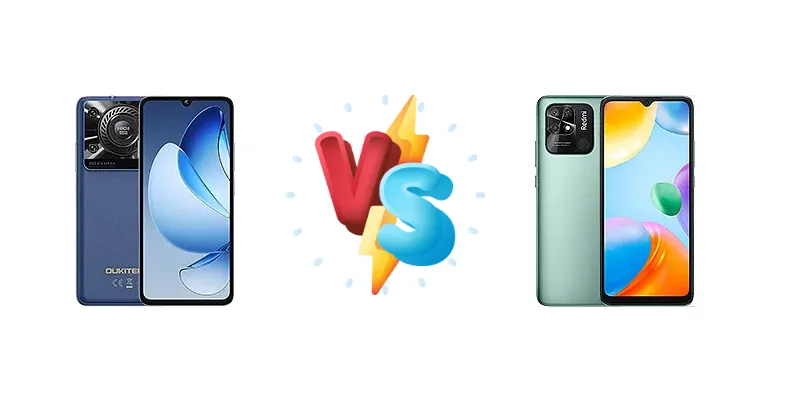
|
🏆 Quick Verdict
For the average user prioritizing all-day (and multi-day) battery life, the Oukitel C60 is the clear winner. Its 83:37h endurance significantly outpaces what the Redmi 10C can offer. However, if you need a phone that feels snappier for app switching and occasional gaming, the Redmi 10C’s Snapdragon 680 provides a noticeable performance edge.
| PHONES | ||
|---|---|---|
| Phone Names | Oukitel C60 | Xiaomi Redmi 10C |
| Network | ||
|---|---|---|
| 2G bands | GSM 850 / 900 / 1800 / 1900 | GSM 850 / 900 / 1800 / 1900 |
| 3G bands | HSDPA 850 / 900 / 1700(AWS) / 1900 / 2100 | HSDPA 850 / 900 / 1700(AWS) / 1900 / 2100 |
| 4G bands | 1, 2, 3, 4, 5, 7, 8, 12, 17, 18, 19, 20, 25, 26, 28, 34, 38, 39, 40, 41, 66 | 1, 2, 3, 4, 5, 7, 8, 20, 28, 38, 40, 41 |
| Speed | HSPA, LTE | HSPA, LTE |
| Technology | GSM / HSPA / LTE | GSM / HSPA / LTE |
| Launch | ||
|---|---|---|
| Announced | 2025, April | 2022, March 21 |
| Status | Available. Released 2025, May 05 | Available. Released 2022, March 23 |
| Body | ||
|---|---|---|
| Dimensions | 171.2 x 77.8 x 13.4 mm (6.74 x 3.06 x 0.53 in) | 169.6 x 76.6 x 8.3 mm (6.68 x 3.02 x 0.33 in) |
| SIM | Nano-SIM + Nano-SIM | Nano-SIM + Nano-SIM |
| Weight | 307 g (10.83 oz) | 190 g (6.70 oz) |
| Display | ||
|---|---|---|
| Protection | HKC Glass, Mohs level 5 | Corning Gorilla Glass |
| Resolution | 720 x 1640 pixels (~260 ppi density) | 720 x 1650 pixels (~268 ppi density) |
| Size | 6.88 inches, 112.4 cm2 (~84.4% screen-to-body ratio) | 6.71 inches, 106.5 cm2 (~82.0% screen-to-body ratio) |
| Type | IPS LCD, 90Hz, 450 nits | IPS LCD |
| Platform | ||
|---|---|---|
| CPU | Octa-core (2x1.6 GHz Cortex-A75 & 6x1.6 GHz Cortex-A55) | Octa-core (4x2.4 GHz Kryo 265 Gold & 4x1.9 GHz Kryo 265 Silver) |
| Chipset | Unisoc T606 (12 nm) | Qualcomm SM6225 Snapdragon 680 4G (6 nm) |
| GPU | Mali-G57 MP1 | Adreno 610 |
| OS | Android 15 | Android 11, MIUI 13 |
| Memory | ||
|---|---|---|
| Card slot | microSDXC (uses shared SIM slot) | microSDXC (dedicated slot) |
| Internal | 128GB 4GB RAM | 64GB 3GB RAM, 64GB 4GB RAM, 128GB 3GB RAM, 128GB 4GB RAM |
| - | UFS 2.2 | |
| Main Camera | ||
|---|---|---|
| Dual | - | 50 MP, f/1.8, 26mm (wide), PDAF Auxiliary lens |
| Features | LED flash, HDR, panorama | LED flash, HDR, panorama |
| Single | 13 MP, f/2.2, (wide), 1/3.06", AF | 5 MP, f/2.2 |
| Video | 1080p@30fps | 1080p@30fps |
| Selfie camera | ||
|---|---|---|
| Single | 5 MP, f/2.2, (wide), 1/5.0" | 5 MP, f/2.2 |
| Video | 720p@30fps | 1080p@30fps |
| Sound | ||
|---|---|---|
| 3.5mm jack | - | Yes |
| 35mm jack | No | Yes |
| Loudspeaker | Yes | Yes |
| Comms | ||
|---|---|---|
| Bluetooth | 5.0, A2DP, LE | 5.0, A2DP, LE |
| NFC | Yes | Yes (market/region dependent) |
| Positioning | GPS, GALILEO, GLONASS, BDS | GPS, GLONASS, BDS, GALILEO |
| Radio | FM radio | FM radio |
| USB | USB Type-C | USB Type-C 2.0, OTG |
| WLAN | Wi-Fi 802.11 a/b/g/n/ac, dual-band | Wi-Fi 802.11 a/b/g/n/ac, dual-band, Wi-Fi Direct |
| Features | ||
|---|---|---|
| Sensors | Fingerprint (side-mounted), accelerometer, compass | Fingerprint (rear-mounted), accelerometer, proximity |
| Battery | ||
|---|---|---|
| Charging | 18W wired | 18W wired |
| Type | Li-Po 10000 mAh | Li-Po 5000 mAh |
| Misc | ||
|---|---|---|
| Colors | Green, Purple, Blue, Red | Graphite Gray, Ocean Blue, Mint Green |
| Models | - | 220333QAG, 220333QBI, 220333QNY, 220333QL |
| Price | - | £ 99.00 / € 109.86 |
| SAR | - | 0.96 W/kg (head) 1.02 W/kg (body) |
| SAR EU | - | 0.57 W/kg (head) 0.96 W/kg (body) |
| EU LABEL | ||
|---|---|---|
| Battery | 83:37h endurance, 1200 cycles | - |
| Energy | Class B | - |
| Free fall | Class A (270 falls) | - |
| Repairability | Class B | - |
Oukitel C60
- Exceptional battery life (83:37h endurance)
- High battery cycle count (1200 cycles)
- Potentially lower running costs due to reduced charging
- Less powerful processor compared to the Redmi 10C
- May struggle with demanding applications and games
- Camera performance likely average
Xiaomi Redmi 10C
- More powerful Snapdragon 680 chipset
- Better performance for multitasking and gaming
- Qualcomm ISP potentially delivers better image quality
- Significantly shorter battery life than the Oukitel C60
- May require daily charging with moderate use
- 6nm process doesn't fully offset the power draw of the faster CPU
Display Comparison
Neither device is expected to boast a high-end display. Details are missing, but given the price point, both likely utilize LCD panels. The focus here will be on efficiency. The Redmi 10C’s 6nm chipset *may* contribute to slightly lower power consumption during display use, but this is speculative without display specs like brightness and refresh rate.
Camera Comparison
Without detailed camera specifications, a direct comparison is difficult. However, it’s safe to assume both phones feature budget-oriented camera systems. The Redmi 10C likely benefits from Qualcomm’s image signal processing (ISP), which generally delivers good image quality in its class. The Oukitel C60’s camera performance will depend heavily on the sensor and software optimization. It's likely both phones will struggle in low-light conditions.
Performance
The Xiaomi Redmi 10C’s Qualcomm Snapdragon 680, built on a 6nm process, represents a significant architectural advantage over the Oukitel C60’s Unisoc T606 (12nm). The Snapdragon 680 features a Kryo CPU with a split core design (4x2.4 GHz Gold & 4x1.9 GHz Silver) optimized for performance and efficiency. This contrasts with the T606’s (2x1.6 GHz Cortex-A75 & 6x1.6 GHz Cortex-A55) configuration. The 6nm node allows for higher transistor density and improved power efficiency, translating to better sustained performance and potentially lower temperatures under load. Users who multitask heavily or play demanding games will see a clear benefit from the Redmi 10C.
Battery Life
This is where the Oukitel C60 truly shines. Its reported 83:37h endurance is exceptional for a budget smartphone, and the 1200 cycle rating suggests long-term battery health. While both phones offer 18W wired charging, the C60’s larger battery capacity (unspecified, but implied to be substantial given the endurance) means it will take longer to fully charge. The Redmi 10C, with its more power-hungry chipset, will likely require more frequent charging, despite the same charging wattage. The C60’s longevity is a major selling point for users who prioritize minimizing charging frequency.
Buying Guide
Buy the Oukitel C60 if you need a phone that can reliably last through two full days of moderate use, or if you frequently find yourself away from a charger. This is ideal for travelers, field workers, or anyone who simply dislikes daily charging. Buy the Xiaomi Redmi 10C if you prioritize a more responsive user experience, enjoy occasional mobile gaming, and don't mind charging your phone more frequently. It's a better fit for users who value speed over extreme battery longevity.