
Oukitel C60 vs Ulefone Note 13P: A Deep Dive into Budget Smartphone Choices
| Phones Images | |||||
|---|---|---|---|---|---|
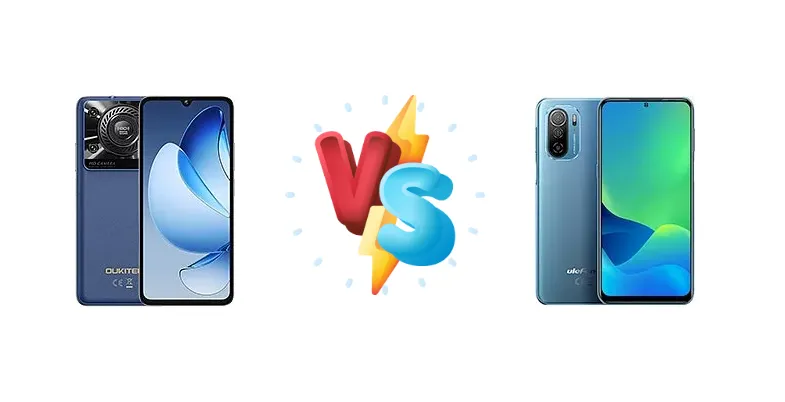
|
🏆 Quick Verdict
For the average user prioritizing longevity and consistent performance, the Oukitel C60 emerges as the stronger choice. Its significantly superior 83:37h battery endurance and more modern CPU architecture (Cortex-A75 cores) outweigh the Ulefone Note 13P’s marginally faster clock speeds, especially considering the latter’s slower charging.
| PHONES | ||
|---|---|---|
| Phone Names | Oukitel C60 | Ulefone Note 13P |
| Network | ||
|---|---|---|
| 2G bands | GSM 850 / 900 / 1800 / 1900 | GSM 850 / 900 / 1800 / 1900 |
| 3G bands | HSDPA 850 / 900 / 1700(AWS) / 1900 / 2100 | HSDPA 850 / 900 / 1700(AWS) / 1900 / 2100 |
| 4G bands | 1, 2, 3, 4, 5, 7, 8, 12, 17, 18, 19, 20, 25, 26, 28, 34, 38, 39, 40, 41, 66 | 1, 2, 3, 4, 5, 7, 8, 12, 13, 17, 18, 19, 20, 25, 26, 28 |
| Speed | HSPA, LTE | HSPA, LTE |
| Technology | GSM / HSPA / LTE | GSM / HSPA / LTE |
| Launch | ||
|---|---|---|
| Announced | 2025, April | 2021, November 24 |
| Status | Available. Released 2025, May 05 | Available. Released 2021, November 24 |
| Body | ||
|---|---|---|
| Dimensions | 171.2 x 77.8 x 13.4 mm (6.74 x 3.06 x 0.53 in) | 162.3 x 75.7 x 9.9 mm (6.39 x 2.98 x 0.39 in) |
| SIM | Nano-SIM + Nano-SIM | Nano-SIM + Nano-SIM |
| Weight | 307 g (10.83 oz) | 198.5 g (7.02 oz) |
| Display | ||
|---|---|---|
| Protection | HKC Glass, Mohs level 5 | - |
| Resolution | 720 x 1640 pixels (~260 ppi density) | 1080 x 2400 pixels, 20:9 ratio (~405 ppi density) |
| Size | 6.88 inches, 112.4 cm2 (~84.4% screen-to-body ratio) | 6.5 inches, 102.0 cm2 (~83.0% screen-to-body ratio) |
| Type | IPS LCD, 90Hz, 450 nits | IPS LCD |
| Platform | ||
|---|---|---|
| CPU | Octa-core (2x1.6 GHz Cortex-A75 & 6x1.6 GHz Cortex-A55) | Octa-core (4x2.3 GHz Cortex-A53 & 4x1.8 GHz Cortex-A53) |
| Chipset | Unisoc T606 (12 nm) | Mediatek MT6765G Helio G35 (12 nm) |
| GPU | Mali-G57 MP1 | PowerVR GE8320 |
| OS | Android 15 | Android 11 |
| Memory | ||
|---|---|---|
| Card slot | microSDXC (uses shared SIM slot) | microSDXC (dedicated slot) |
| Internal | 128GB 4GB RAM | 64GB 4GB RAM |
| - | eMMC 5.1 | |
| Main Camera | ||
|---|---|---|
| Dual | - | 20 MP, f/1.8, 25mm (wide), 1/2.78, 1.0µm, AF 2 MP (macro) |
| Features | LED flash, HDR, panorama | LED flash, HDR, panorama |
| Single | 13 MP, f/2.2, (wide), 1/3.06", AF | 16 MP, f/2.2, (wide), 1/3.09, 1.0µm |
| Video | 1080p@30fps | 1080p@30fps |
| Selfie camera | ||
|---|---|---|
| Features | - | HDR |
| Single | 5 MP, f/2.2, (wide), 1/5.0" | 16 MP, f/2.2, (wide), 1/3.09, 1.0µm |
| Video | 720p@30fps | 1080p@30fps |
| Sound | ||
|---|---|---|
| 3.5mm jack | - | Yes |
| 35mm jack | No | Yes |
| Loudspeaker | Yes | Yes |
| Comms | ||
|---|---|---|
| Bluetooth | 5.0, A2DP, LE | 5.0, A2DP, LE |
| NFC | Yes | Yes |
| Positioning | GPS, GALILEO, GLONASS, BDS | GPS, GLONASS, GALILEO, BDS |
| Radio | FM radio | Stereo FM radio, RDS, recording |
| USB | USB Type-C | USB Type-C 2.0 |
| WLAN | Wi-Fi 802.11 a/b/g/n/ac, dual-band | Wi-Fi 802.11 a/b/g/n/ac, dual-band |
| Features | ||
|---|---|---|
| Sensors | Fingerprint (side-mounted), accelerometer, compass | Fingerprint (side-mounted), accelerometer, proximity, compass |
| Battery | ||
|---|---|---|
| Charging | 18W wired | 10W wired |
| Type | Li-Po 10000 mAh | Li-Po 5180 mAh |
| Misc | ||
|---|---|---|
| Colors | Green, Purple, Blue, Red | Starry Black, Mystery Blue |
| Price | - | About 130 EUR |
| EU LABEL | ||
|---|---|---|
| Battery | 83:37h endurance, 1200 cycles | - |
| Energy | Class B | - |
| Free fall | Class A (270 falls) | - |
| Repairability | Class B | - |
Oukitel C60
- Exceptional battery life (83:37h endurance)
- More efficient CPU architecture (Cortex-A75 cores)
- Faster charging (18W vs 10W)
- Potentially less responsive for very basic tasks compared to the higher clocked Ulefone
- Display specifications are likely standard for the price range
Ulefone Note 13P
- Higher CPU clock speeds (potentially snappier for simple tasks)
- Lower price point (likely, based on market positioning)
- Acceptable performance for basic Android usage
- Significantly shorter battery life
- Slower charging speed (10W)
- Older CPU architecture (Cortex-A53 cores)
Display Comparison
Neither device boasts a standout display. Given the lack of display specifications in the provided data, we can infer both likely utilize standard IPS LCD panels common in this price bracket. The focus here isn't on visual fidelity, but rather basic usability. Bezels are likely to be substantial on both, and color accuracy will be adequate but not exceptional. The absence of high refresh rates or advanced features like LTPO is expected.
Camera Comparison
Without detailed camera specifications, a direct comparison is difficult. However, it’s safe to assume both phones feature basic camera setups geared towards casual photography. The prevalence of 2MP macro lenses in this segment suggests both devices likely include one, but its utility is limited. Image quality will heavily rely on software processing and sensor size, which are unknown. The Oukitel C60’s potential advantage lies in the Unisoc T606’s image signal processor (ISP), which may offer slightly better noise reduction and dynamic range compared to the Helio G35’s ISP.
Performance
The core difference lies in the chipset and CPU architecture. The Oukitel C60’s Unisoc T606, built on a 12nm process, features a combination of Cortex-A75 and A55 cores. The A75 cores, clocked at 1.6 GHz, provide a noticeable performance boost over the Ulefone Note 13P’s MediaTek Helio G35. The Helio G35 relies solely on Cortex-A53 cores, all clocked at 2.3 GHz and 1.8 GHz. While the G35’s clock speed appears higher, the older A53 architecture is less efficient and delivers lower Instructions Per Clock (IPC) than the A75. This translates to the Oukitel C60 handling multitasking and more demanding apps with greater ease. The 12nm fabrication process is identical for both, suggesting similar thermal characteristics, but the architectural advantage favors the Oukitel.
Battery Life
This is where the Oukitel C60 truly shines. Its reported 83:37h endurance is exceptional for a budget smartphone, and the 1200 charge cycles suggest long-term battery health. The Ulefone Note 13P, with its 10W charging, will take significantly longer to fully charge. The Oukitel C60’s 18W charging, while not fast by modern standards, offers a substantial improvement in recharge time. The difference in endurance means the Oukitel C60 can comfortably last a full day with heavy use, while the Ulefone Note 13P may require a midday top-up.
Buying Guide
Buy the Oukitel C60 if you need a phone that can reliably last through two full days of moderate use, or if you frequently find yourself away from a power outlet. This phone is ideal for travelers, field workers, or anyone who simply dislikes daily charging. Buy the Ulefone Note 13P if you prioritize a slightly more responsive interface for basic tasks and are willing to compromise on battery life and charging speed to achieve it.