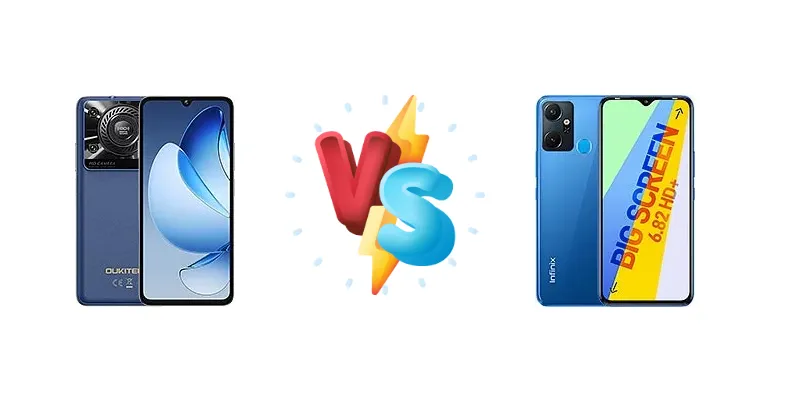
The sub-$150 smartphone market is fiercely competitive. Both the Oukitel C60 and the Infinix Smart 6 Plus (India) aim to deliver essential smartphone functionality at an incredibly accessible price point. However, they take different approaches to achieving this, with the Oukitel prioritizing endurance and a more modern CPU architecture, while the Infinix focuses on a slightly higher clocked CPU, but an older architecture. This comparison will dissect their key differences to determine which device offers the best value.
🏆 Quick Verdict
For the average user prioritizing longevity and consistent performance, the Oukitel C60 emerges as the winner. Its Unisoc T606 chipset, coupled with an impressive 83:37h battery endurance, provides a smoother, more reliable experience than the Infinix Smart 6 Plus, despite the latter's slightly faster clock speeds.
| Network |
|---|
| 2G bands | GSM 850 / 900 / 1800 / 1900 | GSM 850 / 900 / 1800 / 1900 |
| 3G bands | HSDPA 850 / 900 / 1700(AWS) / 1900 / 2100 | HSDPA 850 / 900 / 2100 |
| 4G bands | 1, 2, 3, 4, 5, 7, 8, 12, 17, 18, 19, 20, 25, 26, 28, 34, 38, 39, 40, 41, 66 | 1, 3, 5, 8, 38, 40, 41 |
| Speed | HSPA, LTE | HSPA, LTE |
| Technology | GSM / HSPA / LTE | GSM / HSPA / LTE |
| Launch |
|---|
| Announced | 2025, April | 2022, July 29 |
| Status | Available. Released 2025, May 05 | Available. Released 2022, August 03 |
| Body |
|---|
| Build | - | Glass front, plastic back, plastic frame |
| Dimensions | 171.2 x 77.8 x 13.4 mm (6.74 x 3.06 x 0.53 in) | 172.6 x 77.7 x 8.7 mm (6.80 x 3.06 x 0.34 in) |
| SIM | Nano-SIM + Nano-SIM | Nano-SIM + Nano-SIM |
| Weight | 307 g (10.83 oz) | 202 g (7.13 oz) |
| Display |
|---|
| Protection | HKC Glass, Mohs level 5 | Panda Glass |
| Resolution | 720 x 1640 pixels (~260 ppi density) | 720 x 1600 pixels, 20:9 ratio (~257 ppi density) |
| Size | 6.88 inches, 112.4 cm2 (~84.4% screen-to-body ratio) | 6.82 inches, 112.3 cm2 (~83.7% screen-to-body ratio) |
| Type | IPS LCD, 90Hz, 450 nits | IPS LCD, 440 nits (typ) |
| Platform |
|---|
| CPU | Octa-core (2x1.6 GHz Cortex-A75 & 6x1.6 GHz Cortex-A55) | Octa-core (4x2.0 GHz Cortex-A53 & 4x1.5 GHz Cortex-A53) |
| Chipset | Unisoc T606 (12 nm) | Mediatek MT6762G Helio G25 (12 nm) |
| GPU | Mali-G57 MP1 | PowerVR GE8320 |
| OS | Android 15 | Android 12 (Go edition) |
| Memory |
|---|
| Card slot | microSDXC (uses shared SIM slot) | microSDXC (dedicated slot) |
| Internal | 128GB 4GB RAM | 64GB 2GB RAM, 64GB 3GB RAM |
| | - | eMMC 5.1 |
| Main Camera |
|---|
| Dual | - | 8 MP, f/2.0, AF
Auxiliary lens |
| Features | LED flash, HDR, panorama | Dual-LED flash, HDR, panorama |
| Single | 13 MP, f/2.2, (wide), 1/3.06", AF | 5 MP, f/2.0 |
| Video | 1080p@30fps | 1080p@30fps |
| Selfie camera |
|---|
| Features | - | LED flash |
| Single | 5 MP, f/2.2, (wide), 1/5.0" | 5 MP, f/2.0 |
| Video | 720p@30fps | 720p@30fps |
| Sound |
|---|
| 3.5mm jack | - | Yes |
| 35mm jack | No | Yes |
| Loudspeaker | Yes | Yes |
| Comms |
|---|
| Bluetooth | 5.0, A2DP, LE | 5.0, A2DP, LE |
| NFC | Yes | No |
| Positioning | GPS, GALILEO, GLONASS, BDS | GPS |
| Radio | FM radio | FM radio |
| USB | USB Type-C | microUSB 2.0, OTG |
| WLAN | Wi-Fi 802.11 a/b/g/n/ac, dual-band | Wi-Fi 802.11 a/b/g/n |
| Features |
|---|
| Sensors | Fingerprint (side-mounted), accelerometer, compass | Fingerprint (rear-mounted), accelerometer, proximity |
| Battery |
|---|
| Charging | 18W wired | - |
| Type | Li-Po 10000 mAh | 5000 mAh |
| Misc |
|---|
| Colors | Green, Purple, Blue, Red | Tranquil Sea Blue, Miracle Black |
| Models | - | X6823C, X6823 |
| Price | - | About 100 EUR |
| EU LABEL |
|---|
| Battery | 83:37h endurance, 1200 cycles | - |
| Energy | Class B | - |
| Free fall | Class A (270 falls) | - |
| Repairability | Class B | - |
Oukitel C60
- Exceptional battery life (83:37h endurance)
- More efficient CPU architecture (Unisoc T606)
- Potentially longer lifespan due to 1200 charge cycles
- Lower peak CPU clock speeds
- Display specifications unknown
Infinix Smart 6 Plus (India)
- Higher CPU clock speeds (on paper)
- Potentially lower price (depending on region)
- Widely available in India
- Less efficient CPU architecture (Helio G25)
- Likely shorter battery life
- Display specifications unknown
Display Comparison
Display specifications are not provided for either device. However, given their price point, both likely feature 720p LCD panels. The absence of details like peak brightness or color gamut makes a direct comparison impossible. Users should expect basic viewing experiences suitable for everyday tasks, but not ideal for outdoor use or media consumption. Bezels are likely to be substantial on both devices.
Camera Comparison
Camera details are sparse. Both phones likely feature basic camera setups geared towards casual photography. Without sensor size or aperture information, it's difficult to assess image quality. The presence of a 2MP macro camera on either device is largely inconsequential; these sensors typically produce low-quality images. The primary camera's sensor size and image processing algorithms will be the determining factors, but without data, we can only assume similar, basic performance.
Performance
The core difference lies in the chipsets. The Oukitel C60 utilizes the Unisoc T606 (12nm), an octa-core processor with a heterogeneous architecture – 2x1.6 GHz Cortex-A75 and 6x1.6 GHz Cortex-A55. This configuration offers a good balance between performance and efficiency. The Infinix Smart 6 Plus employs the MediaTek Helio G25 (12nm), also octa-core, but with a less efficient arrangement: 4x2.0 GHz Cortex-A53 and 4x1.5 GHz Cortex-A53. While the G25 boasts higher clock speeds on its cores, the older Cortex-A53 architecture is less performant per clock cycle than the A75 cores found in the T606. This means the Oukitel C60 will likely handle multitasking and demanding apps more smoothly, despite the lower peak clock speeds. The T606's architecture is more modern, leading to better sustained performance.
Battery Life
The Oukitel C60 shines in battery life, boasting an impressive 83:37h endurance and a claimed 1200 charge cycles. This suggests a significantly longer lifespan and usability between charges compared to the Infinix Smart 6 Plus. While the Infinix's battery capacity isn't specified, the less efficient Helio G25 chipset will likely result in shorter runtimes. The Oukitel C60 also supports 18W wired charging, which, while not exceptionally fast, is adequate for its battery size and will provide a reasonable recharge time.
Buying Guide
Buy the Oukitel C60 if you need a phone that will reliably last through a full day (and then some) of moderate use, and you value a CPU architecture that balances performance and efficiency. Buy the Infinix Smart 6 Plus (India) if you prioritize a marginally faster CPU clock speed and are willing to accept potentially shorter battery life and a less efficient processor.
Frequently Asked Questions
❓ Will the Unisoc T606 in the Oukitel C60 struggle with demanding games like PUBG Mobile?
While the Unisoc T606 isn't a gaming powerhouse, its Cortex-A75 cores provide a noticeable advantage over the Helio G25. PUBG Mobile should be playable at medium settings with reasonable frame rates, but don't expect a flagship gaming experience. The focus of this chipset is efficiency, not raw power.
❓ How does the 1200 charge cycle claim for the Oukitel C60 translate to real-world battery health?
The 1200 charge cycle claim suggests the Oukitel C60's battery is designed to retain a significant portion of its capacity even after extended use. This means you can expect the battery to hold a charge well for a longer period compared to phones with standard battery technology. It doesn't guarantee the battery will be at 100% capacity after 1200 cycles, but it indicates a slower degradation rate.
❓ Is the Helio G25 in the Infinix Smart 6 Plus sufficient for everyday tasks like browsing and social media?
Yes, the Helio G25 is perfectly capable of handling everyday tasks like web browsing, social media, and messaging. However, you may experience some slowdowns when multitasking or running multiple apps simultaneously due to its less efficient architecture and limited processing power compared to the Oukitel C60.