
Oukitel C60 vs. Cubot KingKong 7: A Deep Dive into Battery Life and Performance
| Phones Images | |||||
|---|---|---|---|---|---|
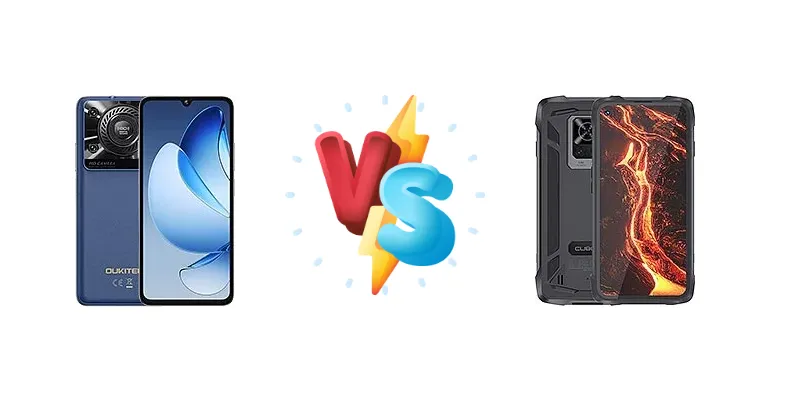
|
🏆 Quick Verdict
For users prioritizing all-day (and multi-day) battery life, the Oukitel C60 is the clear winner, boasting an impressive 83:37h endurance. However, the Cubot KingKong 7’s Helio P60 chipset offers a performance edge for quicker app loading and smoother multitasking, making it better for those who value responsiveness over sheer longevity.
| PHONES | ||
|---|---|---|
| Phone Names | Oukitel C60 | Cubot KingKong 7 |
| Network | ||
|---|---|---|
| 2G bands | GSM 850 / 900 / 1800 / 1900 | GSM 850 / 900 / 1800 / 1900 |
| 3G bands | HSDPA 850 / 900 / 1700(AWS) / 1900 / 2100 | HSDPA 850 / 900 / 1700(AWS) / 1900 / 2100 |
| 4G bands | 1, 2, 3, 4, 5, 7, 8, 12, 17, 18, 19, 20, 25, 26, 28, 34, 38, 39, 40, 41, 66 | 1, 2, 3, 4, 5, 7, 8, 12, 13, 17, 18, 19, 20, 25, 26, 28, 38, 40, 41, 66 |
| Speed | HSPA, LTE | HSPA, LTE |
| Technology | GSM / HSPA / LTE | GSM / CDMA / HSPA / LTE |
| Launch | ||
|---|---|---|
| Announced | 2025, April | 2022 |
| Status | Available. Released 2025, May 05 | Available. Released 2022 |
| Body | ||
|---|---|---|
| Dimensions | 171.2 x 77.8 x 13.4 mm (6.74 x 3.06 x 0.53 in) | 166.8 x 83.5 x 14 mm (6.57 x 3.29 x 0.55 in) |
| SIM | Nano-SIM + Nano-SIM | Nano-SIM + Nano-SIM |
| Weight | 307 g (10.83 oz) | 267 g (9.42 oz) |
| Display | ||
|---|---|---|
| Protection | HKC Glass, Mohs level 5 | - |
| Resolution | 720 x 1640 pixels (~260 ppi density) | 1080 x 2300 pixels (~400 ppi density) |
| Size | 6.88 inches, 112.4 cm2 (~84.4% screen-to-body ratio) | 6.36 inches, 100.4 cm2 (~72.1% screen-to-body ratio) |
| Type | IPS LCD, 90Hz, 450 nits | IPS LCD |
| Platform | ||
|---|---|---|
| CPU | Octa-core (2x1.6 GHz Cortex-A75 & 6x1.6 GHz Cortex-A55) | Octa-core (4x2.0 GHz Cortex-A73 & 4x2.0 GHz Cortex-A53) |
| Chipset | Unisoc T606 (12 nm) | Mediatek MT6771V/CA Helio P60 (12 nm) |
| GPU | Mali-G57 MP1 | Mali-G72 MP3 |
| OS | Android 15 | Android 11 |
| Memory | ||
|---|---|---|
| Card slot | microSDXC (uses shared SIM slot) | microSDXC (uses shared SIM slot) |
| Internal | 128GB 4GB RAM | 128GB 8GB RAM |
| Main Camera | ||
|---|---|---|
| Features | LED flash, HDR, panorama | LED flash |
| Single | 13 MP, f/2.2, (wide), 1/3.06", AF | - |
| Triple | - | 64 MP, (wide), AF 16 MP, (ultrawide) 5 MP (macro) |
| Video | 1080p@30fps | Yes |
| Selfie camera | ||
|---|---|---|
| Single | 5 MP, f/2.2, (wide), 1/5.0" | 32 MP |
| Video | 720p@30fps | Yes |
| Sound | ||
|---|---|---|
| 35mm jack | No | Unspecified |
| Loudspeaker | Yes | Yes |
| Comms | ||
|---|---|---|
| Bluetooth | 5.0, A2DP, LE | 4.2, A2DP |
| NFC | Yes | Yes |
| Positioning | GPS, GALILEO, GLONASS, BDS | GPS, GLONASS, BDS |
| Radio | FM radio | Unspecified |
| USB | USB Type-C | USB Type-C, OTG |
| WLAN | Wi-Fi 802.11 a/b/g/n/ac, dual-band | Wi-Fi 802.11 a/b/g/n |
| Features | ||
|---|---|---|
| Sensors | Fingerprint (side-mounted), accelerometer, compass | Fingerprint (rear-mounted), accelerometer, gyro, proximity, compass |
| Battery | ||
|---|---|---|
| Charging | 18W wired | - |
| Type | Li-Po 10000 mAh | 5000 mAh |
| Misc | ||
|---|---|---|
| Colors | Green, Purple, Blue, Red | Black |
| EU LABEL | ||
|---|---|---|
| Battery | 83:37h endurance, 1200 cycles | - |
| Energy | Class B | - |
| Free fall | Class A (270 falls) | - |
| Repairability | Class B | - |
Oukitel C60
- Exceptional battery life (83:37h endurance)
- High battery cycle count (1200 cycles)
- Efficient Unisoc T606 chipset
- Potentially slower app loading times
- Likely basic camera performance
Cubot KingKong 7
- More responsive performance with Helio P60
- Faster CPU clock speeds
- Potentially smoother multitasking
- Shorter battery life compared to Oukitel C60
- Higher power consumption
Display Comparison
Neither device provides display specifications, but given their price point, we can assume both utilize IPS LCD panels. The focus here is on internal performance. The absence of high refresh rates or advanced panel technologies is typical for this segment.
Camera Comparison
Without detailed camera specs, a direct comparison is difficult. Both phones likely feature basic camera setups geared towards casual photography. The absence of information suggests neither device will excel in low-light conditions or offer advanced features like optical image stabilization. Any 2MP macro lenses included would likely offer minimal benefit due to their small sensor size and limited detail capture.
Performance
The core difference lies in the chipsets. The Oukitel C60’s Unisoc T606 (12nm) utilizes a big.LITTLE architecture with 2x 1.6 GHz Cortex-A75 cores for performance and 6x 1.6 GHz Cortex-A55 cores for efficiency. The Cubot KingKong 7 employs the Mediatek MT6771V/CA Helio P60 (12nm) with 4x 2.0 GHz Cortex-A73 cores and 4x 2.0 GHz Cortex-A53 cores. While both are 12nm, the Helio P60’s Cortex-A73 cores are architecturally superior to the T606’s A75, suggesting faster single-core performance and a snappier feel for app launches. However, the T606’s more efficient A55 cores may contribute to the C60’s exceptional battery life. The Helio P60's CPU clock speed is higher, but the T606's core configuration may offer better sustained performance under load.
Battery Life
The Oukitel C60’s standout feature is its incredible 83:37h endurance and 1200 charge cycles. This suggests a significantly larger battery capacity and optimized power management compared to the KingKong 7. While the KingKong 7’s battery capacity is unknown, its Helio P60 chipset, being more power-hungry, will likely result in shorter battery life. The C60’s 18W charging is standard for this price range, but the focus is clearly on maximizing runtime rather than rapid charging.
Buying Guide
Buy the Oukitel C60 if you need a phone that can reliably last through extended periods without access to a charger – ideal for travelers, outdoor enthusiasts, or anyone who dislikes frequent charging. Buy the Cubot KingKong 7 if you prefer a more responsive user experience for daily tasks like social media, browsing, and light gaming, and don't mind charging your phone more often.