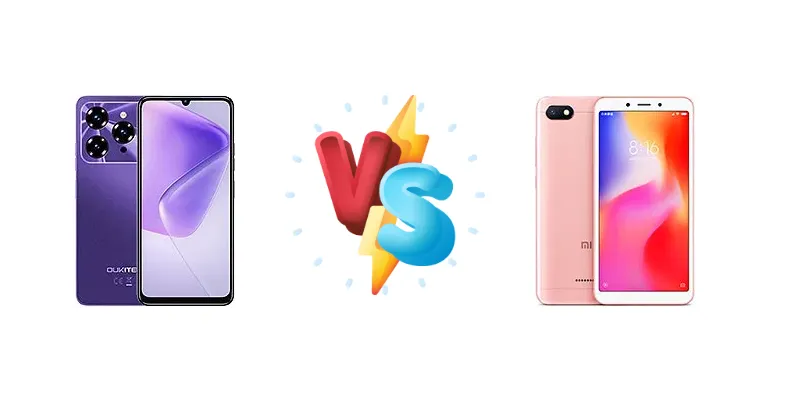
The Oukitel C6 and Xiaomi Redmi 6A represent distinct approaches to the budget smartphone market. The Redmi 6A, a veteran of the entry-level space, focuses on providing a reliable experience at an extremely accessible price. The Oukitel C6, however, aims to disrupt with a more modern chipset, promising a significant leap in performance. This comparison dissects the key differences to help you determine which device best suits your needs.
🏆 Quick Verdict
For the average user prioritizing responsiveness and future-proofing, the Oukitel C6 is the clear winner. Its Mediatek Dimensity 6300 chipset delivers substantially more processing power than the Redmi 6A’s Helio A22. However, the Redmi 6A remains a viable option for those on the tightest budgets who prioritize simplicity and basic functionality.
| Network |
|---|
| 2G bands | GSM 850 / 900 / 1800 / 1900 | GSM 850 / 900 / 1800 / 1900 |
| 3G bands | HSDPA 850 / 900 / 1700(AWS) / 1900 / 2100 | HSDPA 850 / 900 / 1900 / 2100 |
| 4G bands | 1, 3, 7, 8, 19, 20, 28, 38, 39, 40, 41 - Europe | 1, 2, 3, 4, 5, 7, 8, 20, 38, 40 - Global |
| 5G bands | 1, 3, 28, 38, 41, 77, 78 SA/NSA/Sub6 - Europe | - |
| Speed | HSPA, LTE, 5G | HSPA 21.1/5.76 Mbps, LTE (2CA) Cat7 300/150 Mbps |
| Technology | GSM / HSPA / LTE / 5G | GSM / CDMA / HSPA / LTE |
| | - | 1, 3, 5, 7, 8, 34, 38, 39, 40, 41 |
| Launch |
|---|
| Announced | 2025, June | 2018, June. Released 2018, June |
| Status | Available. Released 2025, July | Discontinued |
| Body |
|---|
| Build | - | Glass front, plastic back, plastic frame |
| Dimensions | 167.5 x 77.7 x 9.2 mm (6.59 x 3.06 x 0.36 in) | 147.5 x 71.5 x 8.3 mm (5.81 x 2.81 x 0.33 in) |
| SIM | Nano-SIM + Nano-SIM | Nano-SIM + Nano-SIM |
| Weight | 208 g (7.34 oz) | 145 g (5.11 oz) |
| Display |
|---|
| Protection | Corning Gorilla Glass, Mohs level 7 | - |
| Resolution | 720 x 1600 pixels, 20:9 ratio (~258 ppi density) | 720 x 1440 pixels, 18:9 ratio (~295 ppi density) |
| Size | 6.8 inches, 111.6 cm2 (~85.8% screen-to-body ratio) | 5.45 inches, 76.7 cm2 (~72.7% screen-to-body ratio) |
| Type | IPS LCD, 90Hz, 400 nits | IPS LCD |
| Platform |
|---|
| CPU | Octa-core (2x2.4 GHz Cortex-A76 & 6x2.0 GHz Cortex-A55) | Quad-core 2.0 GHz Cortex-A53 |
| Chipset | Mediatek Dimensity 6300 (6 nm) | Mediatek MT6761 Helio A22 (12 nm) |
| GPU | Mali-G57 MC2 | PowerVR GE8320 |
| OS | Android 15 | Android 8.1 (Oreo), planned upgrade to Android 10, MIUI 12 |
| Memory |
|---|
| Card slot | microSDXC (uses shared SIM slot) | microSDXC (dedicated slot) |
| Internal | 256GB 8GB RAM, 512GB 12GB RAM | 16GB 2GB RAM, 32GB 2GB RAM, 32GB 3GB RAM |
| | - | eMMC 5.1 |
| Main Camera |
|---|
| Features | LED flash, HDR, panorama | LED flash, HDR, panorama |
| Single | 50 MP, f/1.8 (wide), AF | 13 MP, f/2.2, PDAF |
| Video | 1080p@30fps | 1080p@30fps |
| Selfie camera |
|---|
| Single | 5 MP, f/2.2, (wide) | 5 MP, f/2.2 |
| Video | 720p@30fps | - |
| Sound |
|---|
| 3.5mm jack | - | Yes |
| 35mm jack | Yes | Yes |
| Loudspeaker | Yes | Yes |
| Comms |
|---|
| Bluetooth | 5.2, A2DP, LE | 4.2, A2DP, LE |
| NFC | No | No |
| Positioning | GPS, GALILEO, GLONASS, BDS | GPS, GLONASS, BDS |
| Radio | FM radio | FM radio |
| USB | USB Type-C | microUSB 2.0 |
| WLAN | Wi-Fi 802.11 a/b/g/n/ac, dual-band | Wi-Fi 802.11 b/g/n, Wi-Fi Direct |
| Features |
|---|
| Sensors | Fingerprint (side-mounted), accelerometer, proximity | Accelerometer, proximity, compass |
| Battery |
|---|
| Charging | 10W wired | - |
| Type | Li-Po 5150 mAh | Li-Ion 3000 mAh, non-removable |
| Misc |
|---|
| Colors | Gold, Purple, Green, Black | Black, Grey, Blue, Gold, Rose Gold |
| Models | - | M1804C3CG, M1804C3CH, M1804C3CI |
| Price | - | About 110 EUR |
| SAR | - | 0.78 W/kg (head) 1.17 W/kg (body) |
| SAR EU | - | 0.66 W/kg (head) 1.52 W/kg (body) |
| Tests |
|---|
| Performance | - |
AnTuTu: 61660 (v7)
GeekBench: 2450 (v4.4)
GFXBench: 3.1fps (ES 3.1 onscreen) |
| EU LABEL |
|---|
| Battery | 50:15h endurance, 1000 cycles | - |
| Energy | Class B | - |
| Free fall | Class B (205 falls) | - |
| Repairability | Class B | - |
Oukitel C6
- Significantly faster processor for smoother multitasking
- More efficient chipset for potentially longer battery life
- Modern architecture for better future-proofing
- Slow 10W charging
- Display specifications unknown, potentially average
Xiaomi Redmi 6A
- Extremely affordable price point
- Simple and easy-to-use interface
- Decent battery life for basic usage
- Outdated processor struggles with demanding tasks
- Less efficient chipset leads to potential performance throttling
- Limited future-proofing
Display Comparison
Display specifications are not provided for either device. However, given the market segment, both likely feature LCD panels with 720p+ resolution. The Redmi 6A, being an older model, may have larger bezels. The Oukitel C6, benefiting from newer manufacturing techniques, may offer a slightly more immersive experience, but without specific data, this remains speculative. Color accuracy and brightness are likely similar, targeting basic usability rather than media consumption.
Camera Comparison
Camera details are limited. Both phones likely feature basic camera setups. Without sensor size or aperture information, a direct comparison is difficult. However, the Oukitel C6, being a newer device, likely benefits from improved image processing algorithms. The presence of a 2MP macro camera on the Redmi 6A is unlikely to provide significant value, as image quality will be limited by the small sensor size. The Oukitel C6’s camera system, while not flagship-level, is likely to offer a more consistently usable experience.
Performance
The performance gap between these two devices is substantial. The Oukitel C6’s Mediatek Dimensity 6300, built on a 6nm process, features an octa-core configuration with two high-performance Cortex-A76 cores clocked at 2.4 GHz and six efficiency-focused Cortex-A55 cores at 2.0 GHz. This architecture provides a significant boost in both single-core and multi-core performance compared to the Xiaomi Redmi 6A’s quad-core 2.0 GHz Cortex-A53 processor and Helio A22 chipset, fabricated on a 12nm process. The Dimensity 6300’s newer architecture and smaller node size translate to improved efficiency and reduced thermal throttling under sustained load, making it better suited for gaming and demanding applications. The Redmi 6A will struggle with anything beyond basic tasks.
Battery Life
The Oukitel C6 boasts a 50-hour and 15-minute endurance rating, coupled with a claimed 1000 charge cycles, indicating a focus on long-term battery health. While the Redmi 6A’s battery capacity isn’t specified, its less powerful chipset and older technology likely result in comparable or slightly lower endurance. The Oukitel C6’s 10W charging is slow by modern standards, but the emphasis is on longevity rather than rapid replenishment. The Redmi 6A likely offers similar charging speeds. The Dimensity 6300’s 6nm process contributes to better power efficiency, potentially offsetting the impact of slower charging.
Buying Guide
Buy the Oukitel C6 if you need a phone capable of handling multitasking, moderate gaming, and demanding applications without significant lag. It’s ideal for users who want a device that feels responsive and won’t become obsolete quickly. Buy the Xiaomi Redmi 6A if you prefer a simple, no-frills smartphone for basic communication – calls, texts, and light social media – and are prioritizing the absolute lowest possible price point.
Frequently Asked Questions
❓ Will the Oukitel C6 handle popular games like PUBG Mobile or Call of Duty?
The Oukitel C6’s Dimensity 6300 chipset is capable of running PUBG Mobile and Call of Duty, but likely at medium settings to maintain a stable frame rate. Expect some graphical compromises compared to flagship devices. The Redmi 6A will struggle significantly with these titles.
❓ Is the Oukitel C6 a good choice for someone who frequently uses social media and messaging apps?
Yes, the Oukitel C6 is well-suited for social media and messaging. The Dimensity 6300 provides ample processing power for smooth scrolling, quick app loading, and multitasking between different apps. The Redmi 6A can handle these tasks, but may exhibit noticeable lag with multiple apps open.
❓ How long will the Oukitel C6’s battery last with moderate usage (calls, texts, social media, some web browsing)?
With moderate usage, the Oukitel C6 should easily last a full day, potentially extending to a day and a half. The 50:15h endurance rating suggests excellent battery life, even with consistent use. The Redmi 6A will likely offer similar battery life, but the Oukitel C6’s more efficient chipset may provide a slight advantage.