
Oukitel C58 vs. Ulefone Armor 8 Pro: A Deep Dive into Battery Life and Performance
| Phones Images | |||||
|---|---|---|---|---|---|
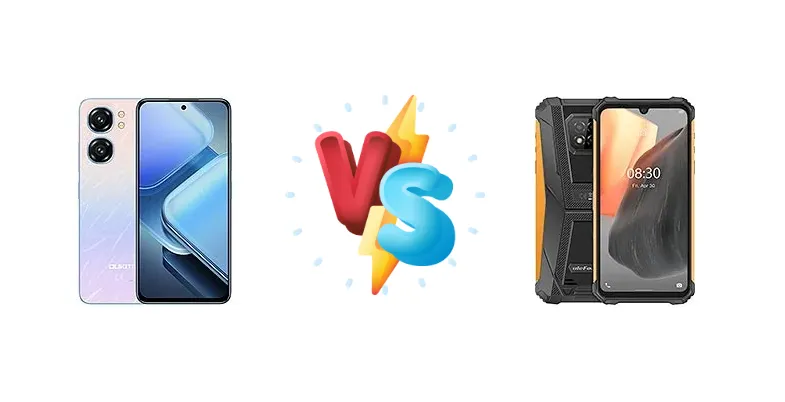
|
🏆 Quick Verdict
For users prioritizing all-day (and multi-day) battery life, the Oukitel C58 is the clear winner, boasting a remarkable 47.5-hour endurance. However, the Ulefone Armor 8 Pro offers a slight performance edge with its Helio P60 chipset, making it better suited for users who need quicker app loading and multitasking.
| PHONES | ||
|---|---|---|
| Phone Names | Oukitel C58 | Ulefone Armor 8 Pro |
| Network | ||
|---|---|---|
| 2G bands | GSM 850 / 900 / 1800 / 1900 | GSM 850 / 900 / 1800 / 1900 |
| 3G bands | HSDPA 850 / 900 / 1700(AWS) / 1900 / 2100 | HSDPA 850 / 900 / 1700(AWS) / 1900 / 2100 |
| 4G bands | 1, 2, 3, 4, 5, 7, 8, 12, 17, 19, 20, 25, 26, 28, 66 | 1, 2, 3, 4, 5, 7, 8, 12, 13, 17, 18, 19, 20, 25, 26, 28, 66 |
| Speed | HSPA, LTE | HSPA 42.2/11.5 Mbps, LTE Cat7 300/150 Mbps |
| Technology | GSM / HSPA / LTE | GSM / HSPA / LTE |
| Launch | ||
|---|---|---|
| Announced | 2024, November | 2021, April 28 |
| Status | Available. Released 2024, November | Available. Released 2021, April 28 |
| Body | ||
|---|---|---|
| Build | Glass front, plastic back | Front glass, aluminum back with rubber, aluminum frame |
| Dimensions | 166.8 x 77.5 x 8.7 mm (6.57 x 3.05 x 0.34 in) | 166 x 81.8 x 15 mm (6.54 x 3.22 x 0.59 in) |
| SIM | Nano-SIM + Nano-SIM | Nano-SIM + Nano-SIM |
| Weight | 199 g (7.02 oz) | 282 g (9.95 oz) |
| - | IP68 dust/water resistant (up to 1.5m for 30 min) Drop-to-concrete resistance from up to 1.2m MIL-STD-810G compliant | |
| Display | ||
|---|---|---|
| Protection | Corning Gorilla Glass 5, Mohs level 4 | Scratch-resistant glass, oleophobic coating |
| Resolution | 720 x 1600 pixels, 20:9 ratio (~262 ppi density) | 720 x 1560 pixels, 19.5:9 ratio (~282 ppi density) |
| Size | 6.7 inches, 108.4 cm2 (~83.8% screen-to-body ratio) | 6.1 inches, 91.3 cm2 (~67.3% screen-to-body ratio) |
| Type | IPS LCD, 430 nits | IPS LCD |
| Platform | ||
|---|---|---|
| CPU | Octa-core (2x1.6 GHz Cortex-A75 & 6x1.6 GHz Cortex-A55) | Octa-core (4x2.0 GHz Cortex-A73 & 4x2.0 GHz Cortex-A53) |
| Chipset | Unisoc T606 (12 nm) | Mediatek MT6771 Helio P60 (12 nm) |
| GPU | Mali-G57 MP1 | Mali-G72 MP3 |
| OS | Android 14 | Android 11 |
| Memory | ||
|---|---|---|
| Card slot | microSDXC (uses shared SIM slot) | microSDXC (uses shared SIM slot) |
| Internal | 128GB 4GB RAM | 128GB 6GB RAM, 128GB 8GB RAM |
| Main Camera | ||
|---|---|---|
| Dual | 13 MP, f/2.2, (wide), 1/3.06", AF other unspecified camera | - |
| Features | LED flash, HDR, panorama | LED flash, Panorama, HDR |
| Single | - | 8 MP, f/2.2 |
| Triple | - | 16 MP, f/2.2, (wide), PDAF 5 MP (macro) Auxiliary lens |
| Video | 1080p@30fps | 1080p@30fps |
| Selfie camera | ||
|---|---|---|
| Single | 5 MP, f/2.2, (wide), 1/5.0" | 8 MP, f/2.2 |
| Video | 720p@30fps | 1080p@30fps |
| Sound | ||
|---|---|---|
| 3.5mm jack | - | Yes |
| 35mm jack | Yes | Yes |
| Loudspeaker | Yes | Yes |
| Comms | ||
|---|---|---|
| Bluetooth | 5.0, A2DP, LE | 4.2, A2DP, LE |
| NFC | Yes | Yes |
| Positioning | GPS, GALILEO, GLONASS, BDS | GPS, GLONASS, GALILEO, BDS |
| Radio | FM radio | FM radio, RDS, recording |
| USB | USB Type-C, OTG | USB Type-C 2.0, OTG |
| WLAN | Wi-Fi 802.11 a/b/g/n/ac, dual-band | Wi-Fi 802.11 a/b/g/n/ac, Wi-Fi Direct |
| Features | ||
|---|---|---|
| Sensors | Accelerometer, proximity | Fingerprint (side-mounted), accelerometer, gyro, proximity, compass |
| Battery | ||
|---|---|---|
| Charging | 10W wired | 15W wired |
| Type | Li-Po 5150 mAh | Li-Po 5580 mAh |
| Misc | ||
|---|---|---|
| Colors | Black, Blue, Green | Black, Orange, Red |
| Price | About 150 EUR | About 190 EUR |
| EU LABEL | ||
|---|---|---|
| Battery | 47:30h endurance, 1000 cycles | - |
| Energy | Class B | - |
| Free fall | Class B (180 falls) | - |
| Repairability | Class C | - |
Oukitel C58
- Exceptional battery life (47.5 hours endurance)
- Potentially more efficient chipset (Unisoc T606)
- 1000 charge cycles suggest long-term battery health
- Slower charging speed (10W)
- Less powerful CPU for demanding tasks
Ulefone Armor 8 Pro
- Faster charging (15W)
- More powerful CPU (Helio P60) for smoother multitasking
- Ruggedized design for enhanced durability
- Shorter battery life compared to Oukitel C58
- Potentially thicker and heavier due to ruggedization
Display Comparison
Neither device provides display specifications, so a direct comparison is limited. However, given the price points, both likely utilize IPS LCD panels. The Armor 8 Pro's ruggedized design may necessitate a thicker bezel, potentially impacting screen-to-body ratio. Color accuracy and peak brightness are likely similar, targeting functional usability rather than media consumption excellence.
Camera Comparison
Without detailed camera specifications, a comprehensive comparison is difficult. Both phones likely feature a multi-camera setup geared towards basic photography. The absence of information suggests neither device will excel in low-light conditions or offer advanced features like optical image stabilization. The focus is likely on providing functional cameras for everyday snapshots, rather than photographic excellence. Any 2MP macro lenses present on either device are likely to offer minimal practical benefit.
Performance
The Ulefone Armor 8 Pro’s Mediatek Helio P60, featuring four Cortex-A73 cores clocked at 2.0 GHz, offers a theoretical performance advantage over the Oukitel C58’s Unisoc T606. The A73 architecture is demonstrably more powerful than the T606’s Cortex-A75 cores (1.6 GHz). This translates to faster app launch times and smoother multitasking on the Armor 8 Pro. However, the T606’s efficiency could contribute to the C58’s superior battery life. Both chipsets are built on a 12nm process, suggesting similar thermal characteristics, but the Armor 8 Pro’s more demanding CPU may generate slightly more heat under sustained load.
Battery Life
The Oukitel C58’s 47.5-hour endurance is its standout feature. This suggests a large battery capacity coupled with efficient power management from the Unisoc T606 chipset. While the Ulefone Armor 8 Pro charges faster at 15W compared to the C58’s 10W, the difference in charging speed is unlikely to offset the C58’s significantly longer runtime. The Armor 8 Pro’s ruggedized build may necessitate a slightly smaller battery to accommodate internal reinforcement, further contributing to the C58’s endurance advantage.
Buying Guide
Buy the Oukitel C58 if you need a phone that can reliably last through extended periods without access to a charger – ideal for travelers, outdoor enthusiasts, or anyone who dislikes frequent charging. Buy the Ulefone Armor 8 Pro if you prioritize a more responsive user experience and require a rugged device capable of withstanding drops and harsh environments, even if it means slightly more frequent charging.