
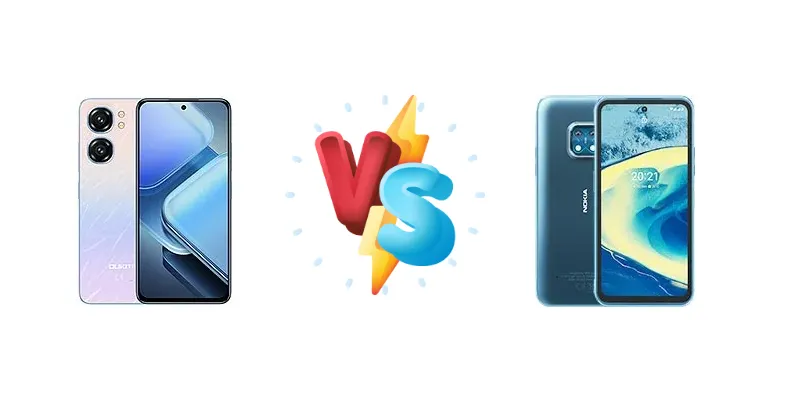
Oukitel C58 vs. Nokia XR20: Which Budget Phone Reigns Supreme?
| Phones Images | |||||
|---|---|---|---|---|---|
|
🏆 Quick Verdict
For users prioritizing maximum uptime and cost-effectiveness, the Oukitel C58 is the clear winner. Its impressive 47:30h endurance significantly outweighs the Nokia XR20’s 5G connectivity for those not reliant on ultra-fast data speeds. However, the XR20’s faster charging and more modern chipset offer a smoother overall experience.
| PHONES | ||
|---|---|---|
| Phone Names | Oukitel C58 | Nokia XR20 |
| Network | ||
|---|---|---|
| 2G bands | GSM 850 / 900 / 1800 / 1900 | GSM 850 / 900 / 1800 / 1900 |
| 3G bands | HSDPA 850 / 900 / 1700(AWS) / 1900 / 2100 | HSDPA 850 / 900 / 1700(AWS) / 1900 / 2100 |
| 4G bands | 1, 2, 3, 4, 5, 7, 8, 12, 17, 19, 20, 25, 26, 28, 66 | 1, 2, 3, 4, 5, 7, 8, 12, 13, 14, 20, 25, 26, 28, 30, 38, 40, 41, 48, 66, 71 |
| 5G bands | - | 2, 5, 25, 38, 41, 48, 66, 77, 78 SA/NSA |
| Speed | HSPA, LTE | HSPA, LTE, 5G |
| Technology | GSM / HSPA / LTE | GSM / CDMA / HSPA / EVDO / LTE / 5G |
| - | CDMA2000 1xEV-DO | |
| Launch | ||
|---|---|---|
| Announced | 2024, November | 2021, July 27 |
| Status | Available. Released 2024, November | Available. Released 2021, August 04 |
| Body | ||
|---|---|---|
| Build | Glass front, plastic back | - |
| Dimensions | 166.8 x 77.5 x 8.7 mm (6.57 x 3.05 x 0.34 in) | 171.6 x 81.5 x 10.6 mm (6.76 x 3.21 x 0.42 in) |
| SIM | Nano-SIM + Nano-SIM | · Nano-SIM· Nano-SIM + Nano-SIM |
| Weight | 199 g (7.02 oz) | 248 g (8.75 oz) |
| - | IP68 dust/water resistant (up to 1.5m for 60 min) Drop-to-concrete resistance from up to 1.8m MIL-STD-810H compliant | |
| Display | ||
|---|---|---|
| Protection | Corning Gorilla Glass 5, Mohs level 4 | Corning Gorilla Glass Victus |
| Resolution | 720 x 1600 pixels, 20:9 ratio (~262 ppi density) | 1080 x 2400 pixels, 20:9 ratio (~395 ppi density) |
| Size | 6.7 inches, 108.4 cm2 (~83.8% screen-to-body ratio) | 6.67 inches, 107.4 cm2 (~76.8% screen-to-body ratio) |
| Type | IPS LCD, 430 nits | IPS LCD, 550 nits |
| Platform | ||
|---|---|---|
| CPU | Octa-core (2x1.6 GHz Cortex-A75 & 6x1.6 GHz Cortex-A55) | Octa-core (2x2.0 GHz Kryo 460 & 6x1.8 GHz Kryo 460) |
| Chipset | Unisoc T606 (12 nm) | Qualcomm SM4350 Snapdragon 480 5G (8 nm) |
| GPU | Mali-G57 MP1 | Adreno 619 |
| OS | Android 14 | Android 11, upgradable to Android 13 |
| Memory | ||
|---|---|---|
| Card slot | microSDXC (uses shared SIM slot) | microSDXC (uses shared SIM slot) |
| Internal | 128GB 4GB RAM | 64GB 4GB RAM, 128GB 6GB RAM |
| Main Camera | ||
|---|---|---|
| Dual | 13 MP, f/2.2, (wide), 1/3.06", AF other unspecified camera | 48 MP, f/1.8, (wide), 1/2.25", 0.8µm, PDAF 13 MP, f/2.4, 123˚ (ultrawide), 1/3.0", 1.12µm |
| Features | LED flash, HDR, panorama | Zeiss optics, Dual-LED dual-tone flash, second LED flash, HDR, panorama |
| Single | - | 8 MP, f/2.0 (wide), 1/4.0", 1.12µm |
| Video | 1080p@30fps | 1080p@30fps |
| Selfie camera | ||
|---|---|---|
| Single | 5 MP, f/2.2, (wide), 1/5.0" | 8 MP, f/2.0 (wide), 1/4.0", 1.12µm |
| Video | 720p@30fps | 1080p@30fps |
| Sound | ||
|---|---|---|
| 3.5mm jack | - | Yes |
| 35mm jack | Yes | Yes |
| Loudspeaker | Yes | Yes, with stereo speakers |
| Comms | ||
|---|---|---|
| Bluetooth | 5.0, A2DP, LE | 5.1, A2DP, LE, aptX Adaptive |
| NFC | Yes | Yes |
| Positioning | GPS, GALILEO, GLONASS, BDS | GPS (L1+L5), GLONASS, BDS, GALILEO, QZSS, NavIC |
| Radio | FM radio | Unspecified |
| USB | USB Type-C, OTG | USB Type-C 3.0 |
| WLAN | Wi-Fi 802.11 a/b/g/n/ac, dual-band | Wi-Fi 802.11 a/b/g/n/ac/6, dual-band, Wi-Fi Direct |
| Features | ||
|---|---|---|
| Sensors | Accelerometer, proximity | Fingerprint (side-mounted), accelerometer, gyro, proximity, compass, barometer |
| Battery | ||
|---|---|---|
| Charging | 10W wired | 18W wired 15W wireless |
| Type | Li-Po 5150 mAh | Li-Po 4630 mAh |
| Misc | ||
|---|---|---|
| Colors | Black, Blue, Green | Ultra Blue, Granite Gray |
| Models | - | TA-1368, TA-1362 |
| Price | About 150 EUR | About 270 EUR |
| SAR EU | - | 1.13 W/kg (head) 1.43 W/kg (body) |
| EU LABEL | ||
|---|---|---|
| Battery | 47:30h endurance, 1000 cycles | - |
| Energy | Class B | - |
| Free fall | Class B (180 falls) | - |
| Repairability | Class C | - |
Oukitel C58
- Exceptional battery life (47:30h endurance)
- Highly affordable price point
- 1000 charge cycles promise long-term usability
- Slow 10W charging
- Less powerful chipset (Unisoc T606)
- Likely basic display quality
Nokia XR20
- 5G connectivity for faster data speeds
- More powerful Snapdragon 480 chipset
- 18W wired and 15W wireless charging
- Shorter battery life compared to Oukitel C58
- Higher price point
- Battery capacity not specified
Display Comparison
Neither device boasts a standout display. Details are missing for the Oukitel C58, but given its price point, we can expect a standard LCD panel. The Nokia XR20, while not specified, likely features a similar LCD. The key difference isn’t display quality, but rather the chipset’s ability to drive it efficiently. The XR20’s Snapdragon 480, built on an 8nm process, will likely offer smoother scrolling and animations compared to the C58’s Unisoc T606 (12nm).
Camera Comparison
Camera details are sparse for both devices. Without sensor size or aperture information, a direct comparison is difficult. However, the Nokia XR20’s chipset includes a more advanced image signal processor (ISP), which will likely result in better image processing, especially in low-light conditions. The Oukitel C58 will likely rely on software processing to compensate for a potentially less capable sensor. The presence of 5G on the XR20 also allows for faster cloud-based image backups and sharing.
Performance
The Nokia XR20’s Qualcomm Snapdragon 480 5G chipset represents a significant architectural advantage over the Oukitel C58’s Unisoc T606. The 8nm fabrication process of the Snapdragon 480 is more efficient, leading to better thermal management and sustained performance. While both utilize an octa-core configuration (2x2.0 GHz Kryo 460 vs 2x1.6 GHz Cortex-A75), the Kryo cores in the Snapdragon 480 are generally more powerful. This translates to faster app loading times and a more responsive user experience for the XR20, particularly in demanding tasks.
Battery Life
The Oukitel C58’s standout feature is its exceptional battery endurance, rated at 47:30h. This is significantly longer than most smartphones on the market. While the Nokia XR20’s battery capacity is not specified, its 18W wired and 15W wireless charging capabilities offer greater convenience. The C58 is limited to 10W wired charging, meaning a full charge will take considerably longer. The trade-off is clear: the C58 prioritizes longevity, while the XR20 prioritizes faster replenishment.
Buying Guide
Buy the Oukitel C58 if you need a phone that lasts for days on a single charge, and your primary use cases are calling, texting, and light social media. It’s ideal for travelers, outdoor workers, or anyone who dislikes frequent charging. Buy the Nokia XR20 if you require 5G connectivity, faster performance for multitasking and streaming, and a more durable build quality, even if it means sacrificing some battery life.