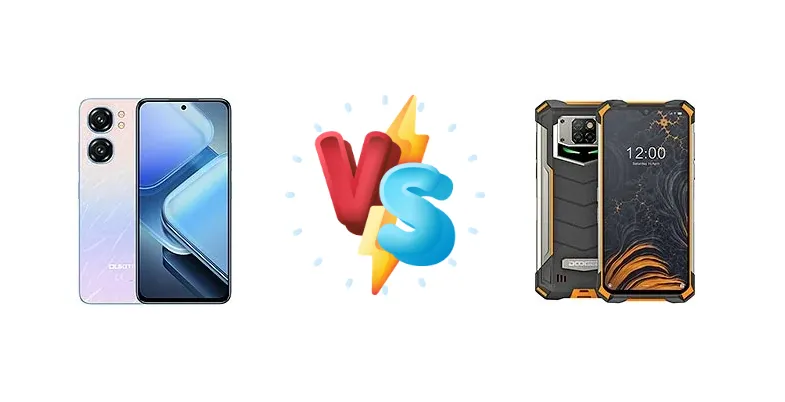
The rugged smartphone market offers a compelling alternative for users prioritizing durability and battery life. The Oukitel C58 and Doogee S88 Pro both cater to this niche, but take distinctly different approaches. The C58 focuses on extreme battery endurance, while the S88 Pro prioritizes faster charging and a slightly more powerful processor. This comparison dissects their key specifications to determine which device best suits your needs.
🏆 Quick Verdict
For the average user prioritizing longevity and minimizing charging frequency, the Oukitel C58 is the clear winner. Its astonishing 47:30h endurance rating significantly outpaces the Doogee S88 Pro’s 202h, making it ideal for extended trips or demanding work environments. However, the S88 Pro’s faster charging and wireless capabilities offer convenience.
| Network |
|---|
| 2G bands | GSM 850 / 900 / 1800 / 1900 | GSM 850 / 900 / 1800 / 1900 |
| 3G bands | HSDPA 850 / 900 / 1700(AWS) / 1900 / 2100 | HSDPA 850 / 900 / 1700(AWS) / 1900 / 2100 |
| 4G bands | 1, 2, 3, 4, 5, 7, 8, 12, 17, 19, 20, 25, 26, 28, 66 | 1, 3, 7, 8, 20 |
| Speed | HSPA, LTE | HSPA, LTE |
| Technology | GSM / HSPA / LTE | GSM / HSPA / LTE |
| Launch |
|---|
| Announced | 2024, November | 2020, June 06. Released 2020, June 06 |
| Status | Available. Released 2024, November | Discontinued |
| Body |
|---|
| Build | Glass front, plastic back | Glass front (Gorilla Glass), aluminum back with rubber, aluminum frame |
| Dimensions | 166.8 x 77.5 x 8.7 mm (6.57 x 3.05 x 0.34 in) | 171.6 x 85.5 x 18.7 mm (6.76 x 3.37 x 0.74 in) |
| SIM | Nano-SIM + Nano-SIM | Nano-SIM + Nano-SIM |
| Weight | 199 g (7.02 oz) | 372 g (13.12 oz) |
| Display |
|---|
| Protection | Corning Gorilla Glass 5, Mohs level 4 | Corning Gorilla Glass |
| Resolution | 720 x 1600 pixels, 20:9 ratio (~262 ppi density) | 1080 x 2340 pixels, 19.5:9 ratio (~409 ppi density) |
| Size | 6.7 inches, 108.4 cm2 (~83.8% screen-to-body ratio) | 6.3 inches, 97.4 cm2 (~66.4% screen-to-body ratio) |
| Type | IPS LCD, 430 nits | IPS LCD |
| Platform |
|---|
| CPU | Octa-core (2x1.6 GHz Cortex-A75 & 6x1.6 GHz Cortex-A55) | Octa-core (4x2.1 GHz Cortex-A73 & 4x2.0 GHz Cortex-A53) |
| Chipset | Unisoc T606 (12 nm) | Mediatek MT6771T Helio P70 (12 nm) |
| GPU | Mali-G57 MP1 | Mali-G72 MP3 |
| OS | Android 14 | Android 10 |
| Memory |
|---|
| Card slot | microSDXC (uses shared SIM slot) | microSDXC (uses shared SIM slot) |
| Internal | 128GB 4GB RAM | 128GB 6GB RAM |
| Main Camera |
|---|
| Dual | 13 MP, f/2.2, (wide), 1/3.06", AF
other unspecified camera | - |
| Features | LED flash, HDR, panorama | Dual-LED dual-tone flash, HDR, panorama |
| Triple | - | 21 MP, f/2.2, (wide), 1/2.4", 1.12µm, PDAF
8 MP, f/2.2, 130˚, (ultrawide), 1/4.0", 1.12µm
Auxiliary lens |
| Video | 1080p@30fps | 1080p@30fps |
| Selfie camera |
|---|
| Single | 5 MP, f/2.2, (wide), 1/5.0" | 16 MP, f/2.2, 26mm (wide) |
| Video | 720p@30fps | 1080p@30fps |
| Sound |
|---|
| 35mm jack | Yes | No |
| Loudspeaker | Yes | Yes |
| Comms |
|---|
| Bluetooth | 5.0, A2DP, LE | 4.2, A2DP |
| NFC | Yes | Yes |
| Positioning | GPS, GALILEO, GLONASS, BDS | GPS, GLONASS, BDS, GALILEO |
| Radio | FM radio | FM radio |
| USB | USB Type-C, OTG | USB Type-C 2.0, OTG |
| WLAN | Wi-Fi 802.11 a/b/g/n/ac, dual-band | Wi-Fi 802.11 b/g/n |
| Features |
|---|
| Sensors | Accelerometer, proximity | Fingerprint (side-mounted), accelerometer, gyro, proximity, compass |
| Battery |
|---|
| Charging | 10W wired | 24W wired
10W wireless
5W Reverse wireless |
| Type | Li-Po 5150 mAh | 10000 mAh |
| Misc |
|---|
| Colors | Black, Blue, Green | Fire Orange, Army Green, Mineral Black |
| Price | About 150 EUR | About 130 EUR |
| EU LABEL |
|---|
| Battery | 47:30h endurance, 1000 cycles | - |
| Energy | Class B | - |
| Free fall | Class B (180 falls) | - |
| Repairability | Class C | - |
Oukitel C58
- Exceptional battery life (47:30h endurance)
- Long-lasting battery health (1000 charge cycles)
- Excellent value for money
- Slower processor compared to the S88 Pro
- No fast charging or wireless charging
Doogee S88 Pro
- Faster processor (Helio P70)
- 24W fast charging and wireless charging
- Higher display contrast ratio
- Significantly shorter battery life (202h endurance)
- Less impressive battery longevity (unknown charge cycles)
Display Comparison
The Doogee S88 Pro boasts a contrast ratio of 1641:1, suggesting a reasonably vibrant display, though specific brightness data is missing. The Oukitel C58’s display specifications are not provided, making a direct comparison difficult. However, given its focus on value, it likely utilizes a standard IPS panel. The S88 Pro’s contrast ratio indicates a better viewing experience in direct sunlight compared to a typical low-cost IPS panel, assuming similar peak brightness levels. Without further data on the C58’s panel type and brightness, the S88 Pro holds an advantage in display quality.
Camera Comparison
Neither device is positioned as a photography powerhouse, and detailed camera specifications are limited. The absence of information regarding sensor sizes and lens apertures makes a meaningful comparison challenging. It’s reasonable to assume both phones feature basic camera setups geared towards casual photography. The presence of a 2MP macro camera on the S88 Pro is likely a marketing feature with limited real-world utility. Without further details, it’s difficult to declare a clear winner in the camera department.
Performance
The Doogee S88 Pro’s MediaTek Helio P70 (4x2.1 GHz Cortex-A73 & 4x2.0 GHz Cortex-A53) offers a performance edge over the Oukitel C58’s Unisoc T606 (2x1.6 GHz Cortex-A75 & 6x1.6 GHz Cortex-A55). The Helio P70’s Cortex-A73 cores are architecturally superior to the T606’s A75 cores, resulting in faster single-core performance. While both chipsets are built on a 12nm process, the P70’s core configuration translates to a smoother experience with demanding applications and multitasking. However, the T606’s efficiency may contribute to the C58’s exceptional battery life. The S88 Pro will likely handle graphically intensive tasks with more ease.
Battery Life
This is where the Oukitel C58 truly shines. Its reported 47:30h endurance rating is a staggering achievement, dwarfing the Doogee S88 Pro’s 202h. This difference is substantial and translates to days of use on a single charge for the C58. While the S88 Pro compensates with 24W wired charging, 10W wireless charging, and 5W reverse wireless charging – features absent on the C58 – these charging capabilities don’t negate the C58’s massive endurance advantage. The S88 Pro’s faster charging is convenient, but the C58 minimizes the need to charge in the first place. The C58 also boasts a claimed 1000 charge cycles, suggesting long-term battery health.
Buying Guide
Buy the Oukitel C58 if you need a phone that can genuinely last for days on a single charge, and aren't concerned with the latest processing speeds. This is the phone for outdoor workers, travelers, or anyone who frequently finds themselves away from power outlets. Buy the Doogee S88 Pro if you prefer quicker top-ups, value wireless charging, and need a bit more processing power for moderate multitasking and gaming, even if it means charging more often.
Frequently Asked Questions
❓ Is the Unisoc T606 in the Oukitel C58 powerful enough for everyday tasks like social media and web browsing?
Yes, the Unisoc T606 is perfectly capable of handling everyday tasks such as social media, web browsing, and messaging. While it’s not a high-end processor, it provides a smooth and responsive experience for typical smartphone usage. However, demanding games or heavy multitasking may experience some slowdown.
❓ How long does it *actually* take to fully charge the Oukitel C58 with its 10W charging?
With a 10W charger, fully charging the Oukitel C58 will take a considerable amount of time – likely between 4-6 hours, depending on the initial battery level. This is a trade-off for the exceptional battery endurance; the focus is on minimizing charging frequency rather than speed.
❓ Does the Doogee S88 Pro’s wireless charging work with any Qi-compatible charger?
Yes, the Doogee S88 Pro supports standard Qi wireless charging, meaning it will work with any Qi-compatible wireless charger. However, charging speeds will vary depending on the wattage of the charger used. Using a 10W or higher Qi charger is recommended for optimal charging speeds.
❓ Is the reverse wireless charging on the Doogee S88 Pro useful for topping up accessories like earbuds?
The 5W reverse wireless charging on the S88 Pro is primarily intended for emergency top-ups of small accessories like wireless earbuds or smartwatches. It’s not a fast charging solution, and will take a significant amount of time to noticeably charge a larger device. It's a convenient feature to have, but not a primary reason to choose this phone.